Category Archives: classroom teachers

Celebrate the Start the School Year!

As we begin another year (or new year) of teaching, I (Cathy) thought you would enjoy this video of a marvelous Flash Mob created for the West Des Moines Community School District to celebrate the start of a new school school year.  The flash mob was published on Youtube Aug 23, 2015.
Descriptor:

“While the West Des Moines Community School District Superintendent was beginning her speech to the staff of WDMCS at the district-wide welcome back meeting, the teachers of the district created a flash mob to the enjoyment of their unsuspecting colleagues. With only one more day of preparation left, the teachers shared their talents by performing a parody of the song, “One more day” from Les Miserables.”

Enjoy!  And have a terrific year!

Accelerated Learning and where it begins

I (Yiola) have been hard at work preparing my teacher education courses. This year was an complete review and reconceptualization of the courses — significant updates to not only the literature but to the ways in which we will explore the content.  I will share some of the changes to the pedagogy of my courses next week. This week I want to start at the start. Where does accelerated begin and how does it begin? I came across this interesting post and wanted to share it here. It is about paperless early years classrooms.

https://tecribresearch.wordpress.com/2015/08/29/step-away-from-the-photocopier-reggio-inspired-liteplay-nomoreworksheets/

I remember when I taught first and second grade, I seldom used worksheets but I also did have the inquiry-based play either. My pedagogy was somewhere in between. But, truth be know, the teacher across the hall who had a full curriculum of worksheets was often commended for being highly organized and “on the ball” with her program.  I always wondered if that way of teaching was better. Her students, most of them, were learning to read and write. That is another truth. However, were they creative thinkers and problem solvers? Again, another truth, we did not pay much attention to those sorts of skills.  This was but a mere 10 – 15 years ago.

But now, I think we can all agree, that critical thinking and creativity and problem solving are very important skills for children to develop early in life. These skills do not develop from worksheet tasks. The link above talks about this and other inspirational considerations.

And so I share this post to begin at the beginning — play in the early years and how we move forward from there to more sophisticated modes of learning, through the grades and into post secondary teaching. Next week I plan to share some of challenges and questions I faced when reconstructing my courses.

Wearing Technology

I (Cathy) looked up the definition of technology the other day because I had lost track of the meaning outside of my association of technology with computers.  According to Dictionary.com, technology is “the application of scientific knowledge for practical purposes, especially in industry.  This refresher helped me to better grasp the technological clothing my husband has been wearing as of late.

For Father’s Day my husband was given an UnderArmour shirt (from our son-in-law) and challenged to wear it for a day. My husband has been a stanch believer in wearing cotton for many, many years, yet our son-in-law insisted that the new technology in fabric was far advanced in comfort and temperature control. I was intrigued.  Fabric technology?  I had to look it up and found this on the net…

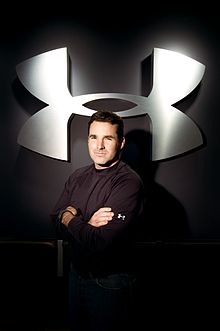
“As a fullback at the University of Maryland, Kevin Plank got tired of having to change out of the sweat-soaked T-shirts worn under his jersey; however, he noticed that his compression shorts worn during practice stayed dry. This inspired him to make a T-shirt using moisture-wicking synthetic fabric.  After graduating from the University of Maryland, Kevin Plank developed his first prototype of the shirt, which he gave to his Maryland teammates and friends who had gone on to play in the NFL. Plank soon perfected the design creating a new T-shirt built from microfibers that wicked moisture and kept athletes cool, dry, and light”

220px-Kevin_Plank_-_UA_photo                                                                                 Kevin Plank

My husband agreed to try the shirt and fell in love with the texture, weight and maintained coolness of this new technologically advanced fabric against his skin. He has several shirts now and is looking at other forms of apparel.  My husband may not be up to date in computer technology, but he is sure ‘in’ when it comes to fabric technology.

My new awareness of technological fabric has given me pause to reconsider what technological advances are in store for us in education that are not computer based.  What will change?  Desks?  Art materials?  Windows?  Will the entire classroom environment transform?  Will we dress differently as a result of technology?  The possibilities are endless… and exciting.

https://en.wikipedia.org/wiki/Under_Armour#Early_history


Why I Can No Longer Teach in Public Education

Stephanie Keiles wrote this powerful letter on why she can no longer teach in public education. It is a true indictment of public education in the U. S. We cannot and should not be losing teachers like Stephanie. I (Clare) would recommend that you have a hankie or two available as you read it! Share it with public officials.

http://www.huffingtonpost.com/stephanie-keiles/why-i-can-no-longer-teach-in-public-education_b_7974784.html

ImagesTeacher'sDesk

Posted: 08/12/2015 8:35 am EDT Updated: 08/12/2015 8:59 am EDT

I am sitting here in my lovely little backyard on a beautiful Michigan summer day, drinking a Fat Tire Amber Ale, and crying. I am in tears because today I made one of the hardest decisions of my life: I resigned from my job as a public school teacher. A job I didn’t want to leave — but I had to.

A little background. I didn’t figure out that I wanted to be a math teacher until I was 28. As a kid I was always told I was “too smart” to be a teacher, so I went to business school instead. I lasted one year in the financial world before I knew it was not for me. I read a quote from Millicent Fenwick, the (moderate) Republican Congresswoman from my home state of New Jersey, where she said that the secret to happiness was doing something you enjoyed so much that what was in your pay envelope was incidental.

I quit my job as an analyst at a large accounting firm determined to find my passion. I floundered for a while, and then eventually got married and decided I would be a stay-at-home mom, but only until my kids were in school. Then I would need to find that passion.

I was pregnant with my oldest child, sitting on a sofa in Stockholm, Sweden, when I had my epiphany: I would be a math teacher — a middle school math teacher! I thought about it and it fit my criteria perfectly. No, I wasn’t thinking about the pension, or the “part-time” schedule, or any of the other gold-plated benefits that ignorant people think we go into the profession for. Two criteria: I would enjoy it, and I would be good at it.

Nine years and four kids later, I enrolled in Eastern Michigan University’s Post-Baccalaureate teacher certification program, and first stepped into my own classroom at the age of 40. I was teaching high school, because that’s where I had my first offer, and I was given five classes of kids who were below grade-level in math. And I still loved it.

I knew I had found my calling.

After three years, I switched districts to be closer to home and to teach middle school, where I belonged. I felt like I had died and gone to heaven! I was hired to teach in my district’s Talented and Gifted program, so I had two classes of 8th graders who were taking Honors Geometry, and three classes of general 8th grade math.

This coming year, I was scheduled to have five sections of Honors Geometry — all my students would be two, and sometimes three, years advanced in math. I was also scheduled to have my beloved first hour planning period, and I was excited to work with a new group of kids on Student Council. It was looking to be a great year — and I’m still walking away.

My friends, in real life and on Facebook, know what a huge supporter of public schools I am. I am a product of public schools, and my children are the products of public schools. Public education is the backbone of democracy, and we all know there is a corporatization and privatization movement trying to undermine it.

I became an activist after Gov. Rick Snyder and his Republican goons took over Michigan and declared war on teachers. I am part of a group called Save Michigan’s Public Schools. Two years ago, we put on a rally for public education at the Capitol steps that drew over 1,000 people from all over the state with just three weeks’ notice and during summer break.

I have testified in front of the Michigan House Education Committee against lifting the cap on charter schools, and also against Common Core. I attended both NPE conferences to meet with other activists and bring back ideas to my compadres in Michigan. I have been fighting for public education for five years now, and will continue to do so.

But I just can’t work in public education anymore.

Coming from the Republicans at the state level and the Democrats at the national level, I have been forced to comply with mandates that are not in the best interest of kids. I am tired of having to perform what I consider to be educational malpractice, in the name of “accountability.”

The amount of time lost to standardized tests that are of no use to me as a classroom teacher is mind-boggling. And when you add in mandatory quarterly district-wide tests, which are used to collect data that nothing is ever done with, it’s beyond ridiculous.

Sometimes I feel like I live in a Kafka novel.

Number one on my district’s list of how to close the achievement gap and increase learning? Making sure that all teachers have their learning goals posted every day in the form of an “I Can” statement. I don’t know how we ever got to be successful adults when we had no “I Can” statements on the wall. (sarcasm)

In addition, due to a chronic, purposeful underfunding of public schools here in Michigan, my take-home pay has been frozen or decreased for the past five years, and I don’t see the situation getting any better in the near future. No, I did not go into teaching for the money, but I also did not go into teaching to barely scrape by, either.

As a 10th-year teacher in my district, I would be making 16 percent less than a 10th-year was when I was hired in 2006. Plus, I now have to pay for medical benefits, and 3 percent of my pay is taken out to fund current retiree health care, which has been found unconstitutional for all state employees except teachers. And I’m being asked to contribute more to my pension.

Financial decisions were made based on anticipated future income that never materialized, for me and for thousands and thousands of other public school teachers. The thought of any teacher having to take a second job to support him/herself at any point in his/her career is disgusting to me, yet that’s what I was contemplating doing. At 53, with a master’s degree and twelve years of experience.

If I were poorly compensated but didn’t have to comply with asinine mandates and a lack of respect, that would be one thing.

And if I were continuing my way up the pay scale but had to deal with asinine mandates, that would be one thing. But having to comply with asinine mandates and watching my income, in the form of real dollars, decline every year? When I have the choice to teach where I will be better compensated and all educational decisions will be made by experienced educators? And I will be treated with respect? Bring it on.

So as of today I have officially resigned from my district, effective August 31, which is when I will start my new job as a middle school math teacher at an independent school. I am looking forward to being treated like a professional, instead of a child, and I’m pretty sure I will never hear the words, “We can’t afford to give you a raise”, or worse (as in the past two years), “You’re going to have to take a pay cut.” I am looking forward to not having to spend hundreds and hundreds of dollars on classroom supplies. And the free lunch, catered by a local upscale market, will be pretty sweet, too.

I will miss my colleagues more than you could ever know, especially my math girls and my Green Hall buddies. It really breaks my heart to leave such a wonderful group of people. In fact, it’s pretty devastating. But I have to do what’s best for me in the long run, and the thought of making more money and teaching classes of 15 instead of 34, and especially not having to deal with all the BS, was too much to refuse.

I will always be there to fight for public education. I just can’t teach in it.
Practicing Situated Practice through Storytelling

As mentioned before, I (Cathy) am a committed supporter of  implementing a pedagogoy of mulitliteracies (New London Group, 1996) in the classroom.  There are many components to multiliteracies, but for this post I will highlight my use of  only one  component- situated practice.    The situated practice component suggests that pedagogy must consider “the affective and sociocultural needs and identities of all learners” (NLG, 1996, p. 85).  By the inclusion of  students’ “lifeworlds” or home-life and culture, a classroom environment is created where students feel secure and will take risks (NLG, 1996, p. 65).

In a recent storytelling workshop I delivered to ECE students (in a higher education setting), I was intrigued at how the significant situated practice became.   Prior to the class,  I asked the professor what cultures were represented, so I could reflect at least some of these cultures through my story selection.  The list was long, so I had to be selective.  I decided to tell a story from Jamaica, the US and one from India.  These represented not only a range of the participants’ cultures, but also a broad range of storytelling styles, which I thought might be useful for the students to see.   During the workshop I explained to the students that eventually being inclusive of all of the cultures and backgrounds represented in their classrooms  through the stories we tell (and books we read) was essential.  It was our responsibility to get to know our students and know what was important to them.  They agreed that this was important.  But I had a lot to learn about how important,  even when working with adults.

I knew how much the  participants  enjoyed and learned from the experience, as they were highly engaged during the workshop, but i was also treated to written feedback  as the  professor asked the students to post their critiques online.  The following comments caught my interest:

“The workshop really resonated with me… I learned about stance, gestures and facial expressions”

“I was amazed to see how storytelling could grab our attention”

“I am excited to step out of my comfort zone a little bit and try out these strategies with children”

My favourite was:

“I really enjoyed the ending of the workshop using the Urdu [story] “Ek thi Raja, ek thi Rani, doono margy khatm kahanni'” as Urdu is my mother tongue and I was able to understand this very famous [story].”

I did indeed end the workshop with a very short story in Urdu.  In case you do not understand Urdu, in this story there is a  king and a queen, they  die, so the story is over.   That’s it.  It is a traditional ending to a storytelling set.  I usually ask a participant to translate the story for the rest of the group.  Even though my Urdu is not the best, I can always tell who understood the story, because they are the only ones laughing.  Children  are usually delighted that I took the time and effort to be able to tell , regardless of how short,  a story from their culture.  But this small gesture never became more evident  to me than at the conclusion of this workshop.   I was approached by a woman wearing  a khimar (a long, cape-like veil that hangs down to just above the waist, but leaves the face clear).  The woman introduced herself and told me that she was most impressed that I told a story in Urdu.  She said she felt it made her Urdu speaking colleagues very happy.  She then asked me to do something I was not expecting.  “Would you”, she asked timidly, “consider sometimes ending your storytelling in Arabic?”  I smiled and immediately answered “of course, if you will teach me!”   She was delighted and proceed to teach me  the following traditional ending:

Touta touta.  Kelset el haa do tah.

This is now part of my repertoire.  I was never more convinced of how significant it is to honor the cultures of our students.   Young or older, it is their identity and they need us, their teachers, to validate this.  I will endeavor to enlarge my commitment to situated practice by sometimes speaking in Arabic for my students and hope my  students, whether ECE students, student teachers, or teacher educators will consider doing the same.

Bored? Try Mindfulness.

bored pic


I (Cathy)  sometimes wonder if children  just need go outside and be part of nature.  Life isn’t just about about  being entertained.  In our society of things, gadgets and high tech, this is sometimes overlooked.   An experience can be  about being contemplation or just learning to listen or observe.  My high school visual arts teacher, Robert Bateman was gifted at encouraging us (his students) to practice this.  He would tell us to just go sit in a field an look at one thing and listen. Pay attention.  I think now this practice would be called “mindfulness”.  As teachers, as parents, do we do  encourage this?  Just a thought.

Blending old and new world literacies: Storytelling and Technology

I (Cathy) was recently asked to give a storytelling workshop for a third year Early Childhood Education Class. The professor felt the experience might broaden her students’ concept of literacy.   As a practitioner of multiliteracies (New London Group, 1996) I felt compelled to blend “old world literacy” which in this case would be storytelling (it is the oldest form of entertainment for our species), and new world literacy, which in this case was an online interactive learning system called Today’s Class.  (I have mentioned Today’s Class in an earlier post.  Today you get to hear how I put it into practice).

Initially, the students (a broad range of ethnicities, ages, and English language proficiencies) shared they had never previously experienced storytelling.  They had been read to and assumed this was the same thing.  Most admitted they had never heard of Todays’ Class either, but were game to give it try.  I warmed them up by delivering an old folktale (old world style, just me, them and their imaginations) which blew them away.  “I could see the story!”, and “I was captivated” were some of the responses.  The class was then arranged into small groups of three, each group having a lap top with access to the internet.  Each group was “invited” into the Today’s Class site and asked to give their group a “nick name”.  On the large screen at the front of the room, I posted questions about the storytelling experience for them to consider.  After some deliberation, the groups posted their responses, using only their nick names for identification.  I was intrigued by their reactions as the team responses popped up on the screen.  They were highly engaged.   I could have heard a pin drop they were so intent on reading the other groups’ answers.  When I used to do this kind of activity, the groups used chart paper and markers to record their answers and these were posted around the room.  I usually read out the answers because the printing was often not legible across the room.  Also, I often filtered what I read aloud, instantly deciding what the key points were and only sharing those.   However, with the big screen, it became each students’ responsibility to do the reading and the  filtering. The accountability and engagement levels were higher.

As we moved through the workshop, experiencing different forms of storytelling, the groups returned to conferencing at their computers, analyzing the responses and discussing the salient points.  Both my students and myself were delighted with the results.  Storytelling and technology were a perfect fit.  The students left with a much deeper understanding of an ancient literacy form, many vowing to use it in their child care centers, but also left with a much broader view of the usefulness of modern literacies.   Old and new world do blend.   I couldn’t help but wonder how Aesop might have felt about Today’s Meet.    I think he would have liked it.

New London Group. (1996) A pedagogy of multiliteracies: Designing social futures.  Harvard   Educational Review,1, 60-89.

https://todaysmeet.com/


Cyber -Seniors

“A humorous and heartwarming documentary feature, Cyber-Seniors chronicles the extraordinary journey of a group of senior citizens as they discover the world of the internet through the guidance of teenage mentors.”                                                                                                      Business Insider

Directed by Saffron Cassady, the idea for the Cyber-Seniors documentary began with a high school project that was launched by two sisters. The sisters had the support of their mom, Brenda Rusnak, who had worked her entire career with seniors. After a successful first year, Brenda helped continue the Cyber-Seniors program, expanding it to a second retirement home and helping to engage more youth mentors. Over the next ten months, Saffron and her film crew captured over 120 hours of footage and many memorable moments.  Of this film, the Washington Post reports:

Kerstin Wolgers made it through almost 82 years on this Earth without ever once checking an e-mail, watching a YouTube clip or sending a tweet. But last week, as part of a crash course that introduced her to the Internet for the first time, the former Swedish actress did all three — plus Googled, Instagrammed, Wikipedia-ed, shopped, video-gamed … even online-dated, eventually. “Lots going on here,” she says of Tinder. “It’s really exciting, if you asked me.”

Understanding how significant this program is to the lives of seniors was captured for me (Cathy) in a single moment when I watched one senior weep while he viewed his grandson play the piano via Skype. The differences technology makes in their lives, is remarkable.

Under the Getting Started heading of the web page for this documentary (link below) you can learn how to begin such a project in your community.  It also will let you know when the documentary is coming to a theatre near you.  Personally, I (Cathy) can’t wait to see it.

http://cyberseniorsdocumentary.com/

A delightful trailer for this film can be viewed at:

www.cyberseniorsdocumentary.com.


A Message to Graduates:  Choose Love or Choose Fear

I (Cathy) was deeply moved by a key note address presented at Maharishi University in Iowa that was captured on Youtube (link below).  The convocation address was delivered by funny man Jim Carey who, quite unexpectedly, revealed a rarely witnessed serious and profound side of his personality. During the speech, Carey unveiled a compelling 20 foot-high painting that he claimed took him thousands of hours to complete.  He said he was “weeks and weeks alone on the scaffolding” painting the picture. The painting depicted the metaphoric players in our lives (and in our minds) that drag us down or keep us from reaching our dreams (e.g. misery, the party host, the clinger).  Carey told the graduates that “painting is one of the ways I free myself from concern.  A way to stop the world through total mental, physical, and spiritual involvement.”

Beyond the painting, Carey’s words were also stirring.  Carey stated:

“As far as I can tell it’s about letting the universe know what you want and working towards it while letting go of how it comes to pass. Your job is not to figure out how it’s gonna happen for you, but to open the door in your head and when the door opens in real life, just walk through it.  And don’t worry if you miss your cue, because there are always doors opening.  They keep opening. And when I say life doesn’t happen to you, it happens for you, I don’t really know if that’s true.  I’m just making a conscious choice to perceive challenges as something beneficial, so that I can deal with them in the most productive way.”

Cary concluded the speech by challenging the students to choose between fear or love to guide them in their life choices when they left the auditorium.

Thank you, Jim Carey.

http://omeleto.com/199433/