Category Archives: literacy

PD James, queen of crime fiction, dies aged 94

P.D. James is one of my (Clare’s) favourite writers – I love her detective novels and have spent many hours curled up reading her books. She passed PD Jamesaway on Thursday. Her life story is almost one of fiction – from working in the Home Office to being a leading author of detective novels. In the Guardian newspaper there was a wonderful tribute which is copied and pasted below.

http://www.theguardian.com/books/2014/nov/27/pd-james-detective-fiction-dies-aged-94-detective-adam-dalgliesh

Creator of much-loved detective Adam Dalgliesh was one of the most successful British authors of d The writer PD James, who charted the transformations of British life through bestselling crime fiction starring the detective Adam Dalgliesh, has died aged 94. Her publisher Faber and Faber confirmed that she had died peacefully at home in Oxford on Thursday morning.

Her debut novel, Cover Her Face, was snapped up by the first publisher to set eyes on the manuscript, launching a career that advanced in parallel with that of her fictional police officer, Chief Inspector Dalgliesh. As he found himself promoted to superintendent and then to commander, so James accumulated a host of awards including the Crime Writers’ Association’s Diamond Dagger and the Mystery Writers of America Grandmaster award. Many of the Dalgliesh novels were subsequently filmed for television, with Roy Marsden taking the role of the investigator.

James also won a good number of public honours, eventually finding herself elevated to the House of Lords in 1991, where she sat with the Conservatives.

Born in 1920, James left school at 16 to follow her father into a career in the Inland Revenue. She married Connor White at 21 and moved to London, giving birth to two daughters as German bombers pounded the British capital. Her husband returned from the war with mental health problems, leaving James to provide for her young family by working in hospital administration. With her daughters at boarding school and her husband in hospital, evenings become devoted to writing.

It had always been her “intention” to become a writer, and she began writing about a detective partly as an apprenticeship for writing “serious” novels, as she explained to the Paris Review in 1994. James had always loved crime novels, was unwilling to explore the “traumatic experiences” of her own life in fiction and was well aware it would be easier to find a publisher for a detective story. But the genre also appealed to her taste for order.

“I like structured fiction, with a beginning, a middle, and an end,” she said. “I like a novel to have narrative drive, pace, resolution, which a detective novel has.”

Published in 1962, Cover Her Face opens “exactly three months before the killing”, with a country-house dinner party which becomes, “in retrospect, a ritual gathering under one roof of victim and suspects, a staged preliminary to murder”. The new parlourmaid announces her engagement to the manor house’s eldest son at the village fete and is strangled the following night, a mystery resolved by the refined poet-detective Dalgliesh. “I gave him the qualities I admire,” James explained in 2001, “because I hoped he might be an enduring character and that being so, I must actually like him.”

The author’s hunch proved accurate, Dalgliesh trading his Bristol Cooper for a Jaguar as he took on cases in hospitals, nursing homes and laboratories over the course of 14 novels.

The erudition of James’s detective and the focus of her murder mysteries on the middle classes brought accusations of elitism, coming to the boil in 1995 after a radio interview in which the author suggested “you don’t get moral choice” in what she called “the pits of the inner-city area, where crime is the norm and murder is commonplace”. But the writer made no apologies, arguing “the contrast between respectability and planned brutality is of the essence” in a detective story.

“If you have appalling and violent events happening in a civilised place, it’s a great deal more horrific,” she explained.

With second-wave feminism at high tide, James flirted with a tough, working-class female lead. When Cordelia Gray made her debut in 1972’s An Unsuitable Job for a Woman, she became one of modern crime fiction’s first female private detectives, paving the way for Liza Cody’s Anna Lee and Sara Paretsky’s VI Warshawski. James managed only one more full-length outing for Gray, abandoning the detective after her television incarnation had an affair and became pregnant. “I realised my character had gone,” James said.

International success came with 1980’s Innocent Blood, in which a young woman discovers the murderous secret at the heart of her adoption. James sold paperback rights for £380,000 and film rights for £145,000 – more than she had earned in 10 years working at the Home Office – and promptly retired. “At the beginning of the week I was relatively poor and at the end of the week I wasn’t,” she remembered.

Writing outside the crime genre, her 1992 novel The Children of Men – set in a dystopian future – was adapted to critical acclaim for the cinema in 2006. She also scored a late hit in 2011 with Death Comes to Pemberley, a murder-mystery sequel to Jane Austen’s Pride and Prejudice.

James’s apprenticeship in crime fiction became a lifelong commitment, as she came to believe “it is perfectly possible to remain within the constraints and conventions of the genre and be a serious writer, saying something true about men and women and their relationships and the society in which they live”. To suggest that the formal constraints of crime fiction prevent its practitioners from producing good novels “is as foolish as to say that no sonnet can be great poetry since a sonnet is restricted to 14 lines”, she argued.

Speaking in 2001 at the launch of Death in Holy Orders, her 11th Dalgliesh novel, James explained that her success was founded on the belief that plot could never make up for poor writing and that authors should always focus on the reader.

“At the end of a book, I want to feel, well that’s as good as I can do – not as good, perhaps, as other people can do – but it’s as good as I can do. There are thousands of people who do like, for their recreational reading, a classical detective story, and I think they are entitled to have one which is also a good novel and well written. Those are the people I write for. They don’t want me to adapt to what I think is the popular market. They want a good novel, honestly written and I think they are jolly well entitled to it.”

Texting at the Table

Below is a link to a vignette that  really struck a chord with me (Cathy).  There is a lot to learn about the etiquette of texting.  According to Maralee McKee, “out attention is a gift.”

McKee also says,

Our full attention is the foundation of every kindhearted, other-centered interaction. Texting alters the continuity, focus, and momentum of our encounters.

It produces anxiety (mild to severe) in the other person, and whether they’re telling you (or even aware of it themselves) or not, they’re attention is apt to desire to focus on someone who pays them back equally.

These are big matters.

If we’re not being careful, texting can hurt our family, our friendships, our business relationships, even our ability to govern.

http://www.mannersmentor.com/only-at-work/seven-ways-to-text-with-graciousness-and-savvy

In the vignette a father makes his point to his sons the ‘old fashaoined way’.  Enjoy.

http://faithtap.com/2114/dad-asks-pass-the-salt-while-sons-text/


FDK Update: Assessment and Communication

Full Day Kindergarten (FDK) Blog #4  tells the literacy teaching story from the perspective of a first time Full Day Kindergarten parent (Yiola).   In this post I share elements of the assessment process and how my child’s development has been communicated.

Here in Ontario it is “Parent-Teacher Interview” time. First term report cards have been written and parents and teachers, and sometimes students, are meeting to discuss student progress.  There are a number of ways the interviews are conducted: student-led conferences are now quite popular processes and the more traditional teacher-led conference sans student are still in effect.

When I received the school newsletter and read that report cards and interviews were about to take place I was surprised and a little anxious; I felt it was too early to have the teachers share my child’s development… I knew my Sylvia Clare was learning a lot but to put in writing her ‘levels’  or acquired learning after 8 short weeks of school seemed far too soon.  Well, I was right. The report cards and formal interviews were meant for students in grades 1 and up, not for kindergarten. Phew! That made more sense to me. As a parent of a child in kindergarten it makes good sense that children in the early years are not formally assessed … well, too early.  From a parent’s perspective, I wonder  if I would feel the same way if my children were in first or second or third grade?

What the FDK program has established is an “observation” time where each parent/guardian is invited to visit the classroom in action, to observe the daily life of the classroom and their child in the classroom. During the observation time the teacher offers some time to discuss questions or concerns with the parents/guardians. I was thrilled with the sounds of process as I was feeling so very curious about the sounds and vibes of the classroom and how Sylvia Clare got on inside that environment. A first hand eye-witness makes such good sense.

A short note arrived home a week before the observation. We were assigned a half hour observation time the following Monday morning.  This worked well for me, but I did wonder, how do full-time working parents without flexible schedules manage the observation?

Monday morning arrived and off I went to visit the classroom. Alive with children’s voices, questions, and energy I walked into a vibrant room filled with learning. I was welcomed by the Teacher and Early Childhood Educator. Sylvia Clare’s face lit up when she spotted me as she hustled over with excitement. I quickly slid into the flow of the room and began to learn what it was my child did in the FDK room. Sylvia Clare was working with another student building the 100s chart on the huge carpet area. She had the 70s cards and while the Senior Kindergarten student was building from the 40s, she watched and waited patiently for the 70s to turn up so she could add to the massive chart… a wonderful, collaborative learning experience.  When done, she showed me around the room:  building centres, reading nooks, sand table, art table, writing table, snack table and well organized low rise shelves embodied the room. The room was as I remembered it back in August (neutral colours, natural light, natural materials) but now evidence of student learning lined the walls; drawings, colourings, writings were on display and I could see Sylvia Clare’s work.

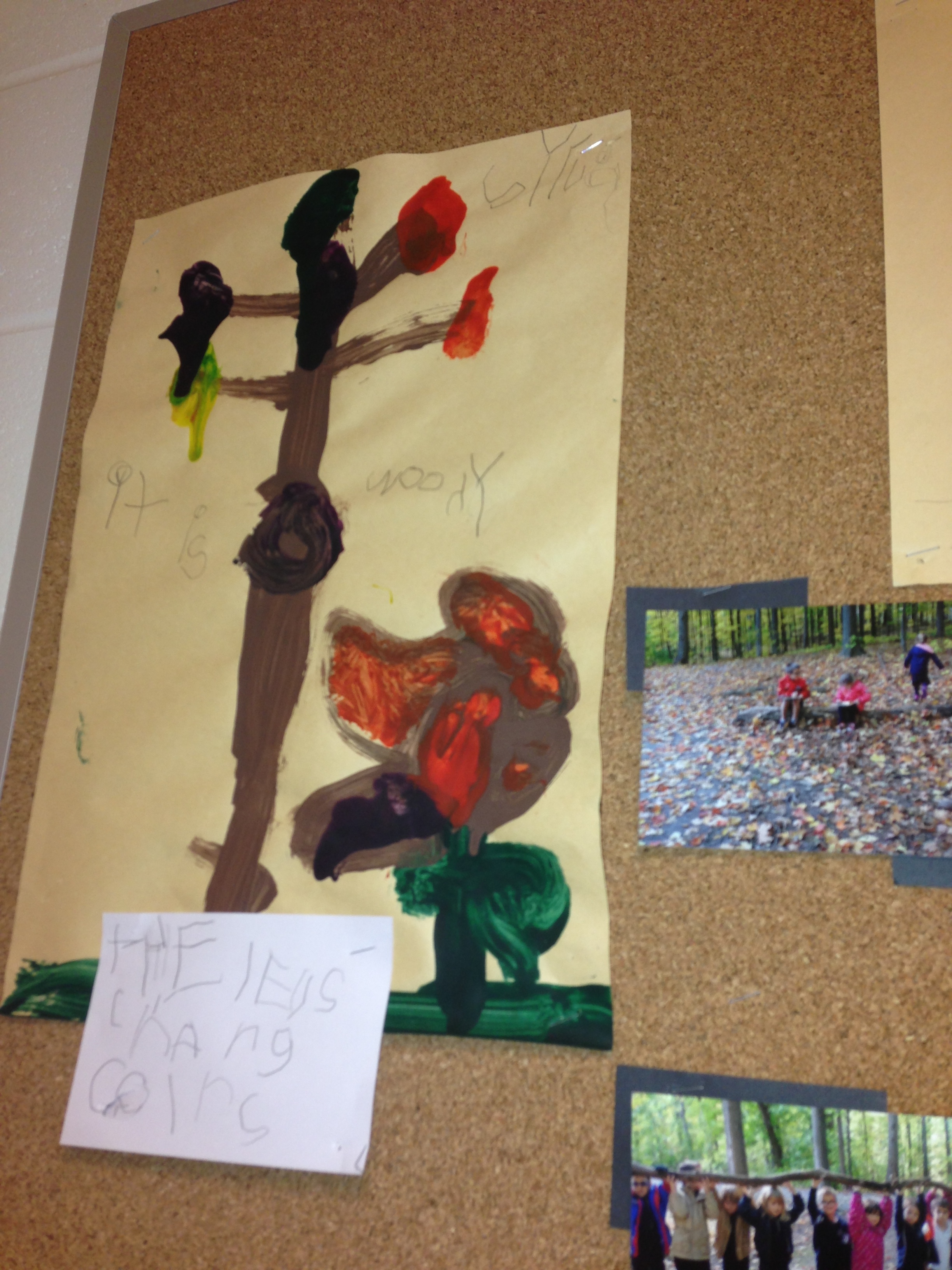
Sylvia Clare's portrait of "Woody", the tree the class adopted from the neighbourhood forest.
Sylvia Clare’s portrait of “Woody”, the tree the class adopted from the neighbourhood forest.

Children working in pairs, in small groups, independently on a variety of tasks throughout the room. The room was bustling yet highly organized. The room was loud but not noisy. I was thrilled to see so many “languages” brought to life (Reggio Emilia’s notion of the 100 languages in the classroom) ~ art opportunities everywhere; all purposeful and engaging. Everyone, including my Sylvia Clare had a place in the space and was engaged in the life of the room. The teachers encouraged Sylvia Clare to show me her portfolio (a binder with evidence of her work). Then Sylvia Clare led me to her interests where we explored and worked together.  Once well settled into the observation, the teacher sat down next to me and asked, “Do you have any questions or concerns?”  This was such an open and  welcoming way to start our discussion. My questions:

Is Sylvia Clare happy at school?

Does she have friends and is she social? Who does she play with the most?

Where does she spend most of her time in the room?

I see she is learning a lot from all that she shares at home. What do you think?

The teacher provided specific description of Sylvia Clare’s work in the classroom: what she talks about, who she plays with, what she enjoys doing, and how she interacts in the classroom. It was clear to me the teachers have a good sense of who Sylvia Clare is, what she likes, areas she has shown significant growth already and areas for improvement. Then I asked:

What can we work on at home to support her learning? 

Continued literacy development, focusing on sound/letter recognition.  I realize now, as a parent of a child who is developing their reading skills just how complex the process is for children. It takes time. Some children acquire skills faster than others; some struggle  but all children need time, exposure, practice to basic skill development. In theory, I knew this. To witness it through the lens of a parent however is somewhat different.  Experiencing literacy development in one young child in live time, watching her gain letter recognition, one letter at a time, one sound at a time, is quite fascinating.  Sylvia Clare is getting there. Beyond the daily read alouds and story telling I need to work through phonic games and drills with Sylvia Clare.

After our brief conversation I felt comfortable and confident that my child has adjusted to full day schooling and getting along well.  Sylvia Clare then ushered me over to the snack table and we chatted while  some of her friends came over to meet me. Shortly after, I said my goodbyes and was on my way.

It was remarkable observing my child in this setting; a setting outside our home, a setting in which I am but an observer and Sylvia Clare is the participant. The observation experience provided very clear, detailed description of my child’s work at school, far more than I would have gathered from a formal report card.


Literacy/English Teacher Educator study

I (Clare) am the Principle Investigator  of a large-scale study of 28 literacy/English teacher educators from four countries. This week I am doing a presentation at the Ontario Ministry of Education where I will give an overview of our findings. Attached is the powerpoint which I thought you might find interesting. MOE LTE 2014

For more information on the study click on the tab  Projects and then click on Literacy Teacher Educators: Their Backgrounds, Visions, and Practices.

Explaining Explain Everything (App)

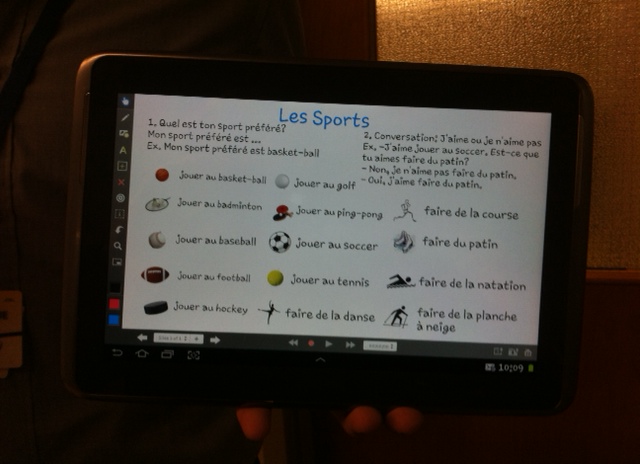
I (Cathy) find that one of the exciting aspects of teaching is learning from my students- especially about digital technology.    One of my student teachers, Drake, taught a lesson last week using Explain Everything.  With the aid of this app he successfully taught  a lesson in French which enabled his grade 6 students to engage in conversations about sports.  How he used the app was definitely key to the success of his lesson and I gave him full credit for cleverly scaffolding the sequence of the questions and answers so that that student conversations were set up for success.  Yet, Drake insisted it was the app that enabled him to teach the lesson so clearly.  Below are pictures of how Drake set up the lesson on his ipad and then mailed it to himself as a handout for his students.  Well done Drake!

Drakeipad

Intrigued, I began to play with this app myself.  I discovered it has a wide range of  applications. It feels like a cross between a power point and a smart board, but completely doable on an ipad.   Very convenient.  Below is an link to a you tube video that demonstrates how students can use the app in a classroom.


Happy Birthday Margaret Atwood

In honour of author Margaret Atwood’s 75th birthday on November 18th CBC Books is celebrating her life and work with a week of special features including archival interviews, infographics, and a selection of passages from her acclaimed books  in the searchable Essential Atwood Reading List. Follow link below:

http://www.cbc.ca/books/mobile/touch/atwood75/index.html

For 75 surprising facts about Margaret Atwood see link below:

http://www.cbc.ca/books/2014/11/75-surprising-facts-about-margaret-atwood.html

Atwood

“Goodnight Moon” revisited

Many are familiar with the picture book Goodnight Moon by Margaret Wise.

Unknown

In case you are not familiar or need a refresher, here is a link to the story:

It is a lovely bedtime story, rhythmical and calming.  Originally published in the late 1940s, and still selling strong today, millions of children have enjoyed the simple tale. It is a classic.

And then came a parody, Goodnight iPad.  Amusingly written by “Ann Droyd” the book is awesome.

Unknown-1

When I (Yiola) first read the book I laughed and laughed and laughed. It is witty and clever while successfully maintaining the rhythm of the original.  It is a powerful message for 21st century learners: know when to unplug!  

Here is a link to the book.

Or for a flashier, more techy version, check out this link:

From the 1940s to today… the images and ideas that need a ‘good night’ have changed  drastically but a child’s wonder and desire to stay up has stayed the same.

I like how the traditional genre of the picture book captures the power of technology in our society so beautifully. A classic communication tool.

I plan to use this text as a closure piece on Technology Day next term.

“Goodnight gadgets everywhere”

Guest Blog: Monica McGlynn Stewart — Tools or Toys?

I (Monica) and my colleague Tiffany MacKay are just starting a new research project exploring oral and visual literacy learning with iPads for 3-5 year olds. Our research will be situated in both childcare centres and public school kindergartens in Ontario. Here is a bit more about our project:

IPadYoung children, aged 3-5 years, are exposed to many forms of digital technology (DT) both inside and outside of their formal learning settings, yet there is little research to guide pedagogical practices for early years literacy teaching. Many registered early childhood educators (RECEs) working in childcare centres are reluctant to introduce DT into their programs, while many RECEs and teachers in Full-Day Kindergarten are using DT in a variety of ways.

Purpose

This research study will introduce educators and students in childcare centres and public kindergarten classrooms to one of two i-Pad applications, 30 Hands or Explain Everything. Both of these applications allow children to easily photograph their work with an i-Pad (e.g., painting, block structure, sand table creation, etc.) and then record their voice explaining what they have created, how they created it, and what they plan to do next, etc. This digital visual and audio file can then be shared with classmates, teachers, or parents via email. Teachers can archive this documentation for assessment and planning purposes.

Objectives

Our objectives include: a) to understand educators’ comfort level and experience using DT for literacy learning with young children; b) to understand children’s use of DT as a means of communicating their work and ideas; c) to explore the value of DT for supporting young children’s literacy development.

Hypothesis

Our hypothesis is that educators will become more comfortable having their students use DT applications that allow for active, creative, and open-ended literacy learning. Furthermore, children will be more motivated to articulate and share their thinking with the i-Pad applications and will become more competent with both their digital technology and oral language skills.

Methods

We will be interviewing the educators before and after the implementation of the software to determine their comfort level and experience with using DT for literacy learning and teaching, their current practices, and in the post-implementation interview, any changes that they observed in their students’ interest and ability with respect to literacy learning. In addition, we will be observing the students in their classes as they use the applications to record and share their work.

Engaging Students in Math

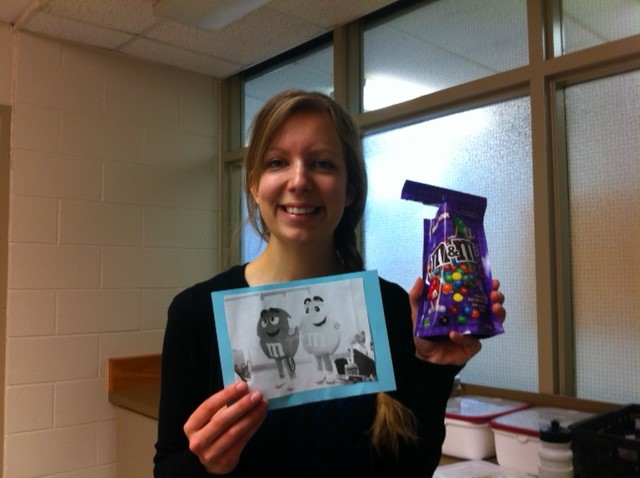
The day after Halloween, one of my (Cathy’s) student teachers, Megan, presented a wonderful lesson to a group of grade four students on probability.  She opened the lesson with a picture of herself dressed as an M&M.  (This was not really her of course, but the students didn’t know that).  She told the story of how she disguised herself as an M&M and went out trick or treating.  One nice lady gave her a whole bag of M&Ms because of her great costume.  Megan wondered aloud on the probability of pulling out red M&Ms as opposed to green M&Ms or yellow ones.  This student teacher had these children with the picture, but the M&Ms clenched it.  All of the students wanted to predict.   The students moved from large group work to small groups to independent work with ease.  Interestingly, Megan did not allow the children to eat the M&Ms.  They were data.  The children accepted this fact and made no protest.  The math remained the focus throughout the lesson.  The lesson was an absolute delight to watch.   Trouble is, I may never eat M&Ms the same way again.  I will always be calculating the probabilities of pulling that red one.

photo

Celebrating the 25th Anniversary of True Story of the Three Little Pigs

As the 25th anniversary of the picture book The True Story of the Three Little Pigs approaches author Jon Scieszka and illustrator Lane Smith recount the origins of their collaboration and the challenges of securing a publisher for the sophisticated parody. As Smith recalls, “some editors liked it but were a little confused and not sure if there was a market for it. Back at that time, children’s books were either serious, earnest books, or really funny books. But the sense of parody and irony that is rampant now didn’t really exist then…Viking put the book out very tentatively. They weren’t convinced of anything and did a small run that immediately sold out. It was all word-of-mouth from teachers, librarians and booksellers. They didn’t run ads or do a publicity push. Finally by the fourth or fifth printing the runs were more like 50,000.”

Follow the link below to read the full interview with Jon Scieszka and Lane Smith:

http://www.publishersweekly.com/pw/by-topic/childrens/childrens-book-news/article/64695-the-true-25th-anniversary-story-of-the-three-little-pigs.html?utm_source=Publishers+Weekly&utm_campaign=94f331fbd0-UA-15906914-1&utm_medium=email&utm_term=0_0bb2959cbb-94f331fbd0-305134397

ThreePigs