
Tech Humour for Educators
I (Cathy) was amazed to recently read about two Washington University sophomores, David Azodi and Thomas Pryor, who’s work was highlighted in Discover Magazine. These clever young men have been recognized for an invention that could break down communication barriers for the deaf. Sign Aloud is a pair of sensor-filled gloves that interpret the hand movements American Sign Language users use to communicate, and converts them into speech or text that the rest of us can understand. The students designed the gloves inside the CoMotion MakerSpace, a collaborative workshop on campus. They recently received the Lemelson-MIT Student Prizefor their work, which is a yearly award given to undergraduates for innovative inventions. They won in the “Use It” category, and received a $10,000 grant along with the prize.
Follow the link below for a demonstration of this brilliant use of technology.

The Ontario Teacher’s Federation (OTF) recognizes that teachers need to direct their own learning and professional development. To support this need they now offer a professional development problem-based learning model which encourages teacher teams the opportunity to create their own learning projects. The model encourages teachers to: select a team to work with; develop a project; conduct the research; and evaluate the effectiveness. If the proposal is accepted, the OTF also provides support for the project through a mentoring program. Each team is assigned an expert teacher who will act as their mentor, who assists the team as needed throughout the process.
Through this process teachers are given the opportunity to:
This year they have suggested three areas of focus:
Deadline for 2016 proposal applications is May 31.
Some 2015 projects were:
Assessment Technology in Primary Physical Education
Cross-Curricular Integrating Technology/Media Studies
I remember, as a classroom teacher, wishing my school board would allow me the opportunity to identify my own areas of strength and weakness and seek out professional development accordingly. It is appropriate that the OTF is acknowledging this form of PD and taking a step in the right direction. It would be helpful if teacher education programs could also offer similar forms of support for their own staff and faculty.
http://www.otffeo.on.ca/en/learning/teacher-learning-co-op-tlc/
Writing blog posts is one of my most favourite things to do. I (Yiola) do not think I’m an entirely seasoned blogger but with time, practice, and learning I hope to become good at it one day. Why? Well, as an academic one of my goals is to share what I study and what I know with others. One way I do this is through my teaching. I am a teacher educator. My goals as a teacher educator are to prepare pre-service teachers to become excellent teachers by thinking about what they teach, how they teach and most importantly who they teach. I am also a writer — but a very particular kind of writer. I have been taught to write in academic prose for journal articles and book chapters. Sometimes our articles and books are read by others in the field. But… blogging… this is an entirely different genre and such a wonderful way to network and meet amazing people – some directly in the same field and others in slightly different but related fields – while sharing knowledge and information. Since writing on the academic / teaching blog I have met wonderful people and learned many things and taken away wonderful ideas. Let me share an example based on something that happened recently.
Some time ago I posted a blog about creativity in teacher education. Here is the link below:
Last week I received an email from a person who is in the field of creativity who has also done some good work in the area. This person shared their insights on what I had written and provided supportive feedback and then also shared their work with me. What a delightful process! I am now sharing their work with you. The following link leads to a list of ways to infuse creativity into the classroom. I reviewed the link and like it for several reasons: 1. It’s foundations and theoretical underpinnings are closely linked to the work I shared with my student teachers in our classes on creativity 2. The list is very easy to view and accessible 3. I found the list inspiring and doable — so yes! I will now proceed to share this link with my student teachers and friends.
http://www.fusionyearbooks.com/blog/creative-classrooms/
This is but one example of how blogging in academia and in teacher education serves such good purpose. Yet another example of how digital technology and literacy work hand in hand to foster communication and learning. I am delighted when I receive messages with feedback, interest, and sharing. Looking forward to more connections and learning through this medium.
If we talk about literacy, we have to talk about how to enhance our children’s mastery over the tools needed to live intelligent, creative, and involved lives.
Danny Glover

I was curious as to why actor Danny Glover would be credited with such a profound quote on literacy. Looking into his background I discovered two things about him:
1.Danny Glover suffered dyslexia at school when he was younger and the school staff would label him retarded. This definitely was not very encouraging for him but he ended up finding ways to feel better about himself. He says that dyslexia had given him the feeling that he was not worthy to learn and that the people around him would not care of what would happen to his education. With time he eventually regained his self-esteem and became a great actor.
2. Danny Glover is a political and civil rights activist. For example, while attending San Francisco State University (SFSU), Glover was a member of the Black Students Union, which, along with the Third World Liberation Front and the American Federation of Teachers, collaborated in a five-month student-led strike to establish a Department of Black Studies. The strike was the longest student walkout in U.S. history. It helped create not only the first Department of Black Studies but also the first School of Ethnic Studies in the United States.
I am sure these two factors contribute enormously to Mr. Glover’s insightful views on literacy. What we make of our backgrounds shape our identities as leaders, particularly in education. My newly discovered knowledge of Mr. Glover increases my respect for him not only as an actor, but as a human being. I look forward to reading more about his journey and commitment to literacy development.
https://en.wikipedia.org/wiki/Danny_Glover#Civil_rights_activism
http://www.disabled-world.com/artman/publish/article_2130.shtml
I (Clare) am writing with my research team a paper about literacy teacher educators who use a constructivist approach. I found this amazing quote from Virginia Richardson which seems to succinctly sum up the challenge. I thought I would share it with you because it helped clarify some of the issues. 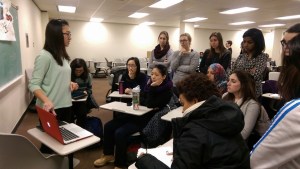
Constructivist teaching as a theory or practice, however, has only received attention for approximately one decade. Current interest and writing in constructivist teaching leave many issues unresolved. These issues relate, in part, to the difficulty in translating a theory of learning into a theory or practice of teaching, a conversion that has always been difficult and less than satisfactory. However, the nature of constructivism as an individual or group meaning-making process renders this conversion remarkably demanding (Richardson, 2003, p. 1623).
Here are some snapshots and highlights of my experience at AERA this year. If I (yiola) could name the experience I would call it: Goosebumps and Inspirations… it was just that good.


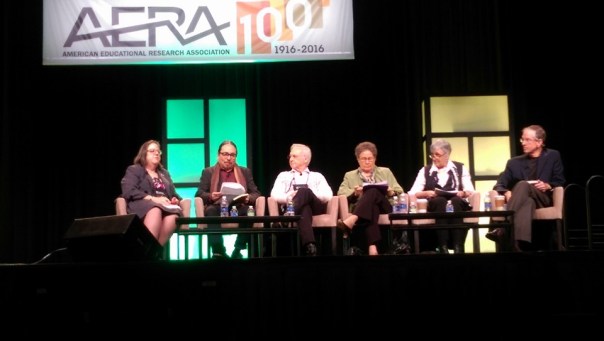
2.I attended a presidential talk that was a tribute to the life and work of Dr. Phil Jackson. The focus of the talk was on the question of education. I really like what this panel did: each panel member selected a passage from a text written by Dr. Jackson and talked about its significance to them. A paragraph was read from The Practice of Teaching and the idea of transformative teaching… such an important and central idea in progressive education. A piece was read from Handbook of Research on Curriculum: Conceptions of Curriculum and the the idea that school is systematically harming children… and how can we work against that? Linda Darling-Hammond read a passage from his famous book Life in Classrooms and spoke of the “multi-dimensionality and simultaneously nature of teaching” and the essential relationships associated with teaching. And, one panel member shared from Dr. Jackson’s last book published in 2012, What is Education and spoke of education as pure and simple; something we must rededicate ourselves too over time.
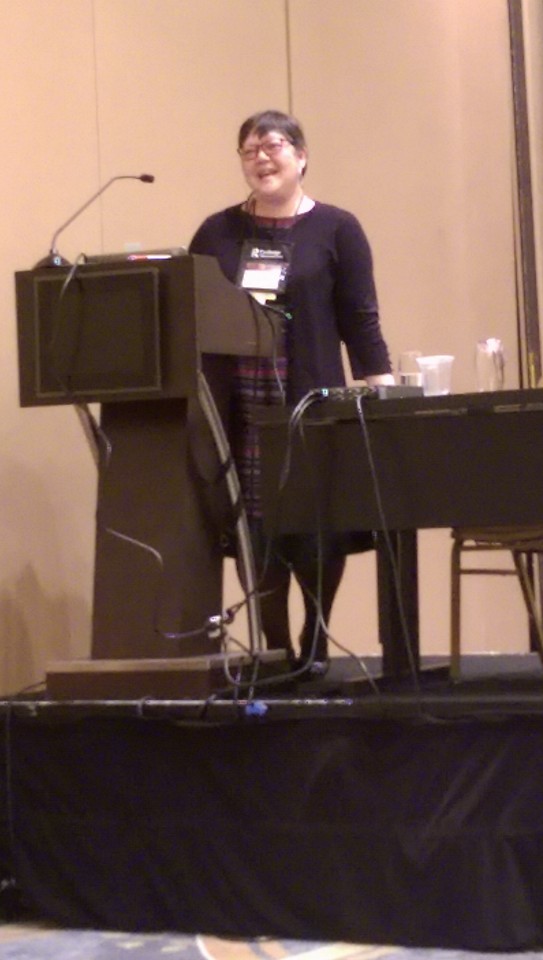
3. I was very fortunate to have the opportunity to listen to the presidential lecture for Division K hosted by Dr. Lin Goodwin, Teachers College Columbia University. A remarkable speaker who not only inspires with her words but truly challenged me to think about what quality teacher education requires. What I like most about Dr. Goodwin is her genuine nature. A distinguished academic and also a beautiful human being. Here are some pictures from her talk including slides from her presentation.



4. Yet another interesting Presidential session with Wayne Au, Marilyn Cochran-Smith, Kevin Kumashiro (and others) that explored policy and standards in Teacher Education. Laden with some controversial findings for the testing systems for new teachers and teacher education programs, the presentations were provocative and interesting:

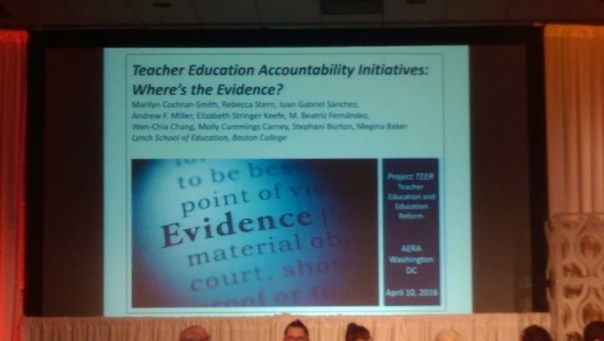
5. The last session I would like to share is one where we presented at the Constructivist SIG. A lovely group of people from across North America, we exchanged ideas of what it means to teach in constructivist ways. Our team leader Dr. Clare Kosnik presented work from the Literacy Teacher Education research and presented on a group of literacy teacher educators who had strong constructivist pedagogies.


Finally, AERA is held at such interesting places. One has to take some time to enjoy the beauty of the district and take in some of the sights.


I was once again thrilled to attend the AERA conference this past week. It is such a remarkable opportunity- so many knowledgeable and committed educators from around the world. Quite inspiring. At the conference this year, one consistent theme emerged in the sessions I attended: Know your students. One particular study in a session entitled Preparing Preservice Teachers to Teach for Social Justice, resonated with me quite profoundly. The study was called Candidate Change in a Community -Engaged Teacher Education Program and was led by Patricia Clarke from Ball State University. Patricia maintained, ” a good teacher must understand the context in which a child lives grows and learns.”
Her team conducted a study which examined: preservice teacher candidates’ attitudes towards diversity and community, and how they changed over the course of a semester-long community-engaged experience. As teacher candidates came to know the community in which they were working, their expressed attitudes and beliefs changed from explicit statements of bias and stereotype to ones that sought community involvement and social action.
This teacher education program at Ball University emphasized community involvement by holding classes in local community centers (as opposed to the university). Student teachers also attended the local church on Sundays to be part of the community gatherings. The teacher educators arranged for “community ambassadors” to welcome the student teachers to their neighborhood and guide the student teachers throughout their weeks in the school. The results were remarkable. The student teachers moved from “being nervous” and “afraid” in the neighborhood to feeling like a community member.
Patricia closed her session with a sweet anecdote shared by one of her student teachers, which I will share with you here. The student teacher was working in a class of grade two students and asked the children to share the markers. She handed the basket of markers to the child beside her who seemed a bit confused. Remembering what she had experienced the previous Sunday when she attended the community church with the children, she said, “pass the basket like you do at church.” The child nodded, and said “Hallelujah!” all the of the children immediately responded with “Praise be the Lord!” and they promptly passed the basket of markers around the circle. The student teacher was somewhat surprised by the response, but because of her inclusion in the community completely understood why the children responded they way they did. She smiled, nodded, and continued on with the lesson.

The commitment of the teacher educators in this program was outstanding and quite inspirational. I sincerely hope teacher education programs worldwide can learn from not only this study, but the model of teacher education Ball University has implemented.

I (Cathy) am delighted to be arriving in Washington D.C. today to attend the American Educational Research Association Conference. I will be presenting a paper entitled, Examining the Influences: Literacy Teacher Educators who us a Multiliteracies Approach. This study is a subset of a larger study on which I have been a researcher. I examined 7 participants who demonstrated a proclivity toward multilitercies. As I used a grounded theory approach (which does not begin the research with a hypothesis) I was both intrigued and surprised by the findings. Hope you can join me on Monday, April 11, 11:45am to 1:15pm, at the Marriott Marquis, Level Three, Mount Vernon Square.
Abstract:
According to Dewey (1974) “[e]ducation, experience, and life are inextricably intertwined”. This study examined how early life experiences and other influences affected the practices of 7 literacy teacher educators (LTEs) who currently enact a multiliteracies approach. Early childhood experiences, mentors along their journey, personal and professional turning points, and developing notions of literacy were explored. Three findings (a) an innate love of language/literature, (b) inspiring mentorship, and (c) a unique set of dispositional qualities were significant contributing factors to these literacy teacher educators adopting a multiliteracies approach. The participants for this study were a subset from a large-scale study entitled, Literacy Teacher Educators: Their Backgrounds, Visions, and Practices which examines the lives of teacher educators from four countries: Canada, the USA, England and Australia.
Hope you can join me!
http://www.aera.net/EventsMeetings/tabid/10063/Default.aspx
I (yiola) along with the research team and many other colleagues are preparing for the American Educational Research Association (AERA) conference that will be held in Washington DC this year. The conference begins on Thursday April 7th until Tuesday April 12th.
An enormous conference that attracts thousands of educational researchers from around the world and across disciplines and methodologies in the area of education. Each year the conference has a theme. This year the theme is Public scholarship to educate diverse democracies. Here is a link to the site and more information about the conference:
http://www.aera.net/EventsMeetings/AnnualMeeting/2016AnnualMeetingTheme/tabid/15861/Default.aspx
The team and our close colleagues will be presenting at AERA. We will be sure to post pictures and updates from the various sessions we attend. We hope to see you there. If you are not attending this year be sure to check out out blog for highlights next week.
 Literacy Teaching and Teacher Education