Category Archives: Teacher education

Blending old and new world literacies: Storytelling and Technology

I (Cathy) was recently asked to give a storytelling workshop for a third year Early Childhood Education Class. The professor felt the experience might broaden her students’ concept of literacy.   As a practitioner of multiliteracies (New London Group, 1996) I felt compelled to blend “old world literacy” which in this case would be storytelling (it is the oldest form of entertainment for our species), and new world literacy, which in this case was an online interactive learning system called Today’s Class.  (I have mentioned Today’s Class in an earlier post.  Today you get to hear how I put it into practice).

Initially, the students (a broad range of ethnicities, ages, and English language proficiencies) shared they had never previously experienced storytelling.  They had been read to and assumed this was the same thing.  Most admitted they had never heard of Todays’ Class either, but were game to give it try.  I warmed them up by delivering an old folktale (old world style, just me, them and their imaginations) which blew them away.  “I could see the story!”, and “I was captivated” were some of the responses.  The class was then arranged into small groups of three, each group having a lap top with access to the internet.  Each group was “invited” into the Today’s Class site and asked to give their group a “nick name”.  On the large screen at the front of the room, I posted questions about the storytelling experience for them to consider.  After some deliberation, the groups posted their responses, using only their nick names for identification.  I was intrigued by their reactions as the team responses popped up on the screen.  They were highly engaged.   I could have heard a pin drop they were so intent on reading the other groups’ answers.  When I used to do this kind of activity, the groups used chart paper and markers to record their answers and these were posted around the room.  I usually read out the answers because the printing was often not legible across the room.  Also, I often filtered what I read aloud, instantly deciding what the key points were and only sharing those.   However, with the big screen, it became each students’ responsibility to do the reading and the  filtering. The accountability and engagement levels were higher.

As we moved through the workshop, experiencing different forms of storytelling, the groups returned to conferencing at their computers, analyzing the responses and discussing the salient points.  Both my students and myself were delighted with the results.  Storytelling and technology were a perfect fit.  The students left with a much deeper understanding of an ancient literacy form, many vowing to use it in their child care centers, but also left with a much broader view of the usefulness of modern literacies.   Old and new world do blend.   I couldn’t help but wonder how Aesop might have felt about Today’s Meet.    I think he would have liked it.

New London Group. (1996) A pedagogy of multiliteracies: Designing social futures.  Harvard   Educational Review,1, 60-89.

https://todaysmeet.com/


Teacher Education Reform Trends

Image Univeristy of SydneyClive and I (Clare) are doing a presentation at the University of Sydney on reforms to teacher education. Along with Lin Goodwin we wrote a chapter for the upcoming Handbook on Teacher Education edited by Loughran & Hamilton (to be published by Springer). We surveyed the literature on teacher education from many countries and identified the following trends:

  • Explicit Standards
  • Minimum Requirements
  • Research Based
  • Assessment + Accountability
  • Alternative Routes
  • Subject Knowledge
  • Theory and Practice
  • Continuing PD

We did mini case studies of England, Canada, U.S., and Singapore – England where they seem to be dismantling university-based teacher education to Singapore where the government, universities, and schools work collaboratively. This research was so enlightening because we looked an many countries beyond the usual big “players” like Finland, the Netherlands …. . We included information on less reported countries like Trinidad and Tobago, Chile, Scotland, and Norway. Will keep you posted on the publication of the handbook.

Classroom management: Beginning teachers’ challenge

An interesting article I (yiola) found on classroom /behaviour management.

http://www.motherjones.com/politics/2015/05/schools-behavior-discipline-collaborative-proactive-solutions-ross-greene

I believe that until you experience teaching it is hard to fully understand what it means to build a safe, secure learning environment that builds intrinsic motivation and confidence in children.

I believe, in teacher education, we teach all that the article describes, yet students do not always see this out in the field. There are many reasons for this theory/bridge gap. Regardless of the gap, it is important that in teacher education we continue to prepare our teacher with best practice and provide them with both the “how” and the “why” of it.

What I love is that we do not even call it “classroom management” at all… at the lab school it is only about building a learning environment that focuses on engagement, safety and securing of the individual.  The idea of “managing” children is counter productive to the philosophy of building creative, innovative, independent and confident children.

Teasting your Knowledge of Semiotic Linguists

My (Cathy’s) research focus is on multiliteracies. Understanding the history and conceptual development of multiliteracies demanded I grasp a basic understanding of semiotics, or semiology.  Semiotics is a branch of linguistics that studies signs, symbols, and signification.  However, it is the study of how meaning is created, not what it is.

Sassureimages

Ferdinand de Saussure is generally credited as the father of semiotics.  His book Course in General Linguistics, was published posthumously by his former students Bally and Sechehaye.  It was through this work that Saussure’s Semiology Theory was made public.  His theory was based on the study of signs; a sign being anything that represented something else.  Saussure proposed that communication is a system of signs that convey meaning, but limited his work to the use of words, spoken and written.  Sassure’s most recognized semiotic terms are signifier, signified, sign and symbolic.  (Glossary at bottom of page)

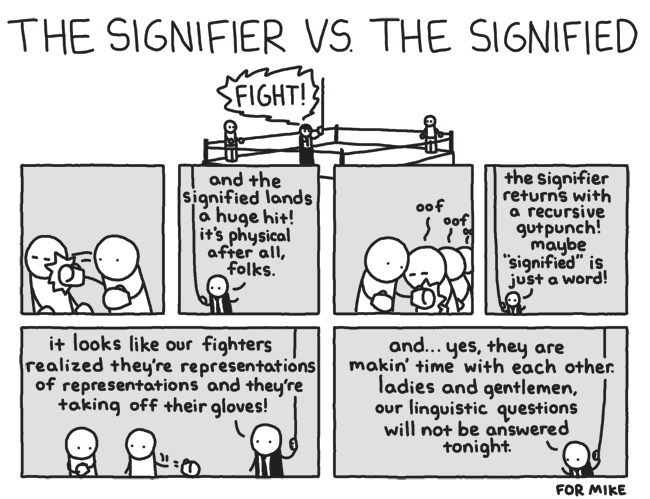
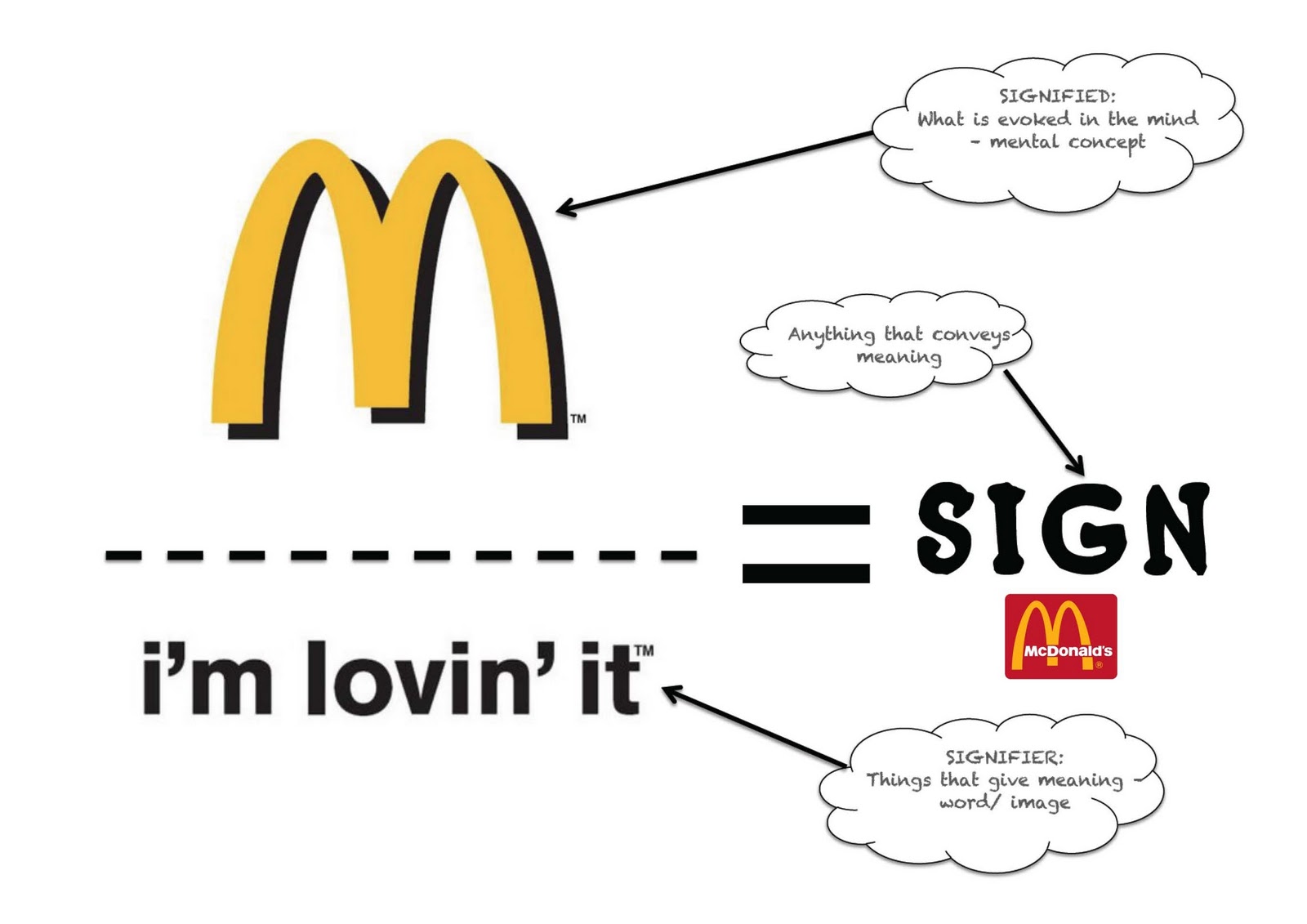
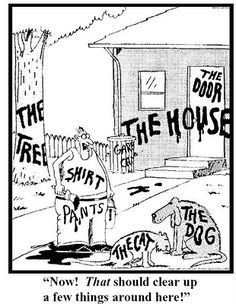
To test our knowledge of these terms, I share the following three graphics. Does their signifier representation signify anything symbolic to you?

Lighthearted Semiotics


 M semiotics-copy

signs


Signifier: any material thing that signifies, e.g., words on a page, a facial expression, an image.

Signified: the concept that a signifier refers to.

Together, the signifier and signified make up the:

Sign: the smallest unit of meaning. Anything that can be used to communicate.

Symbolic (arbitrary) signs: signs where the relation between signifier and signified is purely conventional and culturally specific, e.g., most words.


http://www.uvm.edu/~tstreete/semiotics_and_ads/terminology.html


Hip-Hop Ed Fosters Connections

An article in the New York Times highlighted the work of high school English teacher Brian Mooney, who uses the lens of “hip-hop ed” to engage students in the study of complex literary themes. A blog Mr. Mooney created to share his curriculum and student work caught the attention of a broader audience — rapper Kendrick Lamar visited the high school. Students from Mr. Mooney’s English class and the after-school poetry club performed spoken word poems and raps for Kendrick Lamar.

Link to article: http://www.nytimes.com/2015/06/09/nyregion/kendrick-lamar-rapper-who-inspired-a-teacher-visits-a-high-school-that-embraces-his-work.html


Revisiting Mysteries in Canadian History

A project entitled Great Unsolved Mysteries in Canadian History, engages inquiry-based pedagogy to encourage students’ critical thinking and research skills. The project, based at the University of Victoria, the Université de Sherbrooke and the Ontario Institute for Studies in Education at the University of Toronto, has developed a collection of websites, which invite high school and university students to examine primary source documents, photographic evidence, archival material and historical interpretations, in an effort to solve a historical puzzle (e.g. the mystery of the doomed Franklin expedition; the mysterious death of artist Tom Thomson). John Lutz, University of Victoria history professor and one of the founders of the project noted, “history is too important to be boring, and these mysteries are too intriguing to be left to historians alone.”  All the materials and teachers’ guides are free. Link to project site: http://canadianmysteries.ca/en/index.php Link to the CBC article: http://www.cbc.ca/news/canada/british-columbia/how-franklin-expedition-mystery-could-be-solved-by-high-school-students-1.3086927

Trends in YAL

I try to stay connected with current trends in Young Adult (YA) Literature so I can have thoughtful conversations about these texts with the student teachers in our literacy courses. An article by Publishers Weekly highlighted some of complex topics currently being explored in YAL. Some of the themes YA publishers are prompting include texts “that look thoughtfully at mental illness and suicide” as well as “books that tell sophisticated stories about gender identity across the LGBTQIA spectrum”. To find out about specific YA titles exploring these topics see the following link: http://www.publishersweekly.com/pw/by-topic/new-titles/childrens-announcements/article/66587-what-to-expect-when-you-re-expecting-ya.html

Coding is the Fourth Literacy?

I recently came across an article that suggested “coding is the fourth literacy,” and digital skills such as learning how to code should be part of the contemporary classroom, in order to prepare children/youth for the future job market. The article noted “the UK government instigated a complete overhaul of the computing curriculum in England and Wales…. [with] programming skills placed at the heart of the new curriculum. Now children as young as five are being taught computational thinking and digital creativity… By embedding coding into the new computing curriculum, the UK Department of Education stated the new subject would “ensure every child leaves school prepared for life in modern Britain”.

Link to the article: http://www.gamesindustry.biz/articles/2015-05-04-coding-has-become-the-fourth-literacy


Graham Parr: Experts Speaking about Teacher Education

Last year I (Clare) received a grant for the project: Rethinking Literacy Teacher Education for the Digital Era: Teacher Educators,Graham Parr Literacy Educators, and Digital Technology Experts Working Together. One of the main activities of the project was to bring together 16 experts from three fields and 4 countries (Canada, US, UK, and Australia) to address the following questions.
• How is our understanding of literacy evolving in light of the new ways we communicate?
• How can literacy/English teacher educators (LTEs) prepare student teachers to develop and implement literacy programs that capitalize on digital technology (DT)?
• What teacher education curriculum changes are required to better prepare future teachers to integrate technology in their own teaching?
• What professional learning support do LTEs need to develop courses that will integrate and make greater use of DT?

We held a Symposium in London England in June. Click on the link https://literacyteaching.net/connection-grant/ for more info on the Symposium and for some photos.

At the Symposium we interviewed the participants which we video taped. These videos are now available. They are incredibly interesting, informative, and short. Teacher educators can use these in their courses/presentations. Click on https://literacyteaching.net/connection-grant/powerpoint-presentations-and-videos/ (or the box to the right of this post).

I want to bring your attention to the third video which is of Graham Parr from Monash University, Melbourne Australia. Graham’s video is the third one just scroll down the page. He addresses:

First video: A key insight she has had about education

Second video: Recommendation to improve teacher education

SAMR: Bloom’s Taxonomy for technology education

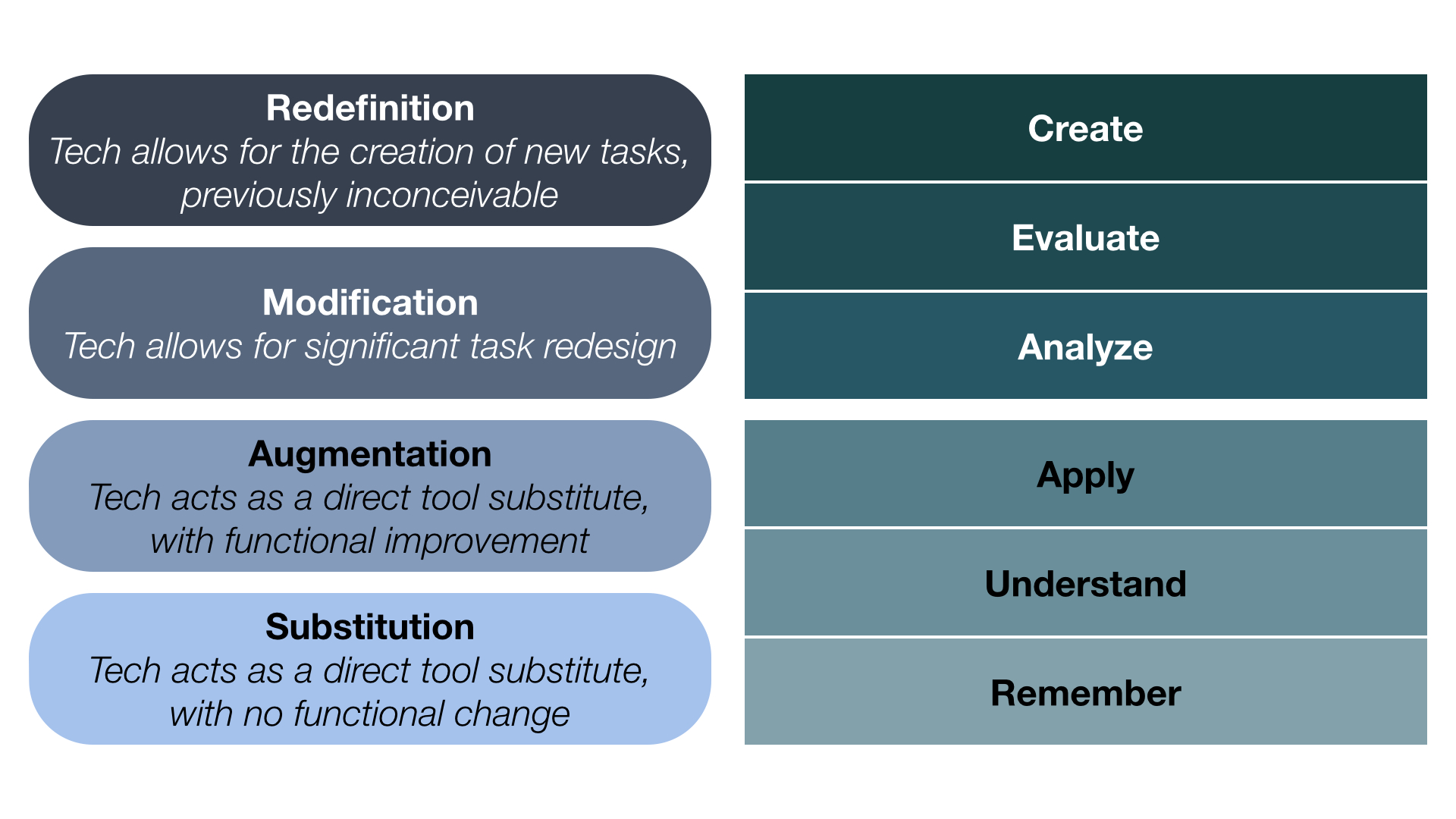
Dr. Ruben Puentedura developed the SAMR model as a way for teachers to evaluate how they are incorporating technology into their classroom practice.  Puentedura constructed his model in the form of a ladder and equates it with a student climbing the cognitive scale associated with Bloom’s Taxonomy.  (i.e. as a task moves from lower to upper levels of Bloom’s taxonomy, so does a task move from lower to upper levels of SAMR).

Below is a comparison of Bloom’s and SAMR:

diagram-puentedura

Puentedura’s model encourages educators to ask themselves if the student task is an act of substitution, augmentation, modification, or redefinition? The suggested threshold for moving from enhancing learning to transforming learning is between augmentation and modification.  As an example of this, consider a student writing a paper.  If the student writes the paper on a computer instead of on a piece of paper, this is an act of substitution.  If the student uses spell check and a formatting tool to assist with the writing process, this is augmentation as there is a slight change in the functional improvement.  Should the student publish the paper, perhaps on a wiki, blog site or through google docs, so other students can read it and give feedback, this is a modification of the process, for it now includes collaboration.  Lastly, in redefinition entirely new tasks are created which were inconceivable without computers and computer software tools.  In this level student transform their written stories into media productions using storyboards, filmed scenes and music.  Students can also publish these and receive feedback on the work.  In this level technology has redefined the task.

Working towards redefinition, is of course the goal for teachers who would like his/her students to be working in the highest thinking levels possible while using technology.

A short video introducing the SAMR model can be found at:                        https://www.commonsensemedia.org/videos/introduction-to-the-samr-model