Category Archives: teacher educators

Motto for Education

I (Cathy)  came across this quote and felt it was most applicable to education.  As teachers and teacher educators we must be forward thinking and forward acting.  We must look to where or students and society is going to be and prepare them. Thank you # 99 for reminding us of our role in the progress of educational theory and praxis.


I skate quote


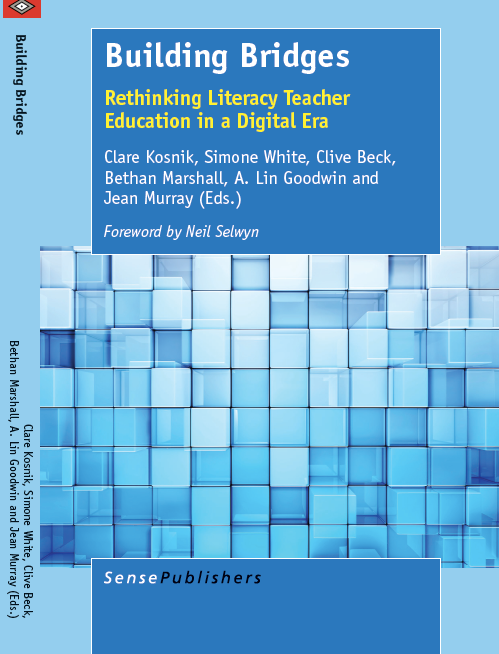
Building Bridges: Rethinking Literacy Teacher Education in a Digital Era

I (Clare) love sharing good news. Our book Building Bridges: Rethinking Literacy Teacher BookCoverCroppedEducation in a Digital Era has just been published. Being modest (tee hee) I think it is blockbuster!!!! Attached is a flier for the book and when you look at the Table of Contents you will see what I mean — incredible contributors. Here a flier for the book Building Bridges_Flyer
If you are comfortable share this info on your FB page/Twitter/Website. The tiny url is http://tinyurl.com/hwtvoua
I am so proud of this book and learned so much editing it!

Teacher Education for High Poverty Schools

Jo Lampert and Bruce  Burnett have recently edited an amazing text,Teacher Education for High Poverty Schools. The text is available from Springer.

http://www.springer.com/us/book/9783319220581Image_LampertBookcover

This volume captures the innovative, theory-based, and grounded work being done by established scholars who are interrogating how teacher education can prepare teachers to work in challenging and diverse high-poverty settings. It offers articles from the US, Australia, Canada, the UK and Chile by some of the most significant scholars in the field. Internationally, research suggests that effective teachers for high poverty schools require deep theoretical understanding as well as the capacity to function across three well-substantiated areas: deep content knowledge, well-tuned pedagogical skills, and demonstrated attributes that prove their understanding and commitment to social justice. Schools in low socioeconomic communities need quality teachers most, however, they are often staffed by the least experienced and least prepared teachers. The chapters in this volume examine how pre-service teachers are taught to understand the social contexts of education. Drawing on the individual expertise of the authors, the topics covered include unpacking poverty for pre-service teachers, issues related to urban schooling as well as remote and regional area schooling.

Our (Clare) research team contributed a chapter to the text which focused on six literacy teacher educators who purposefully prepare student teachers to work in high poverty schools. Here is the chapter: TchingforHighPovertySchools

Second Wave Change

Every once and a while I check online to see if my favorite literacies scholar, Allan Luke, has presented something new I can learn from.

Allen

Although not ‘new’, this time I happened upon a  short and poignant video called Second Wave Change.  It’s a succinct  explanation of  the kind of substantive content our students need to be discussing and thinking about to change our world.  This is a perfect video for student teachers.

So worth watching, but Allen Luke always is.


The Future of Education?

I (Cathy) recently read a blog posted on the The Huffington Post.  If you are not familiar with the Huffington Post, it is an American online news aggregator and blog, that has been public for 10 years.   In 2012, The Huffington Post became the first commercially run United States digital media enterprise to win a Pulitzer Prize.

I qualify the source only because I am always suspect of individuals or groups that make claims or forecasts about education, yet  know little about the systems. As I consider The Huffington Post a relatively reliable and informative source, I gave the claims made by , a guest blogger who was the Former President for the  Society for Quality Education a second look.

In this blog, Dare proposes that all education systems are cartels  (an association of manufacturers or suppliers with the purpose of maintaining prices at a high level and restricting competition) and these cartels will be disrupted by the world of technology.  Dare suggests:

A software company might put together a complete online curriculum, with built-in testing and reporting, that allows students to progress at their own speed using tablet computers. Already much of this software exists, although it is not yet well organized. Another (or the same) software company might make it possible for parents to access individuals, or groups of individuals, who are willing to coach a group of other people’s children, possibly in their own homes or in a community centre, for a reasonable fee. Part of the software company’s services could be to vet the coaches and ensure they pass health and safety checks.

Dare uses Uber and Airbnb as examples of disrupters to systems and claims educational systems are next.  He goes on to say:

In fact, disruption is already taking place in the post-secondary sector — see UoPeople, the world’s first non-profit, near tuition-free, accredited online university. Currently, students can earn an undergraduate degree in business administration and computer science for $4,000 US, and more programs are being added.

I am fascinated by this blog for a number of reasons.  First, Dare assumes that a young adults  seeking to educate themselves  are comparable to young child who are learning to read and learning to socialize. I have taught children to read (and socialize) and I simply do not  think a  computer can do it.  There is a lot more to education than just text book learning!  Secondly,  Dare implies in the blog that teachers are oblivious to the affordances of technology and reject it for fear it will disrupt the “cartel” in which they participate.   Every teacher I know (from K to HE) incorporates (in degrees) technology into the teaching and learning in their classroom.  They are also aware that students can go online and teach themselves many things. They even encourage it.  The Khan Academy was designed for such learning and is largely responsible for the premise of flipped classrooms which are very popular right now  in Canadian colleges.  I do not think technology will disrupt the educational system.  I think it will just continue to enhance both teaching and learning. Technology and education will evolve together.

Lastly, Dare is completely oblivious to the most significant aspect of education – the relationship.  Countless studies have suggested a caring, attentive teacher can do more for a student than any other factor. Personally, I just can’t see technology completely replacing a good teacher, especially in the education of the young. People simply need people.

Thoughts?

http://www.huffingtonpost.ca/malkin-dare/ontario-education-future_b_8916284.html

Current Issues in Teacher Education: A Video Series by Said Sidani

In my graduate course, Current Issues in Teacher Education, I (Clare) gave the students lots of choice for their final assignment. Said Sidani took an incredibly interesting approach – he created a series of videos. I was so impressed I asked him if I could post them on this blog. Some are specific to Ontario but the first one, perceptions of teacher education, was applicability beyond our context.

             For my culminating project, I wanted to examine asaid-image
few topics that stood out to me throughout our course. As a recent graduate from a teacher education program and a beginning teacher, I wanted to focus on themes that resonated with me and that I wanted to learn more about. Instead of writing an academic paper, I decided to use a video series to present my findings.

This video series is divided into 4 parts that focus on: 1) Perceptions of Teacher Education, 2) Occasional Teaching, 3) Hiring Regulations, & 4) Teacher Induction. Each video consists of a narrated Prezi that presents relevant literature related to the topic. I draw on course readings, research in the field, and personal experience.

My intended audience is teacher candidates, teacher educators, professors, students, and anyone interested in the teaching profession. Since there is a large number of stakeholders in education, I believe that almost any viewer will be able to take something away from watching. My goal is not to deter anyone from joining the teaching profession, but rather to inform them of some of the issues that exist and the work that needs to be done.

The position I present is that teacher education is in need of reform. Instead of deregulating teaching, we must focus our efforts on improving people’s perceptions of teacher education programs. Also, occasional teaching and hiring regulations in Ontario are part of a broken system. They discourage new people from entering the profession which in turn impacts the quality of education that students receive. Finally, teacher induction programs that promote mentorship are essential to a beginning teacher’s journey. However, when they are delivered through the use of a transmission model instead of a transformative model, they are not nearly as effective.

The videos are available on YouTube and can be accessed via these links. For the best viewing experience, the video quality should be set to 480p (this is usually automatic). Thanks for watching.

1) Perceptions of Teacher Education:
https://www.youtube.com/watch?v=wWMtBGAoeZQ

2) Occasional Teaching:
https://www.youtube.com/watch?v=45caUBGrqRw

3) Hiring Regulations:
https://www.youtube.com/watch?v=unzh1QiWnVg

4) Teacher Induction:
https://www.youtube.com/watch?v=tNxXqZSHGm8

This link will play all four videos in sequential order:
https://www.youtube.com/watch?v=S8SgF7ohrls&list=PLdOXV0MCo16GcNDd9DSy4DIuw_GgMAYWi

Time Out

I (Cathy) read this lovely blog the other day and wanted to share it with you. It seemed appropriate for this time of year, when so many people seem rushed and pressured, preparing for the holiday season.  I think it applies to teachers and teacher educators alike.  But most of all, it’s about our students.  Where some of us live, we can’t take our students outside due to the weather, but I think if you got creative, you could think of someway for them to “unwind”.

I played hooky a few weeks ago.  I filled out my paperwork for half a personal day and took the afternoon off.

It’s not something that was easy for me to do.  I’m usually overcome with guilt and angst whenever I take time off.  I can count on one hand the times I’ve actually taken a personal day, and sick days are used only when I am so ill, I can’t muster the strength to crawl to the shower—one every few years. There’s too much work to be done to miss school—the students need me too much, right?

So, I don’t take time off.

Yet that day, I did. Where I live, the weather can be fickle and complicated.  We never really know what’s going to happen on any given day. But this month, we were given a delightful weather gift.  We had six uninterrupted weeks of perfect days—blue skies, exquisitely clear air, and leaves that turned color slowly.  Every day dawned beautifully—and stayed that way.

But I knew our streak was almost over.  Forecasts predicted plunging temperatures and heavy rain. That’s why, on a whim, I decided to take the afternoon off.

I went home and settled on our back patio.  I sipped a cup of tea and read my way through a few back issues of my favorite magazines.

As the afternoon came to an end and it came time for me to go gather my children from their school, I thought about how peaceful and easy the afternoon had been. I felt full of energy. I’d put a stop to the hamster wheel and it felt terrific.

Since I felt so good after a simple and easy afternoon, I wondered how something like that would feel to our students.  I worry about them. I fear they feel the effects of our “teacher anxiety.”  Amid the push for high achievement, along with the immense pressure to have students reading and writing on grade level—now!—we forget that sometimes we all just need a break. It doesn’t have to be pedal-to-the-metal every moment of every day, right?  Certainly not.  In fact, I’d argue that kind of approach does more harm than good.

So, to all literacy teachers out there, grant yourself permission:  Sometime soon, on a day that feels just right, let yourself put down the lesson plans for an afternoon.  Ignore the to-do list and the upcoming assessments and the small-group conferences you have planned.  Instead, gather your class and tell them to pick out a light book or magazine.  Take them somewhere lovely and different, away from their routine.  Join them in sinking into a comfortable spot to read—in a corner of the school library, beneath a favorite tree in the courtyard, or spread out on the bleachers near the football field.  It doesn’t matter where—just so it’s away and interrupts the routine of intensity. Make sure it’s easy.

 Jennifer Schwanke                                                                                                                                      Contributor, Choice Literacy

https://www.choiceliteracy.com/articles-detail-view.php?id=2353


Reflections on a Teacher Education Program with a First Nations Focus

I (Clare) am currently teaching a graduate course Current Issues in Teacher Education. The first assignment asks students to:

Write a reflection paper on your experiences in a professional program (teacher education, Teaching English as a Second Language ….). Provide a very brief description of the program. Some questions to consider are: What were the strengths/weaknesses of the program? How well did the program prepare you to assume the duties of a teacher? What were the limitations of the program? Have your views of the program changed since graduation? How could the program have been improved? Did the program prepare you to assume the duties of a teacher (or other position)? Do NOT respond to all of these questions. Select one or two and respond to them. In the fourth class of the course, you will work in small groups and share your paper with your fellow students.

Since all of the students in the course are teachers they have a good perspective on their program. Their assignments were so stellar I felt these would be of great value to share with other teacher educators. Over the next few weeks I will be sharing these papers. I learned much and I suspect you will too. I have changed the name of the university so that no school of education is identified.

My teacher education program was at University XXX, where I was part of the primary/junior cohort (K-grade 6) cohort in the year of 2013-2014. The cohort had a First Nations focus. There were about sixty students from various places, with vast variety of experiences, knowledge, interests and skills. My teacher education program consisted of many strengths and areas of improvement. Due to the areas of improvement, I feel that my teacher education program could have prepared me better.

During my teacher education program at University XXX, I had witnessed many strengths and weaknesses of the program. I will start off by addressing the strengths and then the weaknesses. To begin with, coming to class at XXX everyday was the highlight of my day, as the program culture was very supportive, caring and one that respected diversity. I found all my professors to be extremely genuine and caring, as they treated every single student teacher as a whole (emotionally, physically and mentally). The student teachers in my class were a pleasure to learn with, as we provided one another with assistance with course assignments, we had lunches together in big groups, and we also made time to socialize after class by going to a near by pub. A quote from the article titled Teacher Education at the University of Virginia: A Study of English and Mathematics, that resonated with my experience at XXX, “There, she says, professors worked to create a strong, caring community that respected diversity…. being a part of a strong, supportive community was a key experience” (Merseth & Koppich, p.75). This quotation resonated with my experience at XXX, as I felt part of a community of educators who learned together by supporting one another. However, half way through the program, many students started getting in arguments with one another and complaining how they were not getting a lot out of their teacher education program. My cohort coordinators dealt with the situation in a very positive manner. My coordinators split the class in half, and we had a community circle where a talking stick was used, and everyone had the opportunity to say what was on their mind. Soon enough, the conflict was resolved and strategies were put in place for improvements. In addition to this, another strength of my teacher education program was during my practicum experience at YYY Public School in a grade 4 classroom. One and a half weeks in to my practicum, my associate teacher had been going through a great deal of back pain, to a point where she had to take a couple weeks off and had back surgery. I was in her classroom with a Long Term Occasion (LTO) teacher (supply/substitute teacher), whom I did not get along with as she did not let me teach a single lesson. I gave the LTO teacher a couple of days to settle in, in the hopes of her providing me with a chance to teach my lessons that I had prepared. I felt like a volunteer in her class, and the way she dealt with the students did not fit my teaching philosophy. I remember coming home and crying and making a connection of my experience with the LTO teacher to the song ‘Wrecking Ball’ by Miley Cyrus. Although I did have three other student teachers from my class at the same practicum school, I felt like I needed more support. I contacted my practicum coordinator and expressed my concerns with the LTO teacher. My practicum coordinator was very helpful and quick in dealing with the situation, as she had arrived at my practicum school the very next day, and had my placement changed with another associate teacher in the school. I was very impressed with the quick change.


Although my teacher education program had many strengths, through a critical lens, I found there to be a couple of weaknesses/areas of improvement in the program. To begin with, there were sixty student teachers in the class; I feel that class sizes should be smaller; about thirty to forty students maximum. Small class sizes allow for a lot more individual attention, and more critical questioning. Although my cohort had a First Nations focus, I felt that there was not enough infusion. Although we used a talking stick and were exposed to and provided with a certain level of knowledge, we were not provided with First Nation resources such as books, videos or lesson plans to use in class. I would have liked to receive a ‘First Nations Resource Tool Kit’ that had a package of important rituals, resources and activities to do with the students as a starting guide to educating students about First Nations. In addition to this, I did not gain much knowledge from one of my foundations courses. My professor was not an effective educator on this particular subject. I am not even sure up to this date, what I was suppose to learn from that class. My professor was of First Nation descent, which I really valued because I gained an immense amount of knowledge regarding First Nations, however I did not gain an efficient amount of knowledge dealing with the subject I was suppose to be taught. A quote that resonates with this experience is from the article titled How Teachers Learn and Develop, Teachers are even more important than the material they use because the ways in which they present material highly influence how they are viewed by students” (Hammerness, Darling-Hammond, Bransford, et al. p. 384). Another weakness I found in the program was not enough class time; especially in math seeing as how numeracy is really big within school boards and it is the number one subject students struggle with. I found my math class to be very engaging as we had our ‘math tool kit’ that included a variety of manipulatives, however the learning was rush and clustered together due to time constraints.

My teacher education program could have prepared me to fulfill my duties as a teacher more effectively. My teacher education program did not introduce us to the report card system, how to provide students with final grades or about the types of comments one should include in report cards. In addition it would have been beneficial for student teachers to know about specific buzzwords and interview questions that could be asked during school interviews. I would have felt better prepared if my teacher education program provided us assistance and guidance with job search. However, due to the competitive teaching market, my teacher education could have provided us with suggestions of what else we can do with our degree, other than just teaching in a classroom. I also believe that the program could have prepared me better by making the teacher education program for 2-3 years, instead of 1 year. A longer teacher education program would be able to provide students with more practicum experiences, critical thinking, learner- centered teaching, community based activities among diverse groups, and an increased and effective amount of content knowledge that covers all core subject areas. An example of an effective teacher education program is the Curry School of Education, which is a 5 year BA/MT program in Virginia. As stated in the article, by the end of this program “Somebody who comes out of the Curry School is going to be able to walk into a classroom prepared for almost anything. They’ll be knowledgeable in the subject area, knowledgeable in a variety of strategies of teaching methods, of classroom procedures and discipline” ( Merseth & Koppich, p. 64). This is the type of framework and actions that University XXX needs to implement for a more effective and improved teacher education program.


This reflection paper has really provided me with some in-depth insight about my teacher education program. From an overall stance, I had only considered the strengths for the program. Through this paper, I was able to critically assess my teacher education program and what could be done to improve the program for future student teachers.

Some questions that still arise about teacher education programs are: When choosing placements for students, I am aware that the University has relationships among specific schools and teachers that have acted as associate teachers in prior years. Is the health and well being of those associate teachers checked each year? Or are student teachers just paired up with those teachers, because that particular teacher was used in the past? Another question I still have is, when preparing and improving teacher education programs, who has the say and input of what should be improved? How is this determined? Do student teachers have a voice in this? Are their opinions and advice considered for improvements of the teacher education program?


Works Cited

Darling-Hammond.L. (Ed). (2000). Studies of excellence in Teacher Education: Preparation in a five year program. New York: AACTE Publishers. ISBN NO: 0-9654535-5-3


Darling-Hammond, L. & Bransford, J. (Eds.) (2005). Preparing Teachers for a Changing World: What Teachers Should Learn and Be Able to Do. Jossey Bass.

Division K New Faculty Preconference

Attention Division K New Faculty!

This Division K New Faculty Seminar is an exciting opportunity to meet, share, and network with other new faculty and the facilitators. The seminar is designed to:

  • Provide support for new teaching and teacher education faculty members,
  • Ask long-term Division K members about their experiences-particularly how they made the transition from graduate student to faculty member
  • Examine various methodological approaches to research,
  • Create professional networks that will last a lifetime, and
  • Make important connections that create a community of new scholars.


The preconference organizers are established scholars who will discuss ways to thrive in your career. Our division is committed to supporting new faculty! Last year we had a many more people who were interested than we could accept. We only have 30 spaces and those who register early will be given priority. The pre conference starts on Thursday, April 7 at 4:00. We meet again on Friday, April 8 from 9:00 – 12:00.

The deadline for Applications for the Division K New Faculty Preconference is Friday, December 18, 2015!

To apply for the pre-conference submit a two-page letter of application that includes a description of: (a) applicant’s background; (b) the applicant’s current position and years of service; (c) research interested and methodological approaches to research; and (d) one or two problems of issues in transitioning from being a graduate student to the role of faculty member. Please send it as a Word document (not PDF) and name it with your last name and NFPC – e.g., KosnikNFPC. Apply early, last year we filled all of the slots well before the deadline. If you applied last year but did not get a spot please state that in the opening paragraph of your letter.

Send your application and questions to Clare Kosnik at ckosnik@oise.utoronto.ca

The Pre-conference Facilitators are:

Renée T. Clift, University of Arizona
Tom Dana, University of Florida
Clare Kosnik, University of Toronto/Ontario Institute for Studies in Education
Rich Milner, University of Pittsburgh,
Roland Sintos Coloma, Miami University, Oxford, Ohio


Teacher Education through an Ethnographic Perspective

A book that helped me (Cathy) process my observations more astutely is Ethnographic Eyes : A Teachers Guide to Classroom Observation, by Carolyn Frank.  This book describes how a teacher educator trains her student teachers to see the classrooms they visit through an ethnographic perspective.  To accomplish this, the teacher educator used the tool described below:

I used an activity called Notetaking/Notemaing to help student teachers understand the differences between their own personal perspectives and an insider, classroom perspective. Notetaking/notemaking was presented to the student teachers as an ethnographic tool to help them observe in classrooms.  The student teachers were asked to keep an observation notebook and to divide their observations into two sections: Notetaking (or descriptive fieldnotes) on one side and notemaking (interpretations of what is being observed) on the other side.  We then showed them either a photograph or a video of a classroom.  In this way, it was hoped that the student teachers would begin to reflect on how their own personal biases interfered with an objective account or differed from the classroom members’ perspective.  (p. 9)

This tool was used by this teacher educator throughout the year.  She also showed her student teachers how to use it as a means of data collection towards effective assessment.  At the close of the year, one of the student teachers stated, “[e]thnography has prepared me to think in a new way: a way that makes me think critically about everything that happens in my classroom.”

Try watching part of a classroom literacy event or a video of a class just to observe, then watch using notetaking/ notemaking.  You may be surprised by what comes up.

E eyes