When I (Cathy) first came across Playing for Change, I imagined it was a group of buskers playing music for loose change. But it wasn’t that kind of change they were playing for…
Playing For Change arose from a common belief that music has the power to connect people regardless of their differences. In 2005, a small group of film makers set out with a dream to create a film rooted in the music of the streets. Not only has that dream been realized, it has grown into a global sensation that has touched the lives of millions of people around the world
The most popular piece viewed on the net is a beautiful rendition of the classic hit ‘Sittin’ On The Dock Of The Bay. And it is lovely. But my favourite is the Playing for Change video version of Stand By Me. This video includes: Roger Ridley, Santa Monica , California; Grampa Elliot, New Orleans, Louisianna; Claence Dekker, Amasterdam, Netherlands; Umlazi , South Africa; Twin Eagle Drum Group, Zuni New Mexico; and the Inamuva singing troup in Umliazi, South Africa singing “halanami”, which is “stand by me” in Zulu.
This movement was picked up by a 10th Grade Music class at the American International School of Lusaka, Zambia. Below is a section from the school’s blog:
We came across the Playing For Change video, “Stand by Me”, as our 10th grade music class had been working to come up with project ideas. We were focused on working with some of our great local musicians here in Lusaka.
The students were so inspired by the video that wanted to come up with a way to make our own. We chose to use the classic soul song “Express yourself” by Charles Wright. Charles Wright was graciously allowed us to use his song.
We then got in contact with some of Lusaka’s best musicians from traditional groups to soul, gospel and jazz. The musicians came to our school, gave clinics and each recorded a track for the song. The students sang, danced, played, interacted with and learned from these great musicians.
In the end we had a dozen audio and video tracks that we then mixed and edited to create the video. We held a fundraiser concert with all of the musicians and performed “Express Yourself”. It was a wonderful experience for all involved. Thanks again to “Playing For Change” for all of your support and for being our inspiration!
This movement is a wonderful example of what creative minds, talents and technology can do to inspire hope and transformation around world.
I (Clare) just found out that Thursday March 3 is World Book Day. What a wonderful event to celebrate. Check out this site from England: http://www.worldbookday.com which has lots of suggestions for activities for the day.
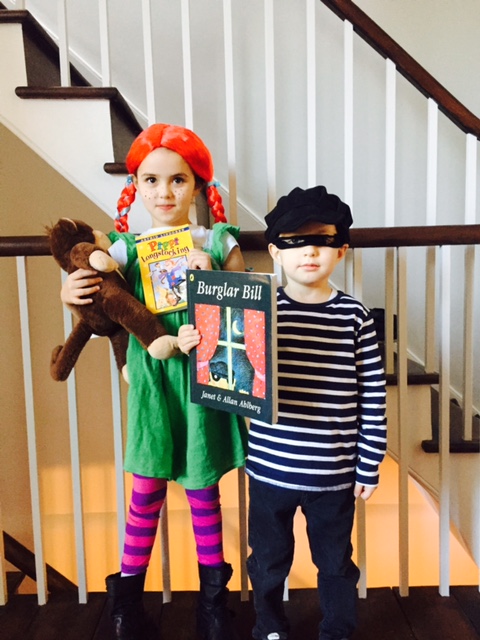
Thought you would like this picture of children dressed up as Pippi Longstocking and Burgler Bill!
One way to promote engagement and learning is to consciously create pauses throughout the day. We can create a sense of spaciousness in our classroom by slowing down the pace of our speech and punctuating our lessons with silence. Introduced well, this practice can improve classroom discourse.
The speed at which we can process information varies from person to person (Droit-Volet, Meck, & Penney, 2007). Some people process auditory information very quickly, while others tend to have more visual or sensorimotor strengths. In any case, when we have more time to process information, the quality of our thinking and learning improves. Younger children require more time to process than do older children, and adults often forget this as they zoom through content as if they were speaking to other adults. No matter what their ages, when we give our students just a little more time to process information, they learn better.
When I introduce this idea to teachers, I often hear concerns that they will be wasting valuable time doing nothing. It’s important to recognize that during the pauses, you and your students are not “doing nothing.” Your students may be considering several alternatives; they may be mulling a picture over in their mind; they may be making associations, comparisons, and contrasts. They may be trying to drudge up the right word from their vocabulary. When we give them this time, their processing becomes richer, deeper, and more abstract. When you rush through a lesson, you may deliver content more quickly and efficiently, but your students may not absorb the content very well, if at all.
The added bonus of these pause punctuations is that they give us as teachers a few moments to practice mindfulness. When this becomes an intentional part of our lessons, we can take the time to notice our body in space, the whole classroom, each student, and the small details that surrounds us, in the present moment. We give ourselves a short break—a micro-vacation from the constant activity of a busy classroom.
We can use the time to tune in to ourselves and our students. We can ask ourselves, “How am I feeling right now? How are the students feeling? What’s happening right now? What do my students need? How can I explain this better?” By taking mindful pauses, we are modeling mindful behavior for our students and letting us all have some time to process the information we are exploring together.
Typically we pause after we ask a question and before we call on someone to answer. Most of the time, this pause is only about one second long. Students who process information quickly are at an advantage under these conditions. They tend to be the ones who always raise their hands immediately. While the speedy students are answering the question, the slower students are still trying to process the question, so they may not hear and comprehend the answer or be able to assimilate it into their existing knowledge. If the quick pace of the session continues, some students may feel left behind.
However, educational researchers have discovered that if the pause between the teacher’s question and the student’s answer lasts between three and five seconds, significant changes occur in student behavior (Rowe, 1987). Students are more likely to respond appropriately to the questions, answer the questions correctly, and offer longer and more complex answers. There are fewer “I don’t know” or non-answer responses. Over time, many more students show higher levels of engagement (Honea, 1982; Swift & Gooding, 1983) and achievement test scores and school retention levels increase (Tobin & Capie, 1982).
Wait time has a positive effect on teachers as well. With conscious use of wait time, teachers’ questioning strategies become more varied and flexible, and they ask follow-up questions that require more complex information processing and higher-order thinking (Casteel & Stahl, 1973; Rowe, 1972; Stahl, 1990; Tobin, 1987).
Robert Stahl (1990) identified eight categories of wait time. When we formally introduce wait time, these periods of silence are trans- formed from periods of awkwardness into valuable moments of silence. The first category is the type of wait time we’ve already discussed: the time between a teacher’s question and the student’s answer. The other seven are as follows:
Within-student’s-response pause time. This is a three-second or longer pause that occurs when a student pauses or hesitates during the process of delivering a response to a teacher’s question. Teachers tend to interrupt students when they are thinking through their answers and take time to pause. However, when given the time, students often follow these periods of silence by successfully completing their responses.
Post-student’s-response wait time. This is a pause after a student has finished a response and other students are considering adding comments or reactions. This gives the other students time to think about what was said and to decide if they have anything to add.
Student pause time. This is a pause after a student has initiated a question, statement, or comment but doesn’t complete the thought. It may seem strange to formalize this type of pause, but this situation arises more often than we might realize because the tendency is to ignore the question rather than allow for a pause. This happens to me a lot. I have a thought, idea, or question. I’m getting ready to tell someone, and my mind goes blank. I can’t remember what I was going to say. When this happens to one of our students, we can give ourselves and the student a little time to recover, rather than just letting it drop.
Teacher pause time. This is a pause that the teacher intentionally initiates to consider what is happening, appraise the situation, and consider the best course of action. A particularly beneficial time for a teacher to pause is when a student has asked a question and the answer requires a complex answer. Taking time to consider how to frame the answer can improve student learning.
Within-teacher-presentation pause time. This is a pause that the teacher intentionally initiates during lecture presentations or other extended periods of content output. The teacher intentionally stops the flow of information to give students three to five seconds of silence to absorb the information and to consolidate their thinking. This type of pause requires no response from the students; it’s simply processing time. Using silence this way, teachers can chunk their content into bite-sized pieces to help students absorb and process the information better.
Student task completion work time. This is pause time intended to allow students to complete an academic task that demands undivided attention. The length of the pause should be related to the time it takes to complete a task. The challenge involved in this type of pause is how to handle the variation in completion time among students. If students learn the value of pausing and some of them finish early, they can use the time to extend their thinking about the subject in some way.
Impact pause time. This is the use of pause time to create impact or drama. When we pause, we can create a mood of anticipation. A dramatic pause can generate feelings of suspense and expectation.
Wait time can be challenging. Many of us get so excited about sharing our own thoughts and ideas that we tend to interrupt students, leaving no space in the discussion for students to process information and respond thoughtfully. In the skill-building practices at the end of this chapter, you will learn more about how to apply wait time in your classroom.
Today, I (Pooja) wanted to share a new online series created by my friend. Curious by international educational reform, her series aims to shed light on the insights and work of “educators who inspire” form around the globe. Her first spotlight introduces us to an educator, Aaron Eden, from the Green School in Bali. Eden is the Director of Entrepreneurial Enterprise Learning at the Green School. Watch the interview and hear Eden’s thoughts on educational reform.
I (Yiola) am excited to share news on a technology conference hosted in the Child Study and Education program at OISE/UT last week. The conference, Technology for Learning, was designed for our first year MA students. To develop the conference, we surveyed the students to better understand their knowledge of technology use in the classroom. We discovered that while most students were users of technology, very few used technology in the classroom and very few were familiar with educational approaches and applications for the classroom. The survey was helpful in developing the structure and content for the conference. We then carefully examined which technology based topics and themes were covered in program courses and from there we decided which areas would be best for the conference.
Students expressed they lacked knowledge in, and seemed most interested in, applied uses of technology in educational settings so we decided to host sessions on: blogging, online literacy, assessment, social media in the classroom, gaming, formal and informal learning sights, coding, assistive/adaptive technologies. For a complete list of the sessions and their descriptions click on the website we designed for the conference here:
Students signed up for the conference via the website and after significant planning, emails and bookings, we were set to go.
Ready for student registration. There were 77 students in attendance.
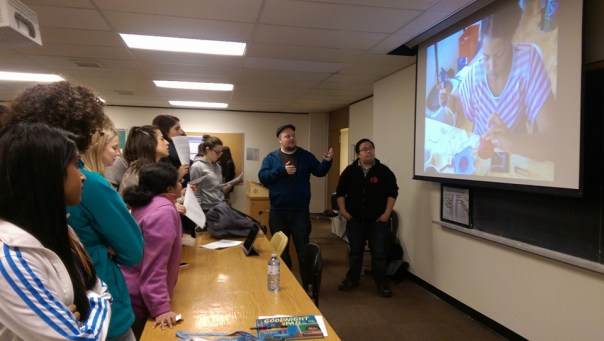
The full day conference included: an introduction, 2 one-hour sessions, lunch break, a 3rd one-hour session, student led poster presentations, Q & A and closure. The introductory session led by myself and Heather (co-designers and hosts) set the stage for the day. I introduced the notion of digital citizenship, its themes and local resources and Heather introduced theoretical frameworks for thinking about technology in education. She shared 3 frames: 1) T-Pack 2) Ed Tech Quintet and, 3) SAMR. Each framework was explained and examples were provided. We left students with the suggestion to select one theme from digital citizenship and one framework that resonated with them and to think about them in relation to the 3 sessions there were about to attend. Here are some pictures from the day:
Director of OISE libraryMonique
Lab School Teacher
Lecturer in Teacher Education
Doctoral Student
Professor from OISE
Teacher from local school board
Doctoral student
We worked hard to include a variety of presenters, from a variety of settings. Included were the Director of OISE library, a lab school Teacher, Professors from the university, a Teacher from the public school board, and Doctoral students.The images above show some of our amazing presenters.
We provided a lunch where the presenters along with Department Chair Professor Earl Woodruff and Program Chair Professor Rhonda Martinussen gathered to share ideas regarding technology for learning.
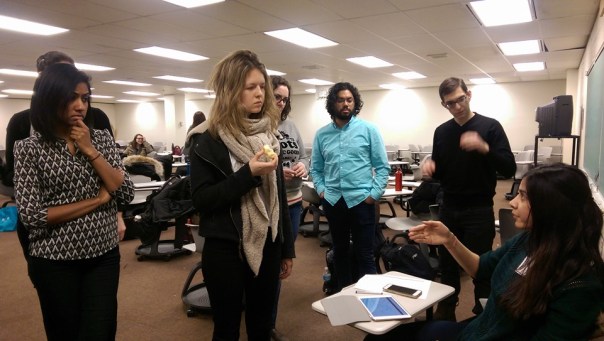
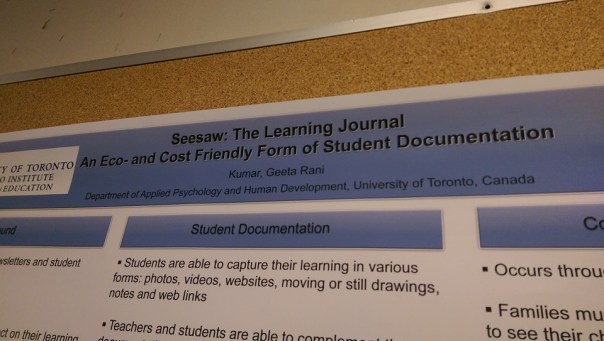
After lunch there was one more set of sessions followed by student-led poster presentations (see images below for student led poster presentations). Students submitted proposals which were reviewed and returned with feedback. The poster presentations provided a wonderful opportunity for students to share their expertise and knowledge in an academic setting. It was a moving and motivational part of the conference.The following 4 images show examples of the student-led poster presentations.
We closed the conference with a Q & A and an unplugging of technology through the fun and fitting picture book “Good night iPad”.
It was a wonderful day. The informal feedback from students has been positive. We plan to send out a post survey about the conference to deepen our understanding of student learning and to improve our own practice in the area of digital literacy teaching. For more information about our conference please feel free to contact us via our blog.
I (Clare) have been involved in a number of discussions re: children and anxiety. I thought I would share with you this upcoming event. For those in the Toronto area you might consider attending.Image_CECflier
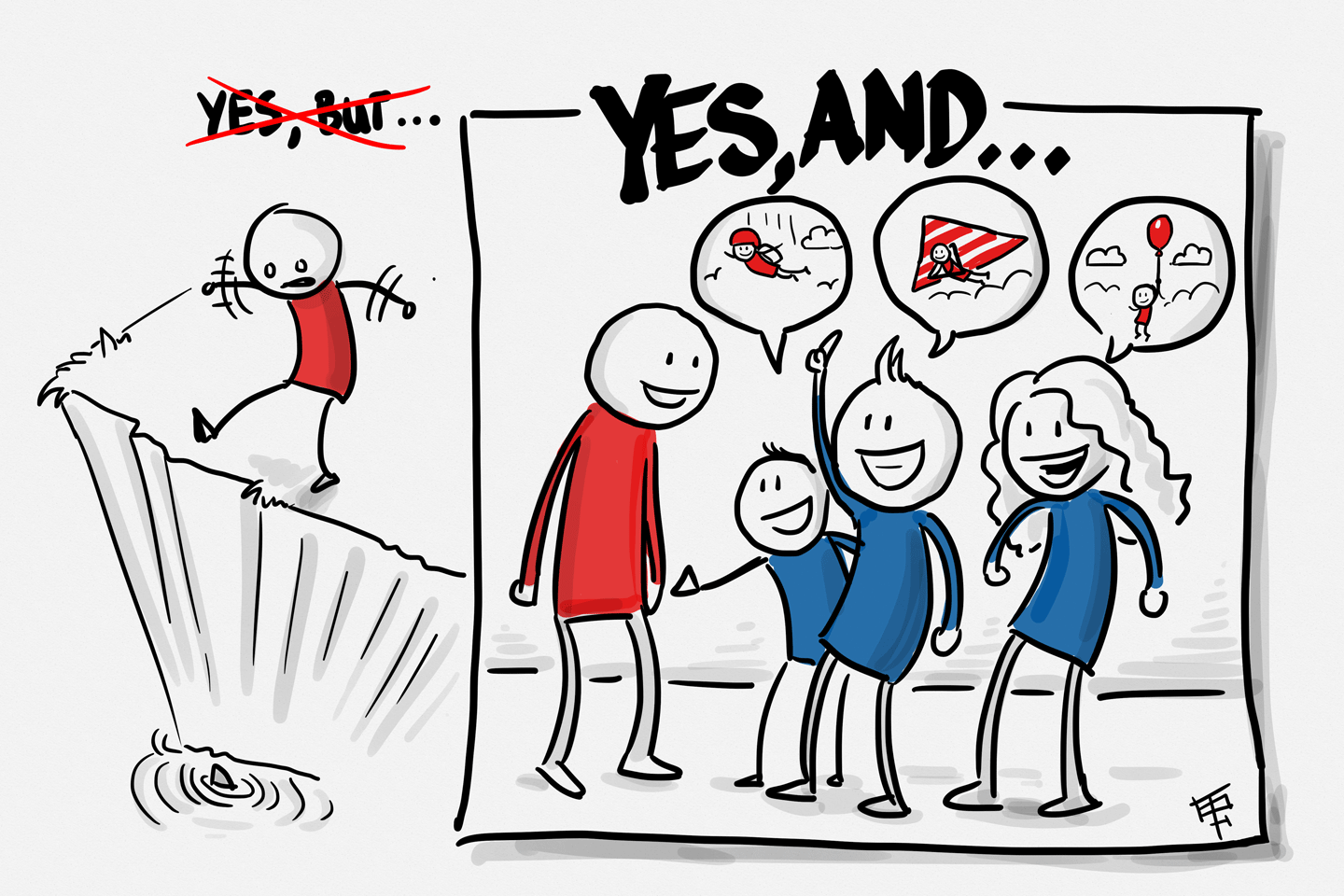
This cartoon reminded me (Cathy) of an incident from when I was teaching grade four. The math problem for the day was:
A man went to bed at 11:00 p.m. and got up at 7:00 a.m. the next day. How many hours did the man sleep?
One of my students just couldn’t figure it out it. He usually didn’t have problems with mathematics, but he just couldn’t “see it”. In an effort to guide him, I told him to draw a clock and count the hours in between 11 and 7.
Sometime later I noticed he was sitting at his desk just staring at his notebook. I walked over to see what he was staring at. This is what he had drawn:
I guess my technology wasn’t matching up with his technology. It’s a constant challenge!
I (Clive) know that self-help books are not everyone’s cup of tea, but given the interest in well-being these days (see Clare’s February 6 posting) they appear to have an important place. Recently I came across a rather impressive one called Rethinking Positive Thinking (Current/Penguin, 2014) by psychologist Gabriele Oettingen.
Oettingen agrees that learning to think positively is essential, but feels that writers on the subject have gone too far. Just focusing on the positive can result in frustration, failure, and un-happiness. As the saying goes, perfection is the enemy of the good. She recommends instead what she calls “mental contrasting,” which involves thinking about both the positive and the negative aspects of a situation, and of life in general.
As well as being helpful at a personal level, Oettingen’s approach seems to me to have application to teaching and teacher education. It supports being realistic about the challenges of teaching – and so not caught off guard by them, as many beginning teachers are – while also reminding ourselves of its many satisfactions and rewards. It calls into question over-the-top government and school district “targets” that promise to “transform” schooling, if only teachers would adopt the latest set of edicts. Mental contrasting can keep us aware of what we need to work on in teaching while taking comfort in the current successes of the profession.
I wanted to share this op-ed piece written by William Doyle, a Fulbright Scholar and author who enrolled his 8-year old son in a rural school in Finland. Throughout his essay, he describes the practices and pedagogies of his son’s fourth grade teacher, Jussi Hietava.
Doyle addresses several trends in educational reform in today’s world, including control, competition, stress, standardized testing, screen-based schools and loosened teacher qualifications and describes how Finnish schools do the exact opposite.
Below is an excerpt from Doyle’s essay. I highly encourage anyone interested in educational reform matters to take a few moments to read the essay in its entirety.
Here, as in any other Finnish school, teachers are not strait-jacketed by bureaucrats, scripts or excessive regulations, but have the freedom to innovate and experiment as teams of trusted professionals. Here, in contrast to the atmosphere in American public schools, Hietava and his colleagues are encouraged to constantly experiment with new approaches to improve learning.
Hietava’s latest innovations are with pilot-testing “self-assessments,” where his students write daily narratives on their learning and progress; and with “peer assessments,” a striking concept where children are carefully guided to offer positive feedback and constructive suggestions to each other.
Link to the op-ed piece: http://hechingerreport.org/how-finland-broke-every-rule-and-created-a-top-school-system/





 Literacy Teaching and Teacher Education