On this site we have shared many of our stories. I (Clare) am happy to share some exciting news. I have been appointed to be the Director of Dr. Eric Jackman Institute of Child Studies at the University of Toronto.
ICS has a tripartite mission to bring together graduate teacher education in a 2-year Master of Arts Program, exemplary educational practices in the Laboratory School, and leading multidisciplinary research in child development at the Dr. R.G.N. Laidlaw Centre.
Faculty, lab school teacher-researchers, and staff are dedicated to setting the highest standards for children’s education and development. By connecting research, training, and practice, Jackman ICS leads the way as Canada’s foremost teaching and learning environment, with an international reputation for leadership.
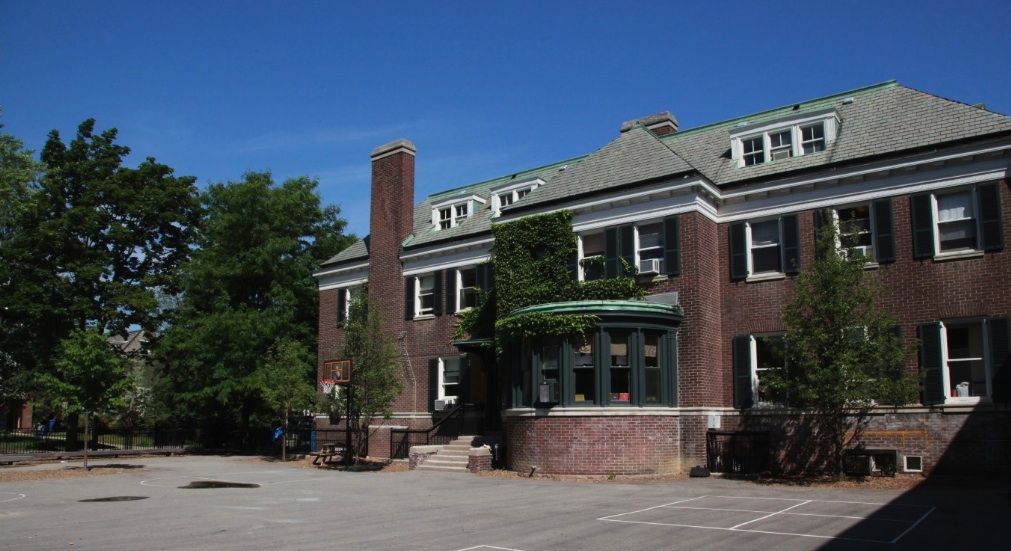
Housed in an old mansion on the university grounds ICS is an outstanding educational institution. There are so many outstanding educators/researchers at ICS including Yiola who is a regular contributor to this blog. By coincidence the principal of the lab school, Richard Messina, is a former student teacher of mine. My appointment begins November 1, 2015.
“A humorous and heartwarming documentary feature, Cyber-Seniors chronicles the extraordinary journey of a group of senior citizens as they discover the world of the internet through the guidance of teenage mentors.” Business Insider
Directed by Saffron Cassady, the idea for the Cyber-Seniors documentary began with a high school project that was launched by two sisters. The sisters had the support of their mom, Brenda Rusnak, who had worked her entire career with seniors. After a successful first year, Brenda helped continue the Cyber-Seniors program, expanding it to a second retirement home and helping to engage more youth mentors. Over the next ten months, Saffron and her film crew captured over 120 hours of footage and many memorable moments. Of this film, the Washington Post reports:
Kerstin Wolgers made it through almost 82 years on this Earth without ever once checking an e-mail, watching a YouTube clip or sending a tweet. But last week, as part of a crash course that introduced her to the Internet for the first time, the former Swedish actress did all three — plus Googled, Instagrammed, Wikipedia-ed, shopped, video-gamed … even online-dated, eventually. “Lots going on here,” she says of Tinder. “It’s really exciting, if you asked me.”
Understanding how significant this program is to the lives of seniors was captured for me (Cathy) in a single moment when I watched one senior weep while he viewed his grandson play the piano via Skype. The differences technology makes in their lives, is remarkable.
Under the Getting Started heading of the web page for this documentary (link below) you can learn how to begin such a project in your community. It also will let you know when the documentary is coming to a theatre near you. Personally, I (Cathy) can’t wait to see it.
Clive and I are off to Australia today. The impetus for the trip was an invitation to speak at the Australian Teacher Education Association Conference in Darwin. The trip then mushroomed to include visiting Clive’s family in Perth, Sydney, and Melbourne. He has lots of family!
Being in education I have long been an admirer of many Australian educators:
Mem Fox (children’s books)
First Steps (literacy program)
Keith Punch (research methodology)
John Loughran (pedagogy of teacher education)
Robyn Ewing (Master of Teaching program at the University of Sydney)
Neil Selwyn (digital technology)
And I love Tim Tams (best cookies) and the new Australian TV series A Place to Call Home (a potboiler of an evening drama).
So while we are on the road we hope to do some blogs about our adventures.
With today being Canada Day it seems fitting to share the news that some uniquely Canadian words, such as dépanneur and inukshuk, were recently added to the Oxford English Dictionary.
Tomorrow Canada turns 148 years old! We are a relatively young country but have plenty to be proud of. Below are some super interesting facts about Canada (as of 2013). Wishing all my fellow Canadians a relaxing, FUN, and warm Canada Day!
This is pride weekend in Toronto. There are a huge number of activities – runs, parades, dinners …. Toronto has truly embraced pride weekend with upwards of 1,000,000 people attending the parade. My (Clare) friend Linda Kooluris Dobbs is an amazing artist and photographer. She is truly a remarkable person:
A native of New Jersey now living more than half her life in Canada, Linda has done extensive work in both painting and photography. She has had many solo exhibitions and has been featured in national and international publications. Her portraits, landscapes, still lifes, limited edition prints and photographs are found in corporate and private collections worldwide.
I (Cathy) was deeply moved by a key note address presented at Maharishi University in Iowa that was captured on Youtube (link below). The convocation address was delivered by funny man Jim Carey who, quite unexpectedly, revealed a rarely witnessed serious and profound side of his personality. During the speech, Carey unveiled a compelling 20 foot-high painting that he claimed took him thousands of hours to complete. He said he was “weeks and weeks alone on the scaffolding” painting the picture. The painting depicted the metaphoric players in our lives (and in our minds) that drag us down or keep us from reaching our dreams (e.g. misery, the party host, the clinger). Carey told the graduates that “painting is one of the ways I free myself from concern. A way to stop the world through total mental, physical, and spiritual involvement.”
Beyond the painting, Carey’s words were also stirring. Carey stated:
“As far as I can tell it’s about letting the universe know what you want and working towards it while letting go of how it comes to pass. Your job is not to figure out how it’s gonna happen for you, but to open the door in your head and when the door opens in real life, just walk through it. And don’t worry if you miss your cue, because there are always doors opening. They keep opening. And when I say life doesn’t happen to you, it happens for you, I don’t really know if that’s true. I’m just making a conscious choice to perceive challenges as something beneficial, so that I can deal with them in the most productive way.”
Cary concluded the speech by challenging the students to choose between fear or love to guide them in their life choices when they left the auditorium.
At AERA this past year, Division K dramatically changed their Business Meeting. Rather than do “administrivia” they used the time to get feedback from teacher educators. In the Division K Summer Newsletter they reported on the feedback. I have copied and pasted some of the report below and included one chart on the most warranted criticisms of teacher educators. Here is the link to the newsletter so that you can read the entire report which provides good feedback for teacher educators. DivKSummer2015-1 Thanks Lin Goodwin our Division K Vice President for moving the discussion forward.
Teacher Educators Talk By: Roxanne Greitz Miller
Division K Program Co-Chair
Chapman University
At our Division K business meeting, we took things to the next level on last year’s theme – Not Business As Usual – and embarked on some original research with the members in
attendance as well additional ones who responded after the meeting electronically. Prior to the meeting, the following questions were posed by our Vice President, Lin Goodwin, as points to consider:
Of the many criticisms leveled against university-based teacher education/teacher
educators, which do you feel is most warranted?
Of the many criticisms leveled against university-based teacher education/teacher
educators, which do you feel is least warranted?
What is one thing you think we should do to address the negative perceptions of university-based teacher education/teacher educators?
During our meeting, attended by 269 people (thank you!), members considered these questions and were able to enter their open ended responses via electronic polling, using either URL or QR code. After the meeting, the URL was distributed to the entire Division K membership for additional participation, and it was posted to our social media links as well. Polls were left open for a week after AERA, and, once closed, the open-ended responses were categorized into common themes and tabulated.
An article in Time Magazine makes an interesting case for why iPads should be left out of the classroom. Author Jervey Tervalon from Los Angeles argues that his school district (and perhaps several others) after spending millions “saw the iPad as a magic talisman that could just about transplant knowledge into students’ brains directly, bypassing teachers.” Through classroom teaching experience, Tervalon understands that “teaching isn’t always efficient. Often it’s messy, and because it’s messy, the process can produce epiphanies, and sparks of creative thinking.”
Tervalon warns that technology isn’t a shortcut to major educational reforms:
“An iPad is an amazing device but it isn’t so amazing without content or the right pedagogical context. School reform isn’t expensive tech and high-stakes testing; it’s the incredibly difficult task of creating highly functioning, transformative educational communities.
And so, this week marks the last week of school for my Sylvia Clare. For those who have read my (Yiola) FDK blog posts you may recall that this year my daughter, Sylvia Clare, attended school for the very first time. As a four year I could only imagine what thoughts and ideas ran through her mind as she entered the big institution of schooling.
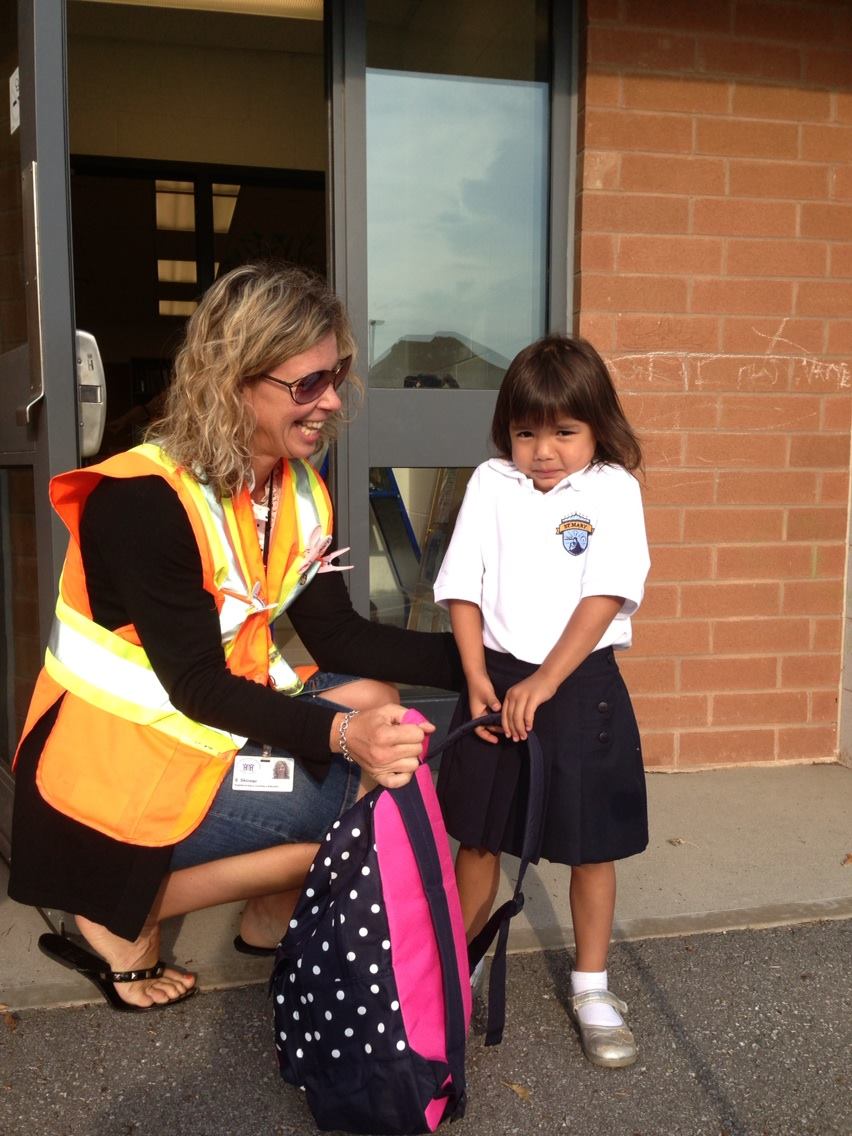
Here is an image of Sylvia Clare on her very first day:
1st day of school. The teacher purposefully crouches to be at the same level as the child — smiles and gentle demeanour go a long way in the early years classroom.
This little human being, with only four years experience in the world, ventured alone into an unfamiliar place with strangers for full day school. How grand is that expectation? I imagine in the mind of my Sylvia Clare it was a significant challenge. And yet, from the first day there was calm and there was success. What is success you ask? From my (a parent’s) perspective it is this: a child who is confident and competent in her environment; a child who is provided opportunities to play, explore, inquire and make decisions about their own learning; and success is when a child is able to manage her day in ways that are comfortable, productive, and enjoyable. This is what full day learning in Junior Kindergarten (JK) means to me. Through this, I have witnessed Sylvia Clare develop skills: critical thinking, creativity, collaboration, and of course literacy skills.
When Sylvia Clare began JK she could not spell her name, she was just learning her ABCs and 123s, and there was no experience with print. Reading was one dimensional, where mommy or daddy read to her. Somehow, by the end of JK, things now are quite different.
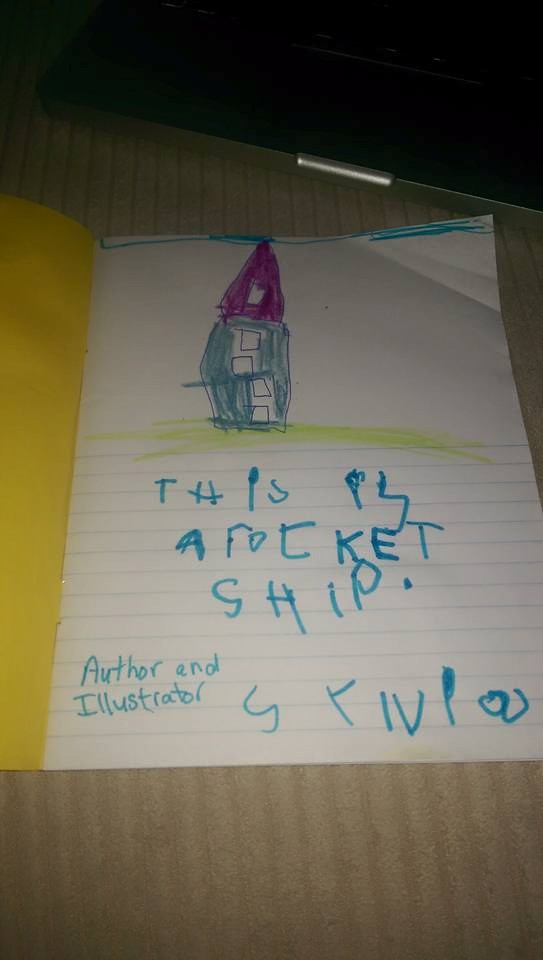
The following example sums up just how much Sylvia Clare has changed. The other other day she stumbled across some of my old school supplies from back when I was a teacher. She helped herself to a journal book and immersed herself in activity. Independently, this is what she produced:
While I was thrilled to see that YES Sylvia Clare understands the beginnings of language, how to write, how to spell, how to produce a sentence, how to tell a story!!! This experience told me so much more about my daughter as a learner: the initiative, confidence, risk, and desire “to do” were even more thrilling for me to witness.
From this simple experience I see the work that has gone into bringing Sylvia Clare to this point. I wish to tell her teachers this:
Thank you for fostering a learning environment that is safe, secure and open for exploration.
Thank you for encouraging Sylvia Clare to speak and to be heard.
Thank you for fostering friendships and encouraging inclusive play in the classroom and the playground.
Thank you for modelling respect and kindness and expecting that from all children in your school.
Thank you for teaching phonemic awareness and for providing direct instruction.
Thank you for listening to Sylvia Clare’s stories about “Old Man’s Lake” and asking her questions.
Thank you for encouraging her sense of invention and creation (I have more cereal boxes than I know what to do with!)
Thank you for using your smart board in ways that enhance students’ awareness of technology and literacy.
Thank you for developing fun games that helped her develop her literacy and numeracy awareness.
Thank you for encouraging Sylvia Clare to sound out words and to try reading books on her own.
Thank you for instilling a love of reading.
Thank you for teaching in ways that are so transparent that Sylvia Clare is able to come home and tell me exactly what she did in school. In fact, she clearly instructs me on what I need to do to have her prepared for the next day!
Thank you for fostering a love and care for the environment. We will be sure to visit “Woody” (the tree) in our local forest.
Thank you for the consistent routines and systematic communication with parents.
Thank you for celebrating my child and every child in the class.
Thank you for caring so deeply about my Sylvia Clare. Your care is evident in her development.
Thank you for working with me to ensure Sylvia Clare is happy, secure, confident, and learning.
You see, teaching literacy is not only about teaching phonics or repetitive worksheets as the proven way to acquire language… or whether direct instruction is proven to increase awareness… without the thoughtful consideration and doing of all of the above, that is the “teaching of children”, something is missing in learning development.
And so here we are, the final week of JK. It has been a remarkable year for Sylvia Clare.
Here is Sylvia Clare during her last week of school with her teachers:
Last week of school- standing tall, Sylvia Clare feels comfortable in hear learning environment.
In the image immediately above, I see comfort and trust. I see calm and happiness. I see a readiness to enjoy a day filled with learning. In my teacher education classes I work hard to share with student teachers the nuances of teachers’ work in order to understand that these elements of school are not innate or simply exist. These elements are crafted with thoughtful consideration on the part of teachers. Our research on literacy teacher educators and on classroom teachers over the years demonstrates these nuances well.
This post present one story, of one child, in her early years schooling experience. It is not the experience of every child. It is, in my opinion, an exemplary experience because of the teachers. We know from research that teachers’ work is the leading factor of student achievement: what teachers plan, do, say, and develop within a classroom often dictates how children experience school and learn. Sylvia Clare’s teachers are an incredible team — and we also know from the research on early years classrooms that the relationship between the teams of teachers is paramount to the success of the program. Teachers, partnerships, pedagogy, and content all come together to form a young child’s experience.
In my final FDK blog post, I want to say, Thank You teachers for bringing all of the above together, for making Sylvia Clare’s (and my) first year of schooling such a wonderful experience. Wishing all teachers and parents and children a wonderful and safe summer holiday.
 ICS has a tripartite mission to bring together graduate teacher education in a 2-year Master of Arts Program, exemplary educational practices in the Laboratory School, and leading multidisciplinary research in child development at the Dr. R.G.N. Laidlaw Centre.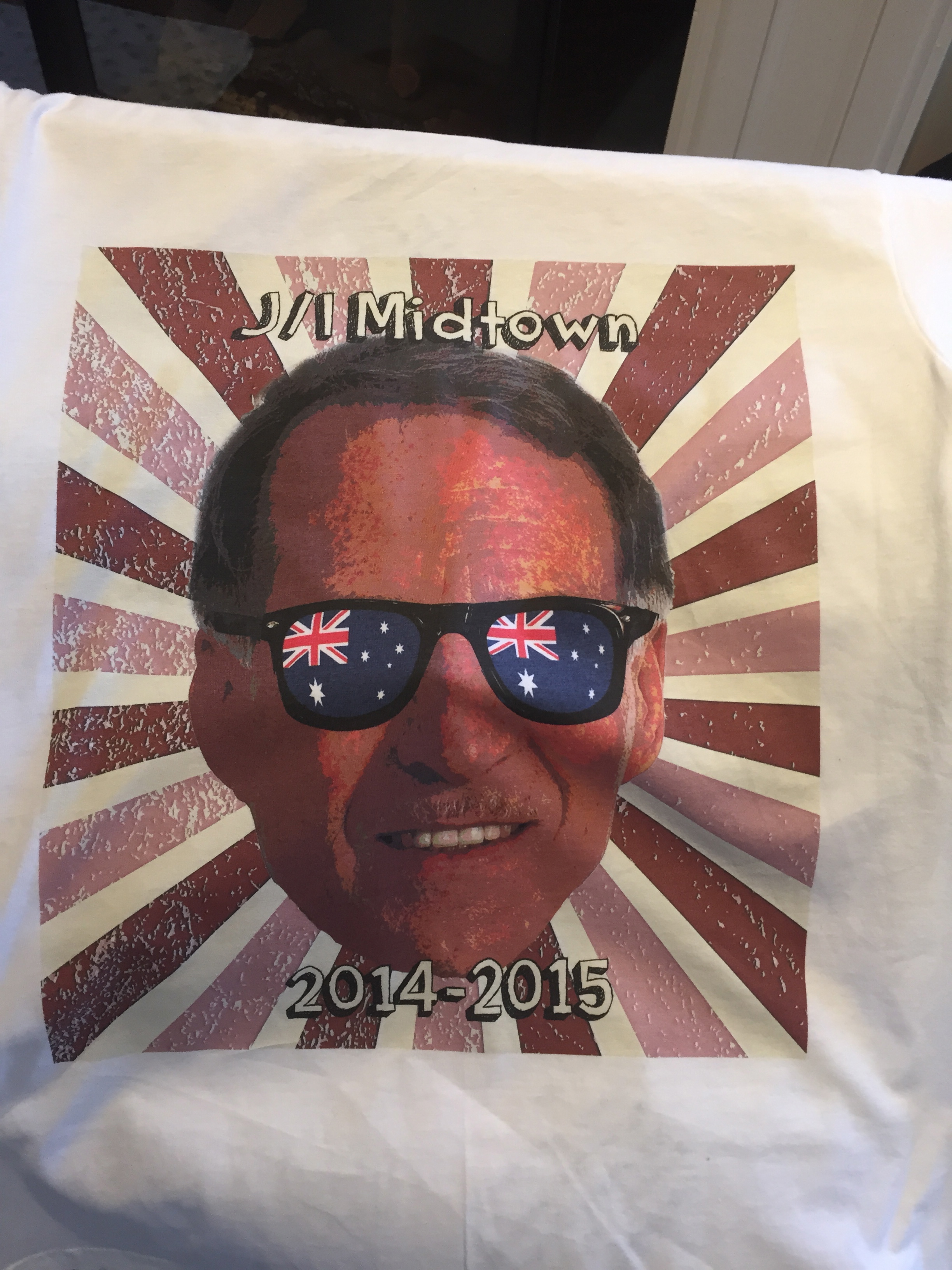






 Literacy Teaching and Teacher Education