Mapping the Word

I watched an interesting Ted talk in which cognitive scientist and MIT researcher Deb Roy explains how he wired his house with video cameras to capture the rich details of his son’s language development. A complex motion analysis was applied to the 90,000 hours of video to map out how his son’s social interactions within different domains of the home informed his language development. Roy describes how the analysis revealed the scaffolding of language learning:

“Every time my son would learn a word, we would trace back and look at all of the language he heard that contained that word…And what we found was this curious phenomena, that caregiver speech would systematically dip to a minimum, making language as simple as possible, and then slowly ascend back up in complexity. And the amazing thing was that bounce, that dip, lined up almost precisely with when each word was born — word after word, systematically. So it appears that all three primary caregivers — myself, my wife and our nanny — were systematically and, I would think, subconsciously restructuring our language to meet him at the birth of a word and bring him gently into more complex language. And the implications of this — there are many, but one I just want to point out, is that there must be amazing feedback loops. Of course, my son is learning from his linguistic environment, but the environment is learning from him. That environment, people, are in these tight feedback loops and creating a kind of scaffolding.”

Link to the Ted Talk:

www.ted.com/talks/deb_roy_the_birth_of_a_word

Deb Roy

Using Improvisation Techniques in the Classroom

Image source: Mindshift.org

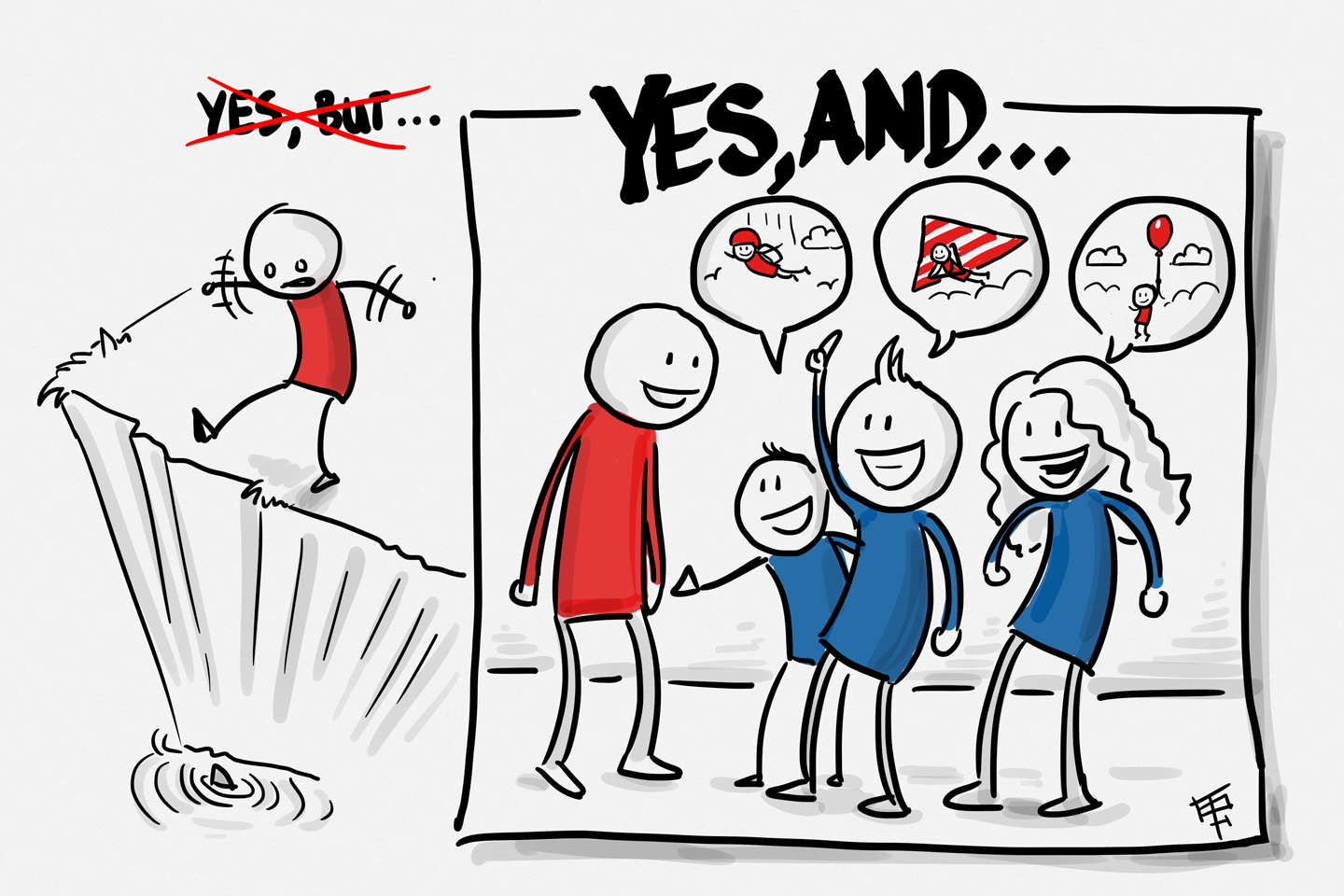
I’ve been to a few improv shows in my life, and whenever I walk away I am always in total awe of the performers. Their ability to think on their feet AND be funny while doing it is so impressive. That’s why when I came across the idea of using improv techniques in the classroom I was intrigued. Linda Flanagan from the blog Mindshift describes how the four pillars of improv(creativity, critical thinking, collaboration, and communication) are developed by following one simple rule: “Yes, and…” This means that any idea or suggestion is welcomed without judgment. This unconditional support helps improv students overcome fears and act without inhibition. It is no wonder why many educators are using tenets of improv in their classrooms.

Flanagan says:

Improv enthusiasts rave about its educational value. Not only does it hone communication and public speaking skills, it also stimulates fast thinking and engagement with ideas. On a deeper level, improv chips away at mental barriers that block creative thinking — that internal editor who crosses out every word before it appears on a page …

 The article suggests both beginner and experienced improv activities for teachers of all levels to try. Read the link below to find out more:

http://blogs.kqed.org/mindshift/2015/01/how-improv-can-open-up-the-mind-to-learning-in-the-classroom-and-beyond/


Dewey meets Delpit: Bringing theory to life in teacher education

Last week I (Yiola) tried something in my teacher education course that was less safe. I brought together divergent theorists,  multiple contexts and eras and encouraged practicum connections in ways that are not typical.  I was unsure of the outcome: would the student teachers understand? connect? appreciate? Just as I encourage our students teachers to take risk, I took a risk in hope new understandings, connections and realizations about teaching and learning would occur.  At the end of class students applauded… when does that ever happen? The comments and reactions at the end of class indicate that students appreciated the class content and left class with much to think about.

I have recently re-read Dewey’s Education and Experience (1938) and was inspired to share the ideas with my class, namely what is miseducative practice? And how do traditional and progressive models of education play out in classrooms today? We discussed how both models are quite transparent in today’s classrooms. We also explored Dewey’s recommendation of a theory of education that is based on a philosophy of experience. Student teachers felt that the notion of experience is now more commonly understood and a desired practice in teaching. We discussed how finding a coherent theory of education based on a philosophy of experience would require transcending the notion of “either/or” traditional or progressive models and moving into integrative reasoning. So this is all quite typical… and then I introduced Delpit.

In Delpit’s work Other People’s Children  (1988) Delpit described herself as “a product of skills-oriented approach to writing and a teacher of process oriented approaches”.  Her amazing chapter, The Silenced Dialogue,  illustrates Dewey’s request to have educators think deeply about the either/or debate between models of education and the implications of our practice on student learning. Delpit explains the following about her chapter, “My charge here is not to determine the best instructional methodology… Rather, I suggest that the differing perspectives on the debate over “skills” versus “process” approaches can lead to an understanding of the alienation and miscommunication, and thereby to an understanding of the “silenced dialogue”… this is precisely what Dewey asked of us fifty years prior, that as educators we must go deeper than thinking across methods; we must use a philosophy of experience to deepen our understanding of the best ways to teach children. For Delpit, the experiences are those of Children of colour and children who experience poverty.

Exploring Dewey’s concepts through the lens of power and Delpit’s context of literacy was remarkable. The process of grounding Dewey’s theories in Delpit’s work provided grounding for both scholars in ways that I wasn’t yet unprepared. Students were excited to talk about a philosophy of experience by looking as social context as a foreground for understanding models of education; for understanding why certain methods may work well and not well and how to move our practice forward so all students are not only learning but are successfully learning in ways that are empowering them.

The final layer of discussion in class was to connect the ideas to their own placements. To tell stories of methodological challenge and to explore how to address those challenges thinking about what Dewey suggests and what Delpit illustrates. Again, students were speaking in detail on the gaps and the glories in their classrooms and schools.  The result of this class: discussion sophisticated and practices validated.

We finished the discussion by reading aloud the last paragraphs of Delpit’s chapter; as a reminder of the enormous but yet delightful task we have as teachers if we truly wish to create learning for all:

We must keep the perspective that people are experts in their own lives. There are certainly aspects of of the outs tide world of which they may not be aware, but they can be the only authentic chroniclers of their own experience. We must not be too quick to deny their interpretations or accuse them of “false consciousness”…And finally, we must be vulnerable enough to allow our world to turn upside down in order to allow the realities of others to edge themselves into our consciousness…  

By doing what Delpit suggests and with keeping Dewey’s foundational perspectives in mind we as teachers can begin to understand how models work in classrooms.

Buried in Acronyms

Hi, I (Cathy) am the new T&LC in CTL, working in FD at SC.  Today I will be exploring ULD in the TLA.  Yesterday I had a meeting with the BBAs from PSOB.   I am now a member of OPSEU and CAAT.  I look forward to working with FAST, FAAD, FAHCS, FHASS, and FCAPS.

Lost?  Welcome to my world.  Last month I started  a new position in HE.  I love the people, the work and the institution.  What I am struggling with are the acronyms.  OMG.  If you think texting is bad, try starting a new position in a new institution.  Everyone talks in code.  During my first week as a new hire, I was given a cheat sheet of common internal and external acronyms to learn.  I had my husband drill me on these so I could learn them right away and feel comfortable in meetings.  Ah, no.  I leave every meeting with a list I have composed that were not on my original list.  Everyday I experience new discourses, practices and social norms.  Enculturation is tiring.  I feel as though I am living my research on new literacy practices.  Yesterday an employee asked me what faculty I was in and I answered ” TLC” instead of  “CTL” and he never even blinked.  Was he just being polite or do we have a faculty called TLC?  I wonder.

If you would like to know what my new position is and where I work now, just check the cheat sheet below.   I’ll let you know in a month how I’m doing with my acronyms.

T&LC – Teaching and Learning Consultant                                                                                                       CTL- Centre for Teaching and Learning                                                                                                           FD- Faculty Development                                                                                                                                      SC- Sheridan College                                                                                                                                              ULD-Universal Learning Design                                                                                                                            TLA – Teaching and Learning Academy                                                                                                .  BBA-Bachelor of Business Administration                                                                                                      PSOB- Pilon School of Business                                                                                                                       OPSEU- Ontario Public Service Employees Union                                                                                       CAAT-Colleges of Applied Arts and Technology                                                                                             FAST – Faculty of Applied Science and Technology                                                                                   FAAD- Faculty of Animation, Arts and Design                                                                                           FAHCS- Faculty of Health and Community Services                                                                                 FHASS – Faculty of Humanities and Sciences                                                                                               FCAPS- Faculty of Continuing and Part Time Studies

Education in Two Worlds: David Berliner Tells Arne Duncan How to Do Teacher Education Right (by David Berliner)

I (Clare) found an amazing site National Education Policy Center. They collect blogs on a range of topics: http://nepc.colorado.edu/blog

Here is a fabulous posting about teacher education by David Berliner and Gene Glass. I think you will find their analysis and insights interesting. http://nepc.colorado.edu/blog/david-berliner-tells-arne-duncan

Improving Teacher Education

Secretary of Education Arne Duncan and the Obama administration want to improve teacher education. Me too. I always have. So I went to the president of the university I was then working at and showed him university data that I had collected. I informed him that a) we were running the cheapest program on campus, even cheaper to run than the English Literature and the History programs; and b) that some of our most expensive programs to run, computer science and various engineering programs, produced well-trained graduates that left the state. But teachers stayed in the state. I told my president he was wasting the states resources and investing unwisely.

I told him that with the same amount of money as we spend on the students that leave the state I could design one year clinical programs so every teacher does clinical rotations in the classrooms of schools with different kinds of students, rotations modeled on medical education.

I said more money was needed to pay the teachers recognized as expert, say Board certified teachers, so I could place teachers in training to observe the regions’ best teachers. I said that more money would also allow me to design video labs for viewing great teaching and for doing micro-teaching so that future teachers could experience, in safe environments, how to teach. In such micro-teaching classroom they would receive feedback on how they taught from the students they just taught and from supervisory teachers who work in the laboratory. I modeled my proposal for a lab on the then newly outfitted kinesiology laboratory of which the university was quite proud.

I said that more money would allow me to buy a five bedroom house in the lowest income community and have teachers who volunteered to spend two weeks there under the tutelage of the communities leaders — their priests and ministers, their concerned parents, the social workers there. The teachers would be the guests of the community and we would pay the community leaders to feed the teachers, to take them on tours around the neighborhoods so they can learn about the strengths of these communities, not their deficits.

I said more money would allow me to provide a one-year support system for all new teachers placed in our region. The support would be provided by clinical professors of practice that visited each new teacher from our university about every ten days. Their job would be to help the new teachers emotionally (teaching requires a great deal of emotional labor), to help them schedule time (teaching requires enormous time commitments) and to provide instructional support. I estimated that would cut the rate of teachers leaving the profession by half. A savings of significant amounts of state and local monies.

The president listened to my proposal and when I was through, he politely threw me out of his office! Charles Baron policy director for Democrats for Education Reform, quoted in the New York Times said it well: “I think you need to wake up the university presidents to the fact that schools of education can’t be A.T.M.s for the rest of the college or university.” Although so much is wrong with the policy recommendations of Democrats for Education Reform, in this case they sure have it right!

 

Questioning the Benefits of Toddlers’ Digital Technology Use

Researchers at Boston University School of Medicine suggest toddlers’ overuse of mobile digital technologies could hinder their social-emotional development. While the researchers recognize “that educational apps on smartphones and tablets may facilitate some academic skills for children” they voice concern that the extended use of such technologies by toddlers could displace valuable play-based interactions. The researchers point out that “toddlers younger than two years are known to learn best via hands-on exploration of their physical world.” Their commentary published in the journal of Pediatrics reviews  existing literature, examines future research directions, and suggests preliminary guidelines for families. What are your thoughts on this topic?

Link to CBC article: http://www.cbc.ca/m/news/topstories/toddlers-overusing-mobile-tech-may-stunt-development-1.2940848

What counts as a “real” word?

Last week Clare shared a TED talk exploring how texting is affecting language (If you haven’t read that post, here it is: https://literacyteaching.net/2015/01/22/txtng-is-killing-language-jk/ ). In a follow-up to her blog post, I am sharing another fascinating talk on “What Makes a Word Real?”

English Professor, Anne Curzan, poses questions to the audience which intend to challenge what makes a word “real” and who gets to decide. She asks: “Who writes dictionaries?”; “Are you bothered by language change?”; and “Who has the authority to make a world real?”

Curzan believes words are made “real” when a “community of speakers” use a word often and for a long time. She makes the point that these words “fill a gap” in the English language. Funny examples of words she’s seen gain traction recently:

                    Screen shot taken from TED Talk

Curzan argues dictionaries have been viewed as a book of truths not to be critiqued for too long. In fact, she points out that dictionary editors look to us to decide what words are “real.” In conclusion, she states:

 “Dictionaries are a wonderful guide and resource, but there is no objective dictionary authority out there that is the final arbiter about what words mean. If a community of speakers is using a word and knows what it means, it’s real. That word might be slangy, that word might be informal, that word might be a word that you think is illogical or unnecessary, but that word that we’re using, that word is real.”

TED Talk Link:

Sue Dymoke: Making Poetry Happen

I (Clare) am happy to share news of a newly published text by Sue Dymoke: Making Poetry Sue DymokeHappen. (Sue is pictured with her new text.) I was lucky to review this text and here is my endorsement. This is an outstanding collection that gives voice to teachers and students as they meet poetry. It is essential reading for those who want to make poetry happen. An invaluable resource for new and experienced teachers, reading this text will change how you approach poetry. Rarely have I read a book that is so transformative. will become a classic.

Here is a link to an interview with Sue Dymoke.http://www.nottinghampost.com/Making-poetry-open-book/story-25887273-detail/story.html

  Making Poetry HappenFor those of you who are literacy/English teacher educators or classroom teachers I highly recommend this text. I learned a huge amount and thoroughly enjoyed every chapter. The stories written by teachers and academics are inspiriting and informative. I used some chapters with my student teachers who felt transformed. Many said they had never experienced poetry this way. Here is a link to Bloomsbury Publishers: http://www.bloomsbury.com/uk/making-poetry-happen-9781472510266/

Phoning vs Texting

I (Cathy) really like texting.  The post Clare shared with us last week entitled Texting is Killing Language really rang true for me.  It is a wonderful tool of communication.  My own children will text me regularly in lieu of using the phone.  Usually it’s fun, definitely like passing a note in class.  However, it also has its limits.  When should someone use a phone instead of a text message?    Following is a texting conversation between myself and my son while I was away on vacation…

in emerg

Y?

anorism?

CALL ME

Interesting how the  simplistic message spoke volumes and was loaded with emotion, yes? I have been told repeatedly not to use CAPS, because it is the equivalent of shouting.  In this incident I felt perfectly justified.

This incident reminded me of Hemmingway’s six word novel:

Baby shoes

For sale

Never worn

We can say sooo much with so little and texting is the perfect tool for this- within limits

Btw, number one son is fine.  Wasn’t an aneurysm- thank goodness.  But, I nearly had a heart attack while waiting for the call.  Sometimes, texting just isn’t enough, at least not for this mom.