Tag Archives: 21st century communication

Digital Technology Tools for the Classroom

Popular educational website Mindshift compiled a list of useful technology tools for the classroom. I have heard/used a few of the tools identified, however most are new to me. The article describes how these tools can be useful for social studies classrooms, but I think most tools can be used across a variety of subjects.

Below are a few I am most interested in exploring:

Screen Shot 2015-06-01 at 6.58.59 PM

Screen Shot 2015-06-01 at 6.59.08 PM

Screen Shot 2015-06-01 at 6.59.25 PM

Screen Shot 2015-06-01 at 7.01.16 PM

Read entire article here: http://ww2.kqed.org/mindshift/2015/05/21/favorite-tech-tools-for-social-studies-classes/

Mining Social Media

A recent CBC news article caught my eye because it highlighted how researchers, in fields such as psychology and computer science, are increasingly mining social media (e.g. Tweets; Facebook profiles) to gain insight into people’s physical and mental health. The article questioned if this method of data mining represents a means to conduct “personality research, without talking to any actual people.”  Computer scientist Michal Kosinski, from Stanford University, points out that “by looking at your Facebook profile or your Twitter feed, we can very accurately predict very intimate traits that you may not be aware you’re revealing.” How do you feel about this type of research – does it represent an innovative approach to health research or an invasive monitoring of our online space?

Link to article: http://www.cbc.ca/news/health/what-facebook-twitter-posts-reveal-about-your-health-1.3000893

SocialMedia

Critically Reading Selfies

selfie

The term ” Selfie” was officially added to the Oxford Dictionary in 2013. People all around the world have been turning their phone camera around to capture themselves in a moment. Many people believe that our selfies reveal a lot about us. It is for this reason Professor Marino from University of Southern California has created an assignment for his students to critically read their selfies. His assignment is titled Know Thy Selfie 🙂 Marino believes that selfies help us analyze our identities because “each selfie bears information that can be used  to read our identity  characteristics: our race-ethnicity, gender, sexuality, and socio-economic status.”

The Assignment:

Write a thesis-driven essay in answering the prompt:

How do your selfies produce or obscure a sense of your identity?

1. Take or choose 5 selfies of yourself. You may be alone or with another person, but try to make sure you are a central and large part of the photo. All of the selfies should be different.

2. Examine your selfies for your performance of
Race-ethnicity
Socio-economic staus
Sexuality
Gender

3. Consider these identity characteristics independently and as they intersect.

Some questions for reflection as you prepare your response.

What in your selfies is accurate?
What is obscured or ambiguous?
Does the image portray one identity trait more than others?
Where do the images place you in the spectrum of possibilities for each characteristic trait — for example, more or less feminine or masculine?
How might different audiences perceive the images differently?
How is the viewer addressed in the image?
How do your selfies play off other well-known images? How do they play off each other?
What is the apparent context of this image? How does that affect how it might be read?

Read more about ‘Know Thy Selfie’ assignment here:

View at Medium.com

Dewey meets Delpit: Bringing theory to life in teacher education

Last week I (Yiola) tried something in my teacher education course that was less safe. I brought together divergent theorists,  multiple contexts and eras and encouraged practicum connections in ways that are not typical.  I was unsure of the outcome: would the student teachers understand? connect? appreciate? Just as I encourage our students teachers to take risk, I took a risk in hope new understandings, connections and realizations about teaching and learning would occur.  At the end of class students applauded… when does that ever happen? The comments and reactions at the end of class indicate that students appreciated the class content and left class with much to think about.

I have recently re-read Dewey’s Education and Experience (1938) and was inspired to share the ideas with my class, namely what is miseducative practice? And how do traditional and progressive models of education play out in classrooms today? We discussed how both models are quite transparent in today’s classrooms. We also explored Dewey’s recommendation of a theory of education that is based on a philosophy of experience. Student teachers felt that the notion of experience is now more commonly understood and a desired practice in teaching. We discussed how finding a coherent theory of education based on a philosophy of experience would require transcending the notion of “either/or” traditional or progressive models and moving into integrative reasoning. So this is all quite typical… and then I introduced Delpit.

In Delpit’s work Other People’s Children  (1988) Delpit described herself as “a product of skills-oriented approach to writing and a teacher of process oriented approaches”.  Her amazing chapter, The Silenced Dialogue,  illustrates Dewey’s request to have educators think deeply about the either/or debate between models of education and the implications of our practice on student learning. Delpit explains the following about her chapter, “My charge here is not to determine the best instructional methodology… Rather, I suggest that the differing perspectives on the debate over “skills” versus “process” approaches can lead to an understanding of the alienation and miscommunication, and thereby to an understanding of the “silenced dialogue”… this is precisely what Dewey asked of us fifty years prior, that as educators we must go deeper than thinking across methods; we must use a philosophy of experience to deepen our understanding of the best ways to teach children. For Delpit, the experiences are those of Children of colour and children who experience poverty.

Exploring Dewey’s concepts through the lens of power and Delpit’s context of literacy was remarkable. The process of grounding Dewey’s theories in Delpit’s work provided grounding for both scholars in ways that I wasn’t yet unprepared. Students were excited to talk about a philosophy of experience by looking as social context as a foreground for understanding models of education; for understanding why certain methods may work well and not well and how to move our practice forward so all students are not only learning but are successfully learning in ways that are empowering them.

The final layer of discussion in class was to connect the ideas to their own placements. To tell stories of methodological challenge and to explore how to address those challenges thinking about what Dewey suggests and what Delpit illustrates. Again, students were speaking in detail on the gaps and the glories in their classrooms and schools.  The result of this class: discussion sophisticated and practices validated.

We finished the discussion by reading aloud the last paragraphs of Delpit’s chapter; as a reminder of the enormous but yet delightful task we have as teachers if we truly wish to create learning for all:

We must keep the perspective that people are experts in their own lives. There are certainly aspects of of the outs tide world of which they may not be aware, but they can be the only authentic chroniclers of their own experience. We must not be too quick to deny their interpretations or accuse them of “false consciousness”…And finally, we must be vulnerable enough to allow our world to turn upside down in order to allow the realities of others to edge themselves into our consciousness…  

By doing what Delpit suggests and with keeping Dewey’s foundational perspectives in mind we as teachers can begin to understand how models work in classrooms.

What counts as a “real” word?

Last week Clare shared a TED talk exploring how texting is affecting language (If you haven’t read that post, here it is: https://literacyteaching.net/2015/01/22/txtng-is-killing-language-jk/ ). In a follow-up to her blog post, I am sharing another fascinating talk on “What Makes a Word Real?”

English Professor, Anne Curzan, poses questions to the audience which intend to challenge what makes a word “real” and who gets to decide. She asks: “Who writes dictionaries?”; “Are you bothered by language change?”; and “Who has the authority to make a world real?”

Curzan believes words are made “real” when a “community of speakers” use a word often and for a long time. She makes the point that these words “fill a gap” in the English language. Funny examples of words she’s seen gain traction recently:

                    Screen shot taken from TED Talk

Curzan argues dictionaries have been viewed as a book of truths not to be critiqued for too long. In fact, she points out that dictionary editors look to us to decide what words are “real.” In conclusion, she states:

 “Dictionaries are a wonderful guide and resource, but there is no objective dictionary authority out there that is the final arbiter about what words mean. If a community of speakers is using a word and knows what it means, it’s real. That word might be slangy, that word might be informal, that word might be a word that you think is illogical or unnecessary, but that word that we’re using, that word is real.”

TED Talk Link:

The Most Popular Teacher Tools Used in 2014

As regular readers of this blog know, I (Clare) am very interested in using digital technology. Although I am not a techie I am always keen to learn more.  The fabulous website Edudemic has a great list of the top technology tools for 2014.  Very interesting and informative. I thought I would share it with others. The article can be found at: http://www.edudemic.com/10-popular-teaching-tools-2014/

By Edudemic Staff on December 11, 2014

Last year, Edudemic published a list of the most essential and popular educational tools used in modern classrooms across the globe. While many of 2013′s contenders retain top spots for 2014, there are a few new and noteworthy tools that made it onto this year’s list, and some of last year’s mentions have shifted in the rankings. We highly recommend taking a look at these “battle-tested” teaching tools; some of them may be a perfect fit for your modern classroom.

1. Google Apps for Education

Google World
Image via Flickr by topgold

It’s no surprise that Google once again reigns supreme. Google claims that more than 40 million students and educators use its suite of free apps. And why wouldn’t they? Google Apps for Education include tools like Google Docs, which helps student and teachers collaborate, and a calendar that helps students and teachers stay organized. The customizable security settings lend peace of mind, and it’s all ad-free. This suite of tools retains its top-dog position from 2013, thanks to its utility and because it continues to be so wildly popular with educators on a worldwide scale.

2. Twitter

Twitter stays planted firmly in its number two spot primarily because it has evolved into a legitimate place for growing a personal learning network (PLN) among educators. More and more teachers, in fact, are realizing just how handy this social network is when it comes to stimulating thought-provoking discussions. Educator Chris Bonke, whose story appeared on The Atlantic’s website, says he initially hesitated to use Twitter for his Freshman English class at North High School in Downer’s Grove, Illinois. However, Bonke explains that he found it helped his students engage in conversation about their assigned reading material.

3. YouTube

What student wouldn’t choose to watch YouTube rather than read a textbook? This video-sharing platform is a universe in itself, with myriad channels that can help educators. Among the most popular channels that are bound to capture students’ attention is Shots of Awe, which presents fascinating facts about a range of scientific topics. For its ever-growing usefulness, YouTube moved up a spot in the rankings from last year’s list.

4. Edmodo
ImageEdmodo
Image via Flickr by espiche

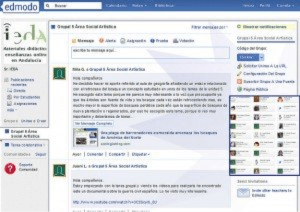
Edmodo, like Google, boasts more than 40 million members. This all-in-one learning platform gives teachers the power to easily schedule homework and assignments, read about the latest trends in education, network with other teachers, and monitor student progress. The best part? Unlike other industry-leading learning management systems, Edmodo is free. Last year, Edmodo came in at number seven, but its booming popularity has secured the number four spot in 2014.

5. Remind

The most popular upstart to break into this year’s list is Remind. One in four teachers use the app, according to a recently published article by NPR. “Think of it as a combo of sticky note and class newsletter for the digital age,” writes nprED reviewer Elissa Nadworny. “Remind allows teachers to send messages — via email, cellphone, iPad or Android device — to an entire class with the push of a button.” Businessweek says that about one million teachers and 17 million students and parents use Remind. The app is particularly popular in Texas, Georgia, and Alabama, where between 40 and 50 percent of teachers use it. Remind is a newcomer on our list of popular teaching tools, but its star is clearly rising.

6. WordPress (and other Blogging Software)

Last year, WordPress came in at number nine on our list, but this year we moved this platform (and all of its associated blogging tools) to the number six spot because of its value to educators. Teachers can start a classroom blog that all students can contribute to; this encourages them to think deeply about what they are learning and engage in discussions. It also serves as a fun way to help them hone their writing skills.

7. Evernote

Evernote proudly points out that it has more than 100 million users. A good number of those users are teachers. They make use of the app to share information with students and substitute teachers, organize lesson plans, and jot down ideas. The tags and reminders features can help you stay on schedule and on top of all your material. Last year, Evernote came in at number five on the list, and the only reason it dropped a few places is because there are so many other awesome teaching tools that merit a mention. See Edudemic’s recent walkthrough on using Evernote to build student portfolios to get an idea of this tool’s potential for your classroom.

8. EDpuzzle

ImageEDpuzzle
Image via edpuzzle.com

EDpuzzle is another newcomer on the list, and its spot is well-deserved, thanks to its ability to transform any video into a real lesson. With EDpuzzle, you can add your voice to videos or even insert questions. You can also search for useful videos across multiple platforms including YouTube and LearnZillion. If you want your students to slow down and digest the material, you can disable skipping on a video.

9. Easel.ly

Easel.ly is a relatively new tool; it stepped onto the scene in 2012, and since then, it has welcomed more than 300,000 users. This free gem lets you create custom infographics. Whether you want to break down a complex idea using charts and images or just want to highlight some main points, Easel.ly lets you do it — well, easily. As Easel.ly continues to evolve, we wouldn’t be surprised to see it climb a few spots on this list.

10. Dropbox

Dropbox is another cloud storage service that gives you easy access to your documents at any time and any place. All you have to do is drag a file or folder into Dropbox, and it syncs across all your devices. Even though it was number six on our list last year, this app has fallen to the 10th spot because Google Drive has usurped much of its functionality.

Honorable Mentions

The following are some teaching tools that we showcased on last year’s list. They still have undeniable value to educators, but were bumped off the list because they’ve become more stagnant in popularity than the exciting newcomers that have supplanted them:

  • Skype: This communication service lets you collaborate with colleagues or students around the world. Skype took the number three spot on last year’s list.
  • Socrative: Socrative came in at number 10 last year. It is a platform that encourages student discussion by allowing teachers to create assessments and activities and keep an eye on how students perform.
  • Class Dojo: This app was in the number eight spot on last year’s list. It is a perfect fit for elementary school classrooms because it lets you instantly reward good behavior and point out less-than-ideal behavior. A little more than 2 million teachers use Class Dojo.

We don’t blame you if all the teaching tools available to educators leave you feeling a tad overwhelmed. Try them out one at a time and see what works for your classroom!



Texting at the Table

Below is a link to a vignette that  really struck a chord with me (Cathy).  There is a lot to learn about the etiquette of texting.  According to Maralee McKee, “out attention is a gift.”

McKee also says,

Our full attention is the foundation of every kindhearted, other-centered interaction. Texting alters the continuity, focus, and momentum of our encounters.

It produces anxiety (mild to severe) in the other person, and whether they’re telling you (or even aware of it themselves) or not, they’re attention is apt to desire to focus on someone who pays them back equally.

These are big matters.

If we’re not being careful, texting can hurt our family, our friendships, our business relationships, even our ability to govern.

http://www.mannersmentor.com/only-at-work/seven-ways-to-text-with-graciousness-and-savvy

In the vignette a father makes his point to his sons the ‘old fashaoined way’.  Enjoy.

http://faithtap.com/2114/dad-asks-pass-the-salt-while-sons-text/


Using Instagram in the Classroom

They say a picture is worth a 1000 words. That is probably one of the reasons why Instagram has become my social media app of choice. I love the simplicity of it. There are no words, simply photos. You get to see what your friends, acquaintances, and public figures (you choose to follow) are up to. My use of facebook has slowly dwindled while my use of Instagram has quickly ramped up. This seems to be the general trend across the world. As educators in this digital age, we think about how to integrate social media effectively into the classroom. Facebook, wikis, blogs and twitter have made their way into many classrooms; however, Instagram is rarely used. I found this very cool infographic for educators and the use of Instagram in the classroom.

All of the below suggestions can be used in K-12 classrooms. Some can be used in higher ed. Contexts.

***Note: Before using Instagram in the classroom:

  • I think educators should have separate Instagram accounts if they are also using it for personal purposes.
  • Also, as a class you should establish a hashtag. So, if your students want to hashtag a relevant picture it gets included in the class hashtag.

10-ways-to-use-instagram

http://www.weareteachers.com/blogs/post/2014/08/07/10-ways-to-use-instagram-in-the-classroom

The Power of Collaboration

Social networking has shown us the power of collaboration. Through applications like Twitter, Facebook, and Instagram we learn with and from one another at a speed like never before. Sir Ken Robinson reminds us of the need to foster collaboration:

Most original thinking comes through collaboration and through the stimulation of other people’s ideas. Nobody lives in a vacuum. Even people who live on their own—like the solitary poets or solo inventors in their garages—draw from the cultures they’re a part of, from the influence of other people’s minds and achievements….This is one of the great skills we have to promote and teach—collaborating and benefiting from diversity rather than promoting homogeneity.

Unfortunately, with the rise of standardized testing in many countries, collaboration is not being valued. Robinson explains:

We have a big problem at the moment—education is becoming so dominated by this culture of standardized testing, by a particular view of intelligence and a narrow curriculum and education system, that we’re flattening and stifling some of the basic skills and processes that creative achievement depends on.

Although comedic in nature  the cartoon below raises some important questions around assessment. Do high-stakes tests help prepare our students for the world in which they will work.  Why don’t we value collaborative learning/assessments in schools?

socialnetworking

Conversational Competence

“Is there any 21st-century skill more important than being able to sustain confident, coherent conversation?”conversation

 As I watched my class struggle, I came to realize that conversational competence might be the single-most overlooked skill we fail to teach students. Kids spend hours each day engaging with ideas and one another through screens—but rarely do they have an opportunity to truly hone their interpersonal communication skills. Admittedly, teenage awkwardness and nerves play a role in difficult conversations. But students’ reliance on screens for communication is detracting—and distracting—from their engagement in real-time talk. (Paul Barnwell, 2014)

The author of this article, teacher Paul Barnwell, worries that without solid conversational skills our students won’t be able to manage important life conversations (e.g., job interviews, discssions with employers about salary negotiations, conversations with their partners, etc.) in their future which rely on them thinking on their feet (without access to Google!).

 MIT professor, Sherry Turkle, spends her time researching people’s relationship with technology. She wrote in the New York Times about the impact of tech-overload: “Face-to-face conversation unfolds slowly. It teaches patience. When we communicate on our digital devices, we learn different habits … we start to expect faster answers. To get these, we ask one another simpler questions. We dumb down our communications, even on the most important matters.”

I couldn’t agree more with Barnwell and Turkle. Teaching our students how communicate to solve problems, deal with emotions, and build meaningful relationships through conversations  is an essential skill which may need to be explicitly taught.

Read the entire article from The Atlantic below:

http://www.theatlantic.com/education/archive/2014/04/my-students-dont-know-how-to-have-a-conversation/360993/