Tag Archives: Digital technology

Technology in the Classroom

A short video clip that demonstrates how technology is being used in a local high school. Interestingly the purpose for the use of technology is connected with well being and class participation.

I (Yiola) am currently preparing a “technology day” conference that will emphasize and highlight the use of technology is classrooms for our student teachers. I like the examples shared in the clip. I will be sure to share the experiences of technology day that will take place next term.

http://toronto.ctvnews.ca/video?playlistId=1.2072063

Using Video Games for Assessments

There has been a movement towards using gaming for educational purposes. Incorporating gaming into lessons for the purposes of engagement has been the most popular use thus far. However, now a case is being made for using games for assessments. Kamenetz (2014) writes an interesting blog explaining the benefits of this non-traditional type of assessment.

Screen Shot 2014-09-21 at 4.26.06 PM

An excerpt from the article:

Imagine you’re playing a computer game that asks you to design a poster for the school fair. You’re fiddling with fonts, changing background colors and deciding what activity to feature: Will a basketball toss appeal to more people than a pie bake-off?

Then, animal characters — maybe a panda or an ostrich — offer feedback on your design. You can choose whether to hear a compliment or a complaint: “The words are overlapping too much,” or, “I like that you put in the dates.”

You can use their critiques as guides to help you revise your poster. Finally, you get to see how many tickets your poster sold.

This little Web-based game isn’t just a game. It’s a test, too.

The article also touches on Schwartz’s theory of assessment which focuses on choice. Schwartz argues that “the ultimate goal of education is to create independent thinkers who make good decisions. And so we need assessments that test how students think, not what they happen to know at a given moment.” I wonder how this form of assessment may change a student’s relationship with test-taking. I’m curious to follow this trend and find out.

Read entire blog here:

http://blogs.kqed.org/mindshift/2014/08/could-video-games-measure-skills-that-tests-cant-capture/

The Interactive Resume

I have never seen something like this before, so I thought I would share it! If any of you are familiar with the Mario Brothers games, this interactive resume will seem very familiar to you. I had so much fun “reading” this resume! 

http://www.rleonardi.com/interactive-resume/

digresume

Literacy/English Teacher Educators and Digital Technology

We (Clare) have begun the third round of interviews of for our research study of  Literacy/English teacher digitaleducators. A focus of these interviews is on their use and views of digital technology. We have learned about some very clever ways technology is being integrated into their literacy methods courses. Wow! What a range of interesting examples:

  • Blogs (student teachers do blog post on the disciplines e.g., their insights into teaching)
  • vodcasts
  • podcasts (both professionally made and student-teacher made)
  • virtual tasks (done individually and in small groups)
  • surveys (during the course to monitor student teacher learning)
  • You Tube videos
  • websites
  • student teacher-made videos of practice teacher
  • SKYPE (with authors that they are reading class)
  • discussion on BlackBoard on readings prior to class
  • cartoons
  • photos
  • PPT
  • Wikis
  • Voice Thread
  • Email (a way to remain connected to student teachers during practice teaching, especially for those working in rural areas)

Slide01Videos were used frequently. These were seen as a way for student teachers to observe and analyze exemplary practice.

When asked the question, What does digital technology provide you that you could not do decades ago?, there was overwhelming recognition that technology is supporting and enhancing teaching and learning. It provides ready access to materials, supports development of community (e.g., student teachers introduce themselves prior to the course beginning; social media connects them socially), and extends their repertoire of pedagogies. All felt that their efforts to teach with, through, and about digital technology took a huge amount of time and effort.

The Future is Here: Social Media in the 21st Century

Tug AgencyOur Symposium was held at Tug Agency http://www.tugagency.com
Founded by Nick Beck Tug Agency is “a search marketing led agency, specialising in pay per click
advertising, biddable display, search engine optimisation, affiliates and 
social media marketing.” (If this is a new world to you, definitely check out their website.)

A HUGE benefit of having the Symposium at Tug was the opportunity Nick Beckto interact with some of the amazing staff. Nick found time to join our informal discussions on digital technology and teacher education. Luckily, two of his staff who specialize in social media found time to discuss their work with us. Eoin O’Neil and Simon Jenkins talked about “how” social media “works,” how search engines can use our past searches to “predict” what we might look at next, the complex formulas used by companies to identify patterns, and so on. Hearing from experts on the power and use of social media contributed to our discussion on place of digital technology in teacher education. Nick, Eoin, and Simon clearly showed that the “future is here” and we need very tech-savvy teachers who understand being digital citizens and the place of digital technology in education. We definitely made connections between teacher education and search engine optimization!

Please note that under the Connection Grant tab I (Clare) have added a photoarray from the Symposium; some of the ppt presentations; and some scholarly articles. More to follow.

Our Symposium: A Model for Teacher Educator and Policy Development

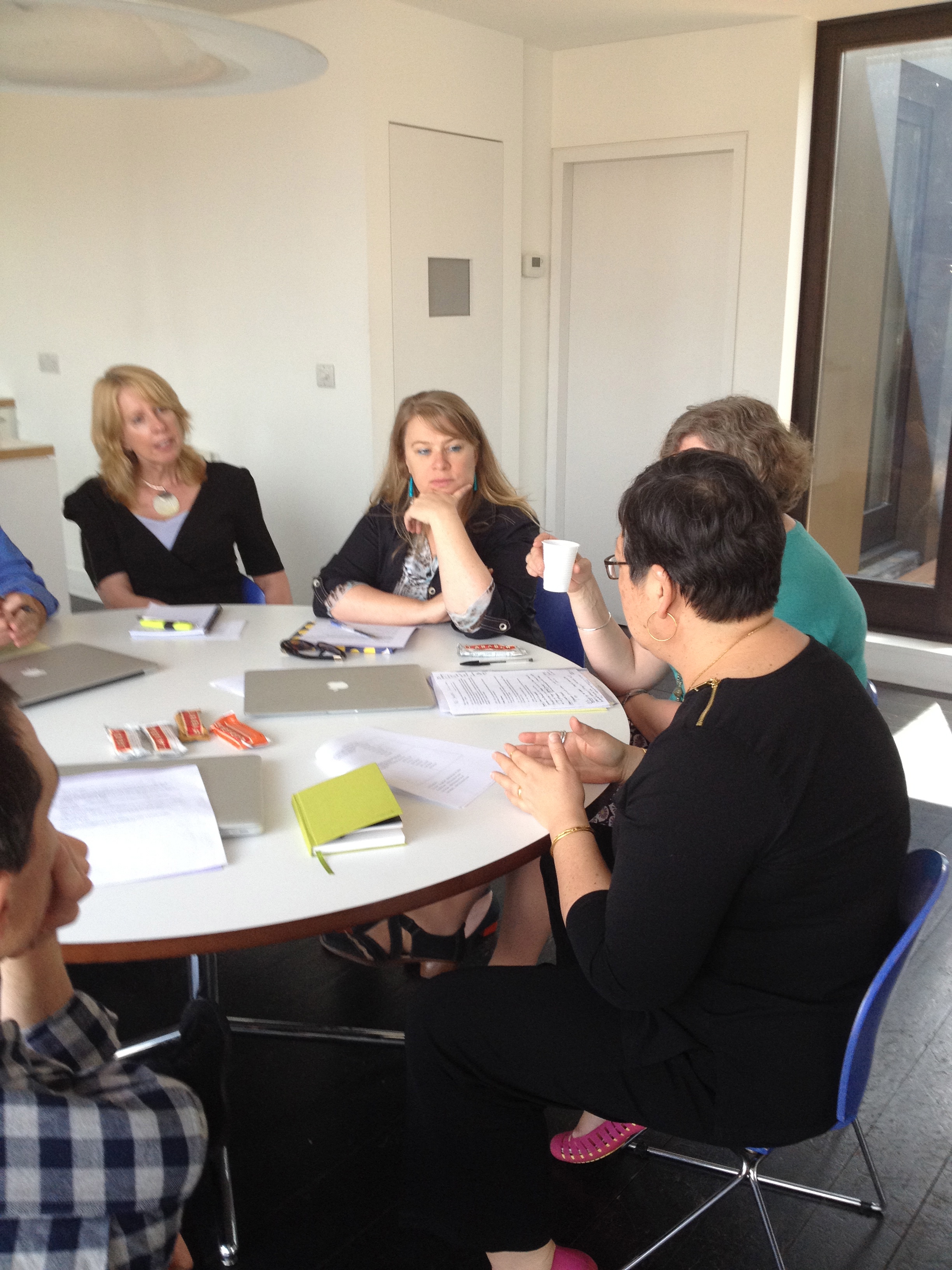
Clare Kosnik and Peter WilliamsonOur Symposium was amazing. For those who have read the blog postsIMG_2609 about it, I (Clare) am sure you got the sense that it was very interesting and productive. One of the words I would use to describe it is dynamic. There was such enthusiasm to discuss and grapple with the issues that we moved so beyond where we started (how to integrate digital technology into teacher education). Given that most people did not know each other, came from different countries, and had different areas of specialization (digital technology, teacher educators, teachers, policy) these differences did not divide us but they somehow brought us together to form a community. Not wanting to sound sentimental or superficial, I feel that something “magical” happened at the Symposium. The barriers melted away instantly and learning happened. Jean Murray’s “speed dating” opening activity immediately got us talking to each other. The laughter as we discovered interesting facts each other (e.g., John was fired as a gravedigger) raised the noise level to a crescendo. From there the Symposium developed into a committed group of educators focused on learning.Participants

Lin GoodwinThe two-day event was not like anything I have never experienced in my life – there was no posturing, there was careful listening, comments were relevant, questions were thoughtfully phrased, and there was commitment to something larger than individual research agendas. The interactions were respectful and genuine. I had assumed we would learn much about each other’s research and national contexts, I did not think that we would become a little community of teacher educators looking at the larger questions of education within a changing world. The level of enthusiasm was still sky high at the end of two intense days. There was no rush to leave or end the discussion.

Alyson BakerSo often in academia, department meetings are monopolized by issues such as timetabling. Conferences presentations are often more monologues that discussion. We need time to talk about the issues. The structure of the Symposium worked well – mini presentations by each person and time for large and small group discussion. This Connection Grant was not extravagant – we did it on a shoe-string budget. A number of universities contributed small amounts and we stretched our dollars. Given the money spent on university and government-based initiatives there is money for these kinds of events. Governments and universities need to spend their money thoughtfully and carefully – I would say, let’s use our Symposium as a Graham Parr and Scott Bulfinmodel of professional development for teacher educators and for policy development – bring the researchers together, devise a format for sharing and discussion, and let them proceed. I suspect the guidelines for education that they develop will be sensible and feasible.
Pooja Dharamshi Securing the grant and organizing the logistics were demanding. Our challenge now is to build on what we built and experienced. It is not just that I have much to learn from the amazing colleagues at the Symposium, but I also know that we are much stronger as a group. Teacher education is under siege. Individuals cannot resolve the challenges we face in teacher education but as a group perhaps we can do “something.” There has never been greater need to work together. I feel gratified — all of the work was so worth it. Thank you to the 16 participants who made this unique experience one I will never forget. I am eager to continue our collaborations. This website and blog will provide updates on our continued work together.

Reflecting on my time at the International Symposium for Digital Technology and Literacy/English Teacher Education

I (Lydia) feel fortunate to have had the opportunity to participate in the symposium last week as many of the issues raised resonated with my current research examining student teachers’ experiences with contemporary literacy teaching and learning. The issues highlighted during the individual presentations and accompanying discussions offered rich insights into the status of teacher educational internationally.

IMG_2590

I’d like to share a few of the questions raised during the symposium that remained with me and will continue to inform my research in literacy teacher education: What should a curriculum of contemporary teacher education include? In what ways can a curriculum of teacher education provide the space and quality time necessary for student teachers to truly engage as learners? How does power continue to operate in the curriculum? How do digital tools and social media spaces construct reading and writing? What do these digital spaces permit and what do they restrict? How is knowledge constructed, represented, and distributed within digital spaces? What are the pedagogical consequences as students engage with different modes within digital spaces? These are just a few of the questions I continue to consider upon my return from the symposium. Having the opportunity to consider the complexities and issues relevant to teacher education with international scholars was truly inspiring. I look forward to continuing our rich conversations.

IMG_2560

International Symposium on Literacy/English Teacher Education: A Focus on Digital Technology

With the symposium a few days behind us, I (Pooja) have had some time to reflect on what was discussed in London, England. Clare wrote a reflection post on day one of the symposium (https://literacyteaching.net/2014/06/06/symposium-day-1-reflections/), so I want to reflect a bit on day two. Day two started off with mini-presentations which asked presenters to focus on a central question: What is happening with digital technology in your context?

IMG_2564

Shawn Bullock, assistant professor at Simon Fraser University, raised some interesting issues related to digital technology and education:

  • Technological Determinism: A theory which asserts we need to stay current with technology to stay relevant in society; technology determines cultural values and society’s structures
  • Digital Publics: The theory that the nature of public space has changed significantly over the past years. The nature of public space has gone from persistent to replicable to searchable in the past few decades:

o   Persistent- recording (video, audio) events changed the nature of public space;

o   Replicable- recordings became replicable;

o   Searchable- today we can search for any recording

(danah boyd)

Understanding how the nature of public space has drastically changed over the years, Shawn posed an important question to the group: What is the role of education in theorizing privacy in the digital age?

IMG_2582

As the symposium was coming to a close, we were guided to reflect on the past two days. Many people realized that the rapid increase of standardization and data driven initiatives was happening across all contexts. However, many individuals commented that the conversations over the past two days were “energizing.” Being in conversation about big issues across international contexts made many teacher educators realize they were not alone. In fact, many commented they wanted to keep up the momentum by further collaborating and “making some noise” in teacher education.


IMG_2617


Once again, we’d like to thank TUG Agency for so graciously hosting us. TUG provided a vibrant and exciting atmosphere for our symposium to take place. Check out their website at: http://www.tugagency.com

Thank you!!!