As a girl, I (Cathy) used to walk to the library regularly. It was a good two mile walk and I usually went alone because no one I knew was as passionate about books as I was. I never minded. I loved the library. It was a treasure chest for me. I find I don’t go very often any more because I can often find what I need on line. But I still like the actual feel of a book. Guess it’s comfort food for the eye and hand. I wonder how many young children actually still go? 
Tag Archives: literacy
Love that Dog: A touching book and useful pedagogical resource
In both my experience teaching pre-service literacy courses and my current research with student teachers I (Lydia) have witnessed the sense of anxiety and discomfort many student teachers voice when they are faced with the prospect of teaching poetry during their practice teaching placements. Often, their associate teachers are themselves not comfortable with poetry and therefore, they have difficulty scaffolding the teaching of poetry or providing supportive resources for student teachers. This awareness has motivated Clare and I to delve into poetry within the first few weeks of the P/J and J/I literacy courses, in an effort to ease some of the initial anxiety student teachers experience in anticipation of teaching poetry. We attempt to provide multiple entry points into the teaching of poetry by presenting student teachers with various forms of poetry, and by highlighting the creative expression and emotive potential offered by this medium. We also provide them with a number of resources and pedagogical strategies they can utilize during their practice teaching placement. I recently picked up a copy of the book Love that Dog by Sharon Creech, which I hope to use in the literacy methods courses this year because the insight provided into how students might feel about reading and writing poetry is useful for both teachers and students. Throughout the book, the main character a young boy named Jack journals back and forth with his teacher Ms. Stretchberry, cleverly expressing his initial resist and eventual connection to poetry. Jack initially pronounces, “I don’t want to because boys don’t write poetry. Girls do”; however, through his ongoing dialogue with his teacher Jack experiments with word choice, sounds, and rhythm as he is engages with various poetic formats. My favorite entry in the book is “November 22.” Hopefully the student teachers in the literacy courses this year will enjoy this touching book as much as I did.
Because of Mr. Terupt- I was touched
I’ve been striking it lucky with my pick of children’s literature lately. Because of Mr. Terupt is a juvenile fiction novel well worth reading to a junior level class. Also perfect as a sample novel for student teachers experiencing literature circles. This touching story, by Rob Buyea, brings up many discussion points regarding what makes a good teacher, plus many other school issues: diversity, inclusion, forgiveness, and bullying just to name a few. Terrific resource for ‘hot seat’ /role playing explorations. A must read for children’s literature fanatics like me!

Symposium: Day One Reflections
 The first day of our Symposium was a smashing success! The large group discussion of “where we are” revealed the extreme pressure on teachers and teacher educators. We heard about the fast and furious rate of reform in some countries – non-stop initiatives coming from the government. These are so prolific that there are often contradictory messages (e.g., be inquiry-based but focus on skills development). The mini presentations addressed a range of issues: what happens when standards are implemented; student teacher expectations for courses versus the teacher
  educators’ goals; problems of teacher retention; the vast number of pathways into teaching creates confusion; and teacher educators having different emphases in their courses even when there is a common syllabus. A problem that arose is lack of control over the implementation of standardization. It can take a very different form from the envisaged use of the standards. The place of digital technology in literacy/English education still eludes and needs much more discussion of what to do and how to do it so that technology is used to support learning.
 The discussion was rich and far-ranging. A number of participants commented that we rarely have an opportunity to discuss “big issues” in education and teacher education.
Today promises to be another day full of lively discussion.
Learning a New Language
My (Cathy’s) husband decided he wanted to learn to speak German. So I bought him the online version of RosettaStone. My husband taught for 38 years, but now he is once again a student. We often meet for ‘recess’ over the island in our kitchen and talk about our day so far. I find it delightfully funny to listen to him reflect on his lesson. He says things like, “it’s hard!” and “my brain is so tired after a couple of hours”. But my personal favourite is after he has had an online session with a live instructor. Sometimes he says things like, “I didn’t like the instructor today, she wasn’t very friendly.” Wow. No matter what the age of the student, learning is challenging and the teacher makes all the difference. He is so much happier when he happens upon a suitably attentive and patient teacher. He feels encouraged and motivated. He is smiling when we have our recess. This says so much about the power we wield as teachers, doesn’t it? I wonder how many students are smiling during recess. I hope lots. BTW, my husband loves the program and highly recommends it!

Kids React to…
The “Kids React” series featured on YouTube reminds us how rapidly the landscape of communication technologies has shifted in the last decade. As the kids are introduced to unfamiliar devices (e.g. Walkman; rotary phone) they respond with funny and interesting comments while they compare these “old” tools to the “new” technological tools they use daily (e.g. iPhone).

Kids react to rotary phones
Wonder is Wonderful
I (Cathy) download audio books from audible.com onto my Ipod nano and listen while I walk, garden or cook. I just finished the book Wonder by R. J. Palacio. It is a very touching juvenile fiction novel about a ten year old boy with severe syndromes that dramatically alter his facial features. The story takes us on his journey surviving his first year in a public school as a grade five student. I cried a lot. This wasn’t so bad when I was in the kitchen cooking or even in my own back yard planting and digging. But walking? Hmmm. People notice. Oh well. When people asked me if I was all right, I just said, “It’s the power of great literature,” smiled and thanked them for their concern. This is a must read my friends, but keep the Kleenex handy and warn the family in case they ‘wonder’ about you!

Can a hashtag make a difference?
Recently, a Globe and Mail article questioned the impact of the Twitter campaign #BringBackOurGirls, designed to draw attention to the abduction of hundreds of Nigerian schoolgirls by an extremist group. The article noted that such online campaigns often ignite fierce, yet fleeting concern for a cause, which ultimately fails to provoke any “particular” action. Indeed, the article echoes the sentiments of others who have critiqued the merits of “digital advocacy.” For instance Malcolm Gladwell argued that online forms of activism such as “Facebook activism succeeds not by motivating people to make a real sacrifice but by motivating them to do the things that people do when they are not motivated enough to make a real sacrifice…which he suggested “makes it easier for activists to express themselves, and harder for that expression to have any impact.” Having participated in a variety of rallies over the years, I (Lydia) understand the momentum that can be mobilized and connections cemented when people collectively gather within physical spaces to champion social causes, matters of concern, and contentious political issues. I do, however, wonder if social media platforms provide an opportunity for us to broaden our conceptions of the creation of publics, public engagement, and relational encounters within social contexts. At the very least, such social media campaigns have demonstrated that they have the potential to draw attention to social issues, communicate information, and establish connections between affinity networks on a massive scale.
Link to the Globe & Mail article: m.theglobeandmail.com/news/world/abduction-of-nigerian-girls-draws-world-outrage-but-can-a-hashtag-offer-any-help/article18596825?service=mobile&cmpid=rss1&click=dlvr.it

Engaging with Suffixes
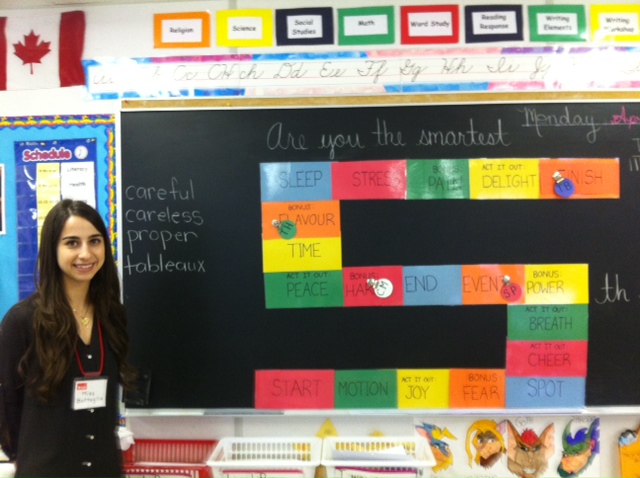
“How to engage students in the understanding and use of suffixes?” was the pressing question on my (Cathy’s) student teacher’s mind. Erica told me she mulled this over for several days, trying to get the pieces to fit together just right. Her final creation – a suffix game. The wonderfully large, colourful game board alone was enough to grab her grade five students’ attention. Played in teams, each group had to role a gigantic die to move their magnetic counter on the board. Some spaces on the game board depicted words (e.g. effort, bonus, time) which each team had to add either the suffix ‘less’ or ‘full’ to, and then write each word correctly in a sentence. Small white boards were provided to each team for this task. Other spaces on the board instructed the teams to create a tableaux depicting the new meaning of the word once the correct suffix was added. A few spaces on the board provided bonus points.
I have always had a concern about student teachers being focused on ‘fun’ over learning and wondered about the level of learning these students would experience with this game. This concern, however, was mollified when I witnessed the mistakes the teams were making which forced them to rethink their answers. The animated group discussions regarding which was correct were very interesting to observe. When the nutrition bell rang and the grammar lesson came to an end, there were groans and moans of protest. Imagine, grade fives liking grammar. Erica wisely told them they could play again soon.
Sharing Our Research
Today the research group will be presenting work from the project Literacy Teacher Educators: Their Backgrounds, Visions and Practices, at the Ministry of Education/Faculties of Education Forum – Research Practice: Nurturing relationships for teaching, learning and well-being. It will be an interesting and exciting day.

 Literacy Teaching and Teacher Education