Below is a link to a vignette that really struck a chord with me (Cathy). There is a lot to learn about the etiquette of texting. According to Maralee McKee, “out attention is a gift.”
McKee also says,
Our full attention is the foundation of every kindhearted, other-centered interaction. Texting alters the continuity, focus, and momentum of our encounters.
It produces anxiety (mild to severe) in the other person, and whether they’re telling you (or even aware of it themselves) or not, they’re attention is apt to desire to focus on someone who pays them back equally.
These are big matters.
If we’re not being careful, texting can hurt our family, our friendships, our business relationships, even our ability to govern.
Full Day Kindergarten (FDK) Blog #4 tells the literacy teaching story from the perspective of a first time Full Day Kindergarten parent (Yiola). In this post I share elements of the assessment process and how my child’s development has been communicated.
Here in Ontario it is “Parent-Teacher Interview” time. First term report cards have been written and parents and teachers, and sometimes students, are meeting to discuss student progress. There are a number of ways the interviews are conducted: student-led conferences are now quite popular processes and the more traditional teacher-led conference sans student are still in effect.
When I received the school newsletter and read that report cards and interviews were about to take place I was surprised and a little anxious; I felt it was too early to have the teachers share my child’s development… I knew my Sylvia Clare was learning a lot but to put in writing her ‘levels’ or acquired learning after 8 short weeks of school seemed far too soon. Well, I was right. The report cards and formal interviews were meant for students in grades 1 and up, not for kindergarten. Phew! That made more sense to me. As a parent of a child in kindergarten it makes good sense that children in the early years are not formally assessed … well, too early. From a parent’s perspective, I wonder if I would feel the same way if my children were in first or second or third grade?
What the FDK program has established is an “observation” time where each parent/guardian is invited to visit the classroom in action, to observe the daily life of the classroom and their child in the classroom. During the observation time the teacher offers some time to discuss questions or concerns with the parents/guardians. I was thrilled with the sounds of process as I was feeling so very curious about the sounds and vibes of the classroom and how Sylvia Clare got on inside that environment. A first hand eye-witness makes such good sense.
A short note arrived home a week before the observation. We were assigned a half hour observation time the following Monday morning. This worked well for me, but I did wonder, how do full-time working parents without flexible schedules manage the observation?
Monday morning arrived and off I went to visit the classroom. Alive with children’s voices, questions, and energy I walked into a vibrant room filled with learning. I was welcomed by the Teacher and Early Childhood Educator. Sylvia Clare’s face lit up when she spotted me as she hustled over with excitement. I quickly slid into the flow of the room and began to learn what it was my child did in the FDK room. Sylvia Clare was working with another student building the 100s chart on the huge carpet area. She had the 70s cards and while the Senior Kindergarten student was building from the 40s, she watched and waited patiently for the 70s to turn up so she could add to the massive chart… a wonderful, collaborative learning experience. When done, she showed me around the room: building centres, reading nooks, sand table, art table, writing table, snack table and well organized low rise shelves embodied the room. The room was as I remembered it back in August (neutral colours, natural light, natural materials) but now evidence of student learning lined the walls; drawings, colourings, writings were on display and I could see Sylvia Clare’s work.
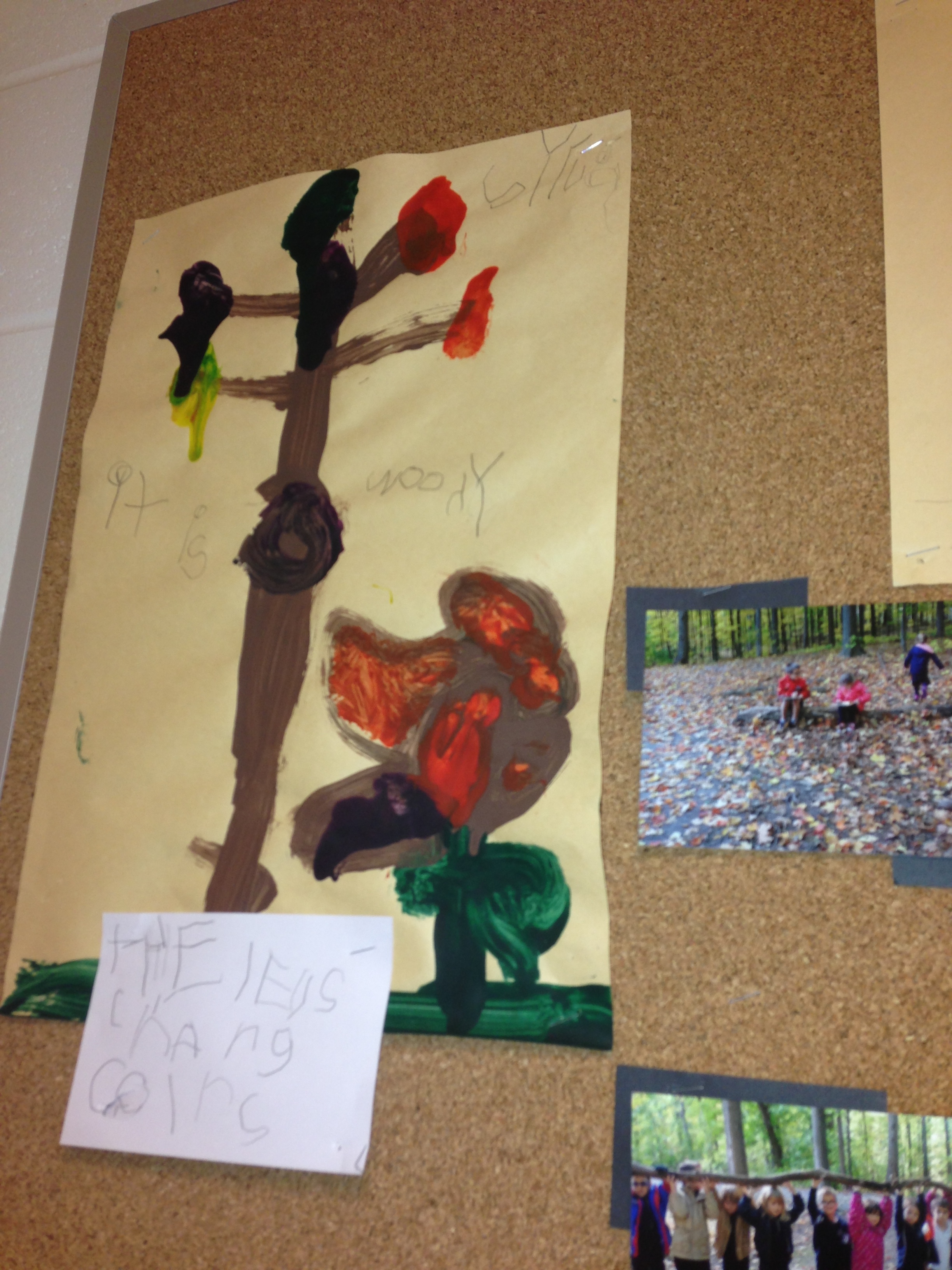
Sylvia Clare’s portrait of “Woody”, the tree the class adopted from the neighbourhood forest.
Children working in pairs, in small groups, independently on a variety of tasks throughout the room. The room was bustling yet highly organized. The room was loud but not noisy. I was thrilled to see so many “languages” brought to life (Reggio Emilia’s notion of the 100 languages in the classroom) ~ art opportunities everywhere; all purposeful and engaging. Everyone, including my Sylvia Clare had a place in the space and was engaged in the life of the room. The teachers encouraged Sylvia Clare to show me her portfolio (a binder with evidence of her work). Then Sylvia Clare led me to her interests where we explored and worked together. Once well settled into the observation, the teacher sat down next to me and asked, “Do you have any questions or concerns?” This was such an open and welcoming way to start our discussion. My questions:
Is Sylvia Clare happy at school?
Does she have friends and is she social? Who does she play with the most?
Where does she spend most of her time in the room?
I see she is learning a lot from all that she shares at home. What do you think?
The teacher provided specific description of Sylvia Clare’s work in the classroom: what she talks about, who she plays with, what she enjoys doing, and how she interacts in the classroom. It was clear to me the teachers have a good sense of who Sylvia Clare is, what she likes, areas she has shown significant growth already and areas for improvement. Then I asked:
What can we work on at home to support her learning?
Continued literacy development, focusing on sound/letter recognition. I realize now, as a parent of a child who is developing their reading skills just how complex the process is for children. It takes time. Some children acquire skills faster than others; some struggle but all children need time, exposure, practice to basic skill development. In theory, I knew this. To witness it through the lens of a parent however is somewhat different. Experiencing literacy development in one young child in live time, watching her gain letter recognition, one letter at a time, one sound at a time, is quite fascinating. Sylvia Clare is getting there. Beyond the daily read alouds and story telling I need to work through phonic games and drills with Sylvia Clare.
After our brief conversation I felt comfortable and confident that my child has adjusted to full day schooling and getting along well. Sylvia Clare then ushered me over to the snack table and we chatted while some of her friends came over to meet me. Shortly after, I said my goodbyes and was on my way.
It was remarkable observing my child in this setting; a setting outside our home, a setting in which I am but an observer and Sylvia Clare is the participant. The observation experience provided very clear, detailed description of my child’s work at school, far more than I would have gathered from a formal report card.
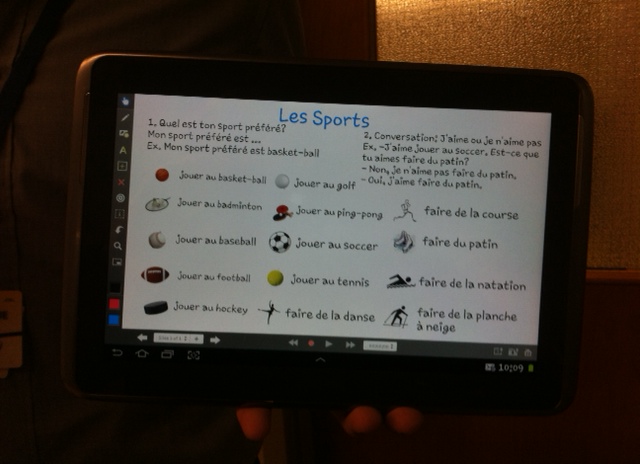
I (Cathy) find that one of the exciting aspects of teaching is learning from my students- especially about digital technology. One of my student teachers, Drake, taught a lesson last week using Explain Everything. With the aid of this app he successfully taught a lesson in French which enabled his grade 6 students to engage in conversations about sports. How he used the app was definitely key to the success of his lesson and I gave him full credit for cleverly scaffolding the sequence of the questions and answers so that that student conversations were set up for success. Yet, Drake insisted it was the app that enabled him to teach the lesson so clearly. Below are pictures of how Drake set up the lesson on his ipad and then mailed it to himself as a handout for his students. Well done Drake!
Intrigued, I began to play with this app myself. I discovered it has a wide range of applications. It feels like a cross between a power point and a smart board, but completely doable on an ipad. Very convenient. Below is an link to a you tube video that demonstrates how students can use the app in a classroom.
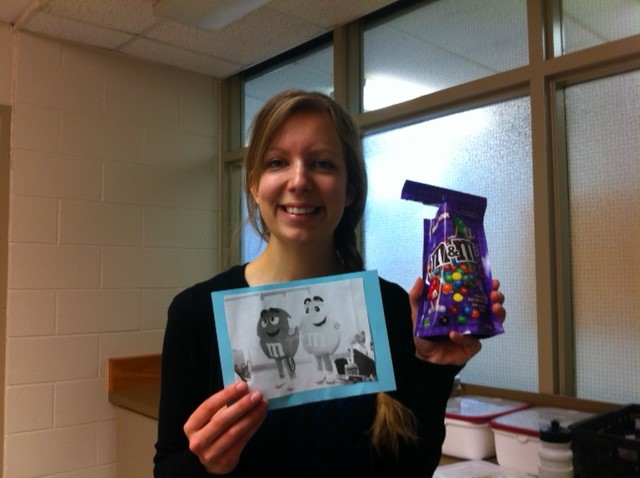
The day after Halloween, one of my (Cathy’s) student teachers, Megan, presented a wonderful lesson to a group of grade four students on probability. She opened the lesson with a picture of herself dressed as an M&M. (This was not really her of course, but the students didn’t know that). She told the story of how she disguised herself as an M&M and went out trick or treating. One nice lady gave her a whole bag of M&Ms because of her great costume. Megan wondered aloud on the probability of pulling out red M&Ms as opposed to green M&Ms or yellow ones. This student teacher had these children with the picture, but the M&Ms clenched it. All of the students wanted to predict. The students moved from large group work to small groups to independent work with ease. Interestingly, Megan did not allow the children to eat the M&Ms. They were data. The children accepted this fact and made no protest. The math remained the focus throughout the lesson. The lesson was an absolute delight to watch. Trouble is, I may never eat M&Ms the same way again. I will always be calculating the probabilities of pulling that red one.
In class this week my (Cathy’s) teacher education students were exploring indirect instruction through learning centers. One of the centers featured Iggy Azalea’s music video, Bounce, and the instructions to discuss the work through a critical literacy lens. (E.g. What message do you think the artist wants us to get from this video? Based on the artist’s thoughts and actions (expressed in the song), how would you say she is portraying herself to the world?)
Most of the students had heard of the video but never actually viewed it until arriving at the literacy center. (Perhaps you haven’t either). Without revealing the content, I will reiterate the general tone of the reactions. Most students were annoyed by the video content. One student said she was disgusted (and this is not sexual content). One group, however, tried to take a broader view. They said they could not judge the work until they understood Azalea’s intent. So they took it upon themselves to look up an interview in which Azalea discusses her purpose for portraying her song the way she did. After viewing the interview, they were angry. Azalea explained that she portrayed herself thusly so she would be seen as “flashy”. No message, just glamour. After this insight, some wonderful discussion ensued about cultural ethics and hegemony.
One student spoke to me at the conclusion of class and confessed that she was surprised by her own reaction. In her words, “I have changed. Studying literacy education has given me a different perspective. I see the world differently, especially things like music videos.”
Below is the link so you can view this content for yourself and decide. The second link is the video in which Azalea discusses her purpose for making the video.
I (Clare) read this really interesting article, Transforming Schools into Community Hubs: Where’s the Spark of Social Innovation?, on thinking outside the box to save our schools. http://educhatter.wordpress.com/
I was so impressed with the analysis of this initiative to create centres for the community – yes there may be policy to support this creative venture but school administrators have to embrace the opportunity. That is they need to think outside the box. Good for Nova Scotia Canada for attempting to support communities and to raise desperately needed funds.
Sitting in the dimly lit, bunker-like Conference Room on a sunny Saturday afternoon in Canada’s last surviving Wandlyn Inn was a little depressing. Listening to a veteran Nova Scotia School Superintendent explain — with clinical precision– the new Hub School Model regulationsreleased in July 2014 was almost too much to bear. The session title gave it all away: “The Operation, Opportunities and Challenges of the Community Hub Model.” A funny thing has happened to an exciting idea on its way to implementation.
Small school activist Kate Oland, a veteran of several Cape Breton school closure battles, was rendered virtually numb. After fighting to save her Middle River School, co-founding the Nova Scotia Small School Initiative,celebrating the April 3, 2013 school closure moratorium, and welcoming the Hub School guidelines, it had all come down to this: the Superintendent in charge of advancing the project still didn’t seem to “get it”: open the school doors to the community and let social innovation in.
Community hub projects come alive with proactive leadership and the scent of social innovation.The founder of Toronto’s Centre of Social Innovation,Tonya Surman, speaking in Sydney, Cape Breton in April 2014, was right on the mark. “You’ve got to be able to dream about what’s possible, ” and she added “social change takes time.”
A “New Dawn’ arrived for Holy Angels Academy in Sydney, Cape Breton, but three years after its closure as a public school. Today it’s a thriving Centre for Social Innovation hosting a lively mix of 20 commercial and non-profit enterprises.
That transformation, spearheaded by Rankin MacSween’sNew Dawn Enterprises Limited, should be on the curriculum for the training of School Superintendents. It’s time to embrace economic renewal and social enterprise, particularly in a struggling economic province like Nova Scotia. Founded in 1976 initially as a community development fund to combat plant and mine closures, New Dawn is now a beacon of light for faltering communities on the verge of losing their schools.
With the adoption of the School Hub regulations, the Nova Scotia Education Department is coaxing school boards into being more proactive in transforming emptying schools into shared use facilities and potentially revenue generating operations.
The Hub School guidelines, in the hands of reluctant administrators, may threaten to extinguish community spirit and enterprise. Developed by a faceless team of school administrators, it treats Hub School proposals as “business case briefs” and guides proponents through a virtual “obstacle course” of new approval rules. Serving existing students should come first, but why is the “protection of property” so prominent in the regulations?
Three Nova Scotia community-school groups in River John, Maitland, and Wentworth are fighting to save their schools and fully committed to supporting the “Hubification” process. Economic and social innovation thrives when it is welcomed, as in the case of the New Dawn success in Sydney. It perishes on sterile ground marked off like the hurdles on a high school track field.
Economic renewal and social innovation are possible under the right conditions. What’s the secret to unlocking Social Innovation and revitalizing our schools? What has happened to the Nova Scotia Community Hub School Model on its way to implementation? Is it still possible for small school advocates to clear the latest hurdles and transform schools into true community hubs?
I (Clare) read a view in the New York Time of The Short and Tragic Life of Robert Peace: A Brilliant Young Man Who Left Newark for the Ivy League. I was fascinated by the review because it described how Robert “escaped” his impoverished neighbourhood through a scholarship to Yale. (He was brilliant). He graduated from Yale but did not “make it.” This book is essential reading for ALL teachers and teacher educators because it shows how complex and challenging it is to overcome your childhood and cultural norms. Yes there were people who helped Robert but …
The book is written by Jeff Hobbs )pictured on the right) http://authors.simonandschuster.ca/Jeff-Hobbs/36063537 who was Robert’s college room mate. It is beautifully written but incredibly painful. Over and over I kept hoping that Robert would make better choices, use his gifts …. And Jeff Hobbs helped me appreciate how difficult life can be. Here is a video link of Jeff talking about the book.
A heartfelt, and riveting biography of the short life of a talented young African-American man who escapes the slums of Newark for Yale University only to succumb to the dangers of the streets—and of one’s own nature—when he returns home.
When author Jeff Hobbs arrived at Yale University, he became fast friends with the man who would be his college roommate for four years, Robert Peace. Robert’s life was rough from the beginning in the crime-ridden streets of Newark in the 1980s, with his father in jail and his mother earning less than $15,000 a year. But Robert was a brilliant student, and it was supposed to get easier when he was accepted to Yale, where he studied molecular biochemistry and biophysics. But it didn’t get easier. Robert carried with him the difficult dual nature of his existence, “fronting” in Yale, and at home.
Through an honest rendering of Robert’s relationships—with his struggling mother, with his incarcerated father, with his teachers and friends and fellow drug dealers—The Short and Tragic Life of Robert Peace encompasses the most enduring conflicts in America: race, class, drugs, community, imprisonment, education, family, friendship, and love. It’s about the collision of two fiercely insular worlds—the ivy-covered campus of Yale University and Newark, New Jersey, and the difficulty of going from one to the other and then back again. It’s about poverty, the challenges of single motherhood, and the struggle to find male role models in a community where a man is more likely to go to prison than to college. It’s about reaching one’s greatest potential and taking responsibility for your family no matter the cost. It’s about trying to live a decent life in America. But most all the story is about the tragic life of one singular brilliant young man. His end, a violent one, is heartbreaking and powerful and unforgettable.
A short video clip that demonstrates how technology is being used in a local high school. Interestingly the purpose for the use of technology is connected with well being and class participation.
I (Yiola) am currently preparing a “technology day” conference that will emphasize and highlight the use of technology is classrooms for our student teachers. I like the examples shared in the clip. I will be sure to share the experiences of technology day that will take place next term.
Each fall and spring I (Clive) invite the students – 65 this year – in my teacher education cohort program to an evening potluck at our house. Most of them come, some with their spouses or significant others, and we are deluged with food – especially desserts! It is a great opportunity for them to get to know each other better and for me to finally learn all their names. It also models the type of community building and teacher-student relationship that I think is so important in any school or university class.
We had the fall party a couple of weeks ago just after our fourth class together, which was on practice teaching and the theory-practice relationship generally (sounds dull I know). One thing I had discussed with them was the importance of bringing our theories about life and education down to earth, using practical ideas that we remind ourselves of in the heat of the moment. I told them how one of the teachers in our research project was having difficulty with her class last year, so she wrote “don’t take it personally” in capital letters (DTIP) on her wrist and found it helped.
Two of the students with special IT talents arranged to have a slab cream cake made, decorated with a photo of me in blue along with three of these sayings: another was “you can’t do and be everything.” They brought the cake to the party and put it on display, and we all hoed in when dessert time came. I didn’t mind having to eat my words, they were delicious!
I (Clare) am following this amazing new blog Eureka Research: Exploring Wellness through digital techniques: http://eurekaresearch.wordpress.com/2014/10/22/first-class-tracking-wellness/
This recent post is about the guidance counsellor who is working with secondary school students to track their wellness and well-being using a number of on-line tools. Wow! This is an amazing use of technology and from the photos it seems the students are very much engaged. I look forward to reading updates on the work and study of the on-line tools.
I am in the middle of running my five classes on using a website to track moods, goals, tips, etc. The website is called Facingus.org and what I like about it is that it is hands on and interactive. Students explored for parts of the site: Journal, Wellness Tracker, Wellness Plan and Wellness Book (Tips). This took almost the full hour to explore. Students wrote for 5 minutes in the online journal – some where very engaged and some struggled quite a bit. I did catch a couple of students reading a book on their laps! I did also have a couple of students asking if they could have more time to write 🙂
For the Wellness Tracker, I had them focus on three aspects – Well-being (track daily), Symptoms (track daily and weekly) and Lifestyle (track daily). What I liked about this section, is that there were a lot…







 Literacy Teaching and Teacher Education