Category Archives: classroom teachers

Thinking about Reading Recovery

I (Yiola) am interested in early literacy for a number of reasons: my area of expertise is elementary  education; I was an early years teacher for ten years; my own children are now in early years programs; and, I believe that understanding literacy in the early years is  foundational for understanding teaching and learning.

With recent discussions going on about early years literacy programs and talk of play versus direct instruction; and, exploration and social development versus academic rigour (neither of which I believe are true binaries but instead call for a thoughtful consideration of a developmental and critically rich fusion) I am compelled to think about reading in the early years. You see, it seems to me parents are often in a panic if their child is not reading and more and more I am hearing of excited parents proudly sharing that their child was reading at 3 or 4 while other parents are silently panicking if their child is not reading by 6 years of age.

I often think back to when I was a classroom teacher and I recall the complex yet carefully crafted time sensitive processes for reading acquisition. I also clearly remember having a Reading Recovery Program at our school and watching our first and second graders enter and exit the program with a good degree of improvement and development. Most children would come out of reading recovery with gains. The very few who did not required further testing and support that went beyond the readiness phenomenon.

In my readings I came across this interesting article about Reading Recovery and the relevance of levelled texts, phonological processing AND comprehension as all significant  components of early reading development.

Here is the article in full: http://onlinelibrary.wiley.com/doi/10.1111/1467-9817.12041/epdf

This reading reminded me that there needs to be an amalgamation of approaches and strategies in the early years classroom. More and more I think that the programming and planning of early years teachers is by far their greatest challenge – not deciding upon play versus directed learning – knowing how to plan in ways that are engaging, that tap into curiosities and children’s questions and that allow for literacy rich exploration while also ensuring time for literacy focused experienced.


Young Minds Create Breakthrough Communications

I (Cathy) was amazed to recently read about two Washington University sophomores, David Azodi and Thomas Pryor, who’s work was highlighted in Discover Magazine. These clever young men have been recognized for an invention that could break down communication barriers for the deaf. Sign Aloud is a pair of sensor-filled gloves that interpret the hand movements American Sign Language users use to communicate, and converts them into speech or text that the rest of us can understand. The students designed the gloves inside the CoMotion MakerSpace, a collaborative workshop on campus. They recently received the Lemelson-MIT Student Prizefor their work, which is a yearly award given to undergraduates for innovative inventions. They won in the “Use It” category, and received a $10,000 grant along with the prize.

Follow the link below for a demonstration of this brilliant use of technology.

https://youtu.be/4uY-MyoRq4c

SignAloud-gloves

FDK Update:Literacy happenings and the like

I (Yiola) having been sharing my experiences with the Full Day Kindergarten (FDK) program from a parent’s point of view and here is another update.  My wee ones, Sylvia Clare (Senior Kindergarten) and Gallaway (Junior Kindergarten) are trekking merrily along in their kindergarten programs.  They are happy — and this makes me very happy. Some updates and observations about FDK and literacy.

  1. Sylvia Clare got into French Immersion. In our province, not all school board’s hold the same policy on French Immersion. This makes understanding the program less clear.  Some school boards/districts give every child the opportunity to go into French Immersion while others (like the one we are in) have a first come/first serve system.  The online database opened at 12pm on a set date and by 12:01 Sylvia Clare was 63rd on the list. 42 students are admitted into the program… We were notified last Monday that Sylvia Clare has been admitted and on Tuesday I registered her into the program. What does this mean? Beginning in first grade 50% of her learning will happen in French. She will have 2 classrooms teachers plus a “prep” teacher.  Big questions arise: How will this impact her language development in the short term/long term?  How will this impact her social development? Will this slow down her reading development?  Will this alter her level of engagement? So many questions and uncertainties and I’m not entirely convinced yet much of the literature AND community feedback suggests to go for the French. As a teacher educator I can speak to the general trends of French Immersion programs: students in immersion programs: acquire more vocabulary over time; catch up and often exceed reading levels of monolingual students… and yet when I look at this wee individual child, in spite of what research and theory state, only time and experience will determine if its best for her. I will keep you posted.
  2. Technology in FDK. Amazing things are happening with the whiteboard in the FDK classroom. I have observed students working individually and in groups: standing directly in front of it, touching it and manipulating shapes, words, images on the screen to solve problems. I have seen students engaged in listening activities and responding with their whole bodies to instructions provided through programs on display on the white board. I have seen attendance being tracked on the white board: all students’s names are in one row and as students enter they go up to the white board and slide their name to the other side — small details to practical use of technology in FDK.  I have seen iPads used in the FDK classroom: for gathering research, reading, listening to stories, and playing “games”. And, I have experienced communication with the teacher via REMIND technology. Oh how I love receiving a text with a pic of my son in educational action accompanied by a short text from the teacher. It makes me smile each and every time. The way digital technology is used in the classroom is meaningful, productive, and purposeful. I have also observed that it has just become a way of being in the classroom. It just is.
  3. My last update on FDK is on the idea of inquiry. I will share my understanding of inquiry in FDK with a anecdote.  Yesterday, as we drove on the Gardiner passing the CN Tower, Sylvia Clare explained Mommy we did research at school.  Harrison asked the teachers if the CN tower was the tallest building in world  and the teachers said they did not know but that it was a good question to research. So we started to research.  We looked in books and on the computer and guess what? We found out its not.  You know where the tallest building is mommy? Its not in Canada. We also learned the CN tower is a tower but not a building… and on and on she spoke about her research on towers and buildings.

These are some of the key literacy based elements that have me excited about FDK. Am I concerned about how many sight words they know? Not really. I am more concerned with their active engagement in learning and wanting to learn and this is what I see happening in the early years.

The First Year of Teaching Can Feel Like a Fraternity Hazing

One of my (Clare) students sent me this article from the Atlantic: http://www.theatlantic.com/education/archive/2016/04/first-year-teaching/477990/?utm_source=SFTwitter

As I read it my heart sank for these new teachers. I recall my first year of teaching (I lost 15 lbs. between September and December) from sheer work. Does it have to be that way? And given all that we have learned about beginning teachers I am not sure how much the situation has changed. Yes the first year of any new job is going to be a challenge but does it need to feel like “fraternity hazing)? I think no.

Brendan Hoffman / AP

This is the first story in a three-part series about teacher preparation and whether programs are doing enough to prepare new teachers to take over their own classrooms.

MIDDLE RIVER, MD—On a chilly November morning, Michael Duklewski stood outside his seventh-grade classroom as students filed in, some shoving each other playfully, others still half asleep. One by one they took a piece of paper from a bin by the front door and made their way to their seats.Image Michael Duklewski
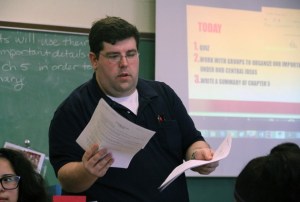
“Good morning!” Duklewski, 33, said in a loud and confident voice over the classroom chatter. He closed the door and paused. A wad of paper flew through the air.

“I’m warning you man, the next time I see someone throw something, it’s lunch detention,” Duklewski said sternly, looking at the student who had thrown the paper.

As students in this second-period English class began to work on their warmup drill—to define the terms “setting” and “mood” in literature—the chatter continued. Duklewski walked over to the chalkboard in the front of the room where he was tracking the points for good behavior that each class had earned. Next to “second period,” he erased the number 14 and changed it to 13.

“Ladies and gentlemen, I already took off a point,” he warned. He waited as the conversations slowly died down, before launching into his lesson for the day on the play A Raisin in the Sun.

Duklewski, one of a growing number of career-changers that enter the teaching profession each year, switched from political lobbying to education after volunteering at an after-school program in Baltimore. This school year is his first, and it has been even tougher than he imagined. In the second week of September, reality hit. “I was like, ‘Oh God, I don’t know what I’m doing here,’” Duklewski recalled.

Duklewski is one of three teachers The Hechinger Report, which partnered with The Atlantic to produce this story, has followed over the course of their first year to look at how training programs prepare new teachers for the classroom—or don’t. As the American education system faces a drumbeat of criticism for its stubborn achievement gaps and lackluster performance compared to other countries, education schools are under attack.

Traditional education schools are trying to reinvent themselves, and alternative fast-track routes are popping up to offer shortcuts to the classroom. Both models seek to help prospective teachers deal with rising standards, increasing student diversity, new technology and, inevitably, the gauntlet of spitballs, note passing, and, these days, illicit texting.

Michael Duklewski leads a lesson in his second-period English language-arts class. (Jackie Mader)

While aspiring educators now have more choices than ever before when it comes to launching their careers, new teachers continue to leave the profession at an alarming rate, suggesting a breakdown in training and support. At the same time, there is little evidence to show which education programs are graduating the most successful teachers or what kind of support is most helpful for rookies.

Duklewski chose the traditional route to becoming a teacher. In 2015, he graduated from Towson University, a state institution outside of Baltimore that has been training teachers for more than 150 years and graduates nearly 700 new teachers each year. He selected the school because of its strong reputation, and it helped that his mother earned her own teaching degree there in 1972. His course of study took two years, including more than 20 classes and 16 weeks of full-time student teaching—typical for traditional programs, which provide more in-depth pre-teaching training than most alternative programs.

Duklewski was hired to teach seventh-grade English language arts at the same school where he completed his student teaching experience. He was familiar with Middle River Middle School’s administration and policies and already knew many of the nearly 900 students in the sprawling, single-story brick building, located in a suburb of Baltimore.

“We’ve gotten into a habit of accepting that we treat the first year of teaching like a fraternity hazing”

Though Duklewski said surviving the initial year hasn’t been easy, many first-year teachers are so traumatized they don’t come back at all. Data on new-teacher attrition varies, but studies have found that anywhere from 17 percent to 46 percent of new teachers quit within their first five years. If teachers were trained better, more might stick around, experts say.

“We’ve gotten into a habit of accepting that we treat the first year of teaching like a fraternity hazing,” said Kate Walsh, president of the National Council on Teacher Quality (NCTQ). “People say, ‘I just don’t think you can learn this ahead of time.’ Well, you need to set up those conditions ahead of time,” she argued.

Is it possible for teacher programs to prepare educators with everything they need to know on Day 1? Maybe not everything, according to the three teachers we followed.

For Duklewski, although he’s struggled at times with unruly students, he’s not sure what else his teacher education program could have done. There’s no better way to learn how to teach, he argued, than just jumping in and doing it.

* * *

A student works on a reading assignment in Duklewski’s English language-arts class. (Jackie Mader)

Back in second period, Duklewski, wearing black dress pants and a blue polo shirt, continued to give directions for the next part of the lesson: using evidence from the A Raisin in the Sun script to draw a diagram of the set.

As he ran the discussion he moved constantly around the room, stopping the lesson abruptly—and frequently—as students talked to their neighbors. He kept an even tone as he threatened to call parents and reminded students that one of the class rules is “don’t talk while others are talking.”

Four minutes in, second period was down to 10 good behavior points. “Don’t draw on your arm,” Duklewski told one student. He ignored a student hitting himself in the face with a red folder. Duklewski stared down a chattering group of students until they started working again.

It was now 10 minutes into the period. Duklewski stepped up to the overhead projector in the front of the room and counted down from three. The class fell silent. “Our purpose is to find details about the staging of the Youngers’s home,” Duklewski said, referring to the family in the play. “What rooms are there? What things are there?” Some students raised their hands, but a few boys continued to talk to each other, or, in a couple of cases, to themselves.

“Ladies and gentleman, I’m literally asking you to do nothing when other people are talking,” Duklewski said in a calm and assertive voice. “We’re going to practice being silent for fifteen seconds. If we can do that, I’ll put a point on the board. If not, I’ll take two off.”

Duklewski set a timer for 15 seconds. Four seconds later, a student started talking.

Less than three months into his first year of teaching, Duklewski exuded the confidence of a more experienced teacher. But his second-period class was difficult compared to the other four classes he’d been teaching, a difference he attributed to several strong personalities and too many students—33, far bigger than his other classes.

For the worst behavior problems, his chosen strategy is keeping students after class for a one-on-one talk instead of addressing them in front of other students. “Some teachers come straight at a student when they have an issue with them in class,” Duklewski said. “I found that doesn’t work with them, especially not in a classroom full of their peers. They get yelled at enough.”

The ability to manage classroom behavior is one of the top concerns for every new teacher and can often lead to the undoing of a rookie. A 2014 report by the nonprofit Alliance for Excellent Education found that trouble managing student discipline is one of the many reasons teachers leave the classroom. Poor classroom management can also get in the way of learning, said Arthur Levine, the president of the Woodrow Wilson Foundation and former president of Teachers College, Columbia University. “If a teacher can’t manage a classroom, nothing they’re going to do will be successful.” (The Hechinger Report is an independent unit of Teachers College.)

Although classroom management is one of the most important topics for new teachers, it is one of the least taught in preparation programs, said NCTQ’s Walsh. “Programs swear up and down that they teach this stuff … [but] there’s little evidence that they’re being taught it,” she said.

In fact, a 2013 report by NCTQ found that many teacher-preparation programs fail to teach certain aspects of classroom management. Of 122 programs examined by NCTQ, the majority focused on the setting up of routines and rules in classrooms, an important skill. But 74 percent did not teach teachers how to use praise in their classrooms to reinforce positive behavior or other day-to-day tricks to keep classes focused and get unruly kids under control.

“If a teacher can’t manage a classroom, nothing they’re going to do will be successful.”For Duklewski, talkative students can be irritating, but they’re not enough to make him quit teaching.

By December, his second-period class was getting better; during the fall, he had started giving students the chance to earn the right to come to his classroom during lunch and watch cartoons on Fridays. (He nixed the cartoons before winter break.) He moved one particularly energetic student to the back of the classroom where he could sit on a window ledge, stand up or move around without distracting other students.

His class-points system, however, had fallen apart. Right before winter break, Duklewski switched to an individual-point system to reward students for independent behavior. Students could earn points by being on-task, finishing the class warmup first, or answering questions correctly. They could then earn small prizes, like pencil sharpeners, or larger prizes, like “renting out” his classroom for lunch with friends.

He also switched from pointing out negative behavior to pointing out positive behavior. Sometimes he found that just announcing what students were doing—“Jimmy is working on his warmup”—made a huge difference. And only a few weeks into the new system, Duklewski said that the changes were both improving student behavior and his own sanity. “I’m just happier, because I’m saying good things all the time instead of harping on bad things,” Duklewski said.

Happiness is relative for a new teacher. Since Duklewski took over his own classroom last September, it’s been nearly impossible to balance his workload with his personal life, a problem many new teachers experience.

Every morning Duklewski wakes up by 5:30 and he tries to be in bed by 9 p.m., although he often stays up late preparing lessons. He saves time by not eating breakfast in the morning and has 35 minutes to eat lunch—15 minutes of which is taken up by hall duty or checking on students in the cafeteria. After 13 to 15 hours at school each day, he drives home, eats dinner, watches a little television, and packs his lunch for the next day. His weekends are mostly filled with grading.

Moving from a role as a student teacher to a full-time classroom teacher was a bigger jump than he had expected. He realized after his first week that there were many things he didn’t know, like the exact procedure for a fire drill. Or how to balance teaching with noninstructional duties like communicating with parents, filling out attendance, and responding to each day’s barrage of emails.

“When it’s all resting on you, it’s just that much more exhausting,” Duklewski said. “Some of it you just figure out as you hit the ground running.”

On a rainy January day, Duklewski stood in front of his fourth-period class having already downed several cups of coffee to keep up his energy. At 10 p.m. the night before, he had thrown out his lesson plan on monologues, and then stayed up until 1 a.m. reworking it to include video examples.

Students were transfixed. After watching monologues from The Lion King, Harry Potter, and The Incredibles, the class discussed the purpose of a monologue. Duklewski then instructed them to write their own, using point of view and voice. On a worksheet, students answered questions about who they would be, why they were talking, and who they were talking to. Kids erupted into excited chatter as they began to plan and write their monologues.

“I’m myself, talking about sacking Tom Brady, to myself,” one student explained. He read his first line aloud. “Ohh I’m gonna sack Tom Brady!”

When the class ended, students filed out still chatting about their monologues. Oner bonus of an engaging lesson, Duklewski added, is that students stay on task and he doesn’t deal with as much misbehavior.

* * *

Duklewski was assigned a consulting teacher who observes him every two weeks. After those observations, he has a chance to discuss the lesson and receive feedback, such as on his classroom management approach or his use of tests.

The mentoring and a high level of support from his school have helped him keep a positive attitude, he said. “I feel the freedom to take risks, mess up and experiment because I don’t feel pressure. If I screw up, I screw up. They’ll help me fix it.” On his mid-year evaluation, Duklewski was rated “effective” on a scale that included the ratings “developing,” “effective” and “highly effective.”

Next year, he wants to do a better job using student data to plan lessons that touch on the skills students are lacking—something he rarely had the chance to do this year because of all the other demands of his classroom and the hours spent preparing lessons. He also wants to get better at long-term planning. And he’s learned from his challenging second-period class that it pays to set up better rules and classroom procedures from the beginning of the year.

As spring break approached, a series of snow days and holidays threw Duklewski’s students off track. He increased the number of phone calls home to parents and doubled down on his positive praise. “I think we’ve come to some sort of understanding about how we’re all going to get along in class,” Duklewski said. He was also getting the hang of balancing his schedule, and had cut his work hours down—to less than 12 hours a day. It helped that he was seeing academic growth. On standardized writing assessments, the class average had gone up by about 50 percent in most of his classes. On reading tests, scores were also rising steadily.

“Next year, I expect it to be much, much easier,” Duklewski said. “I’ve already done everything once. I’ll have stuff to fall back on.”

Although he’s starting to plan his summer vacation, including work as a counselor at a summer camp, he still has one final goal for his students as the year winds down. “By the end of the year, they will not talk over other people while they are talking,” Duklewski said with a laugh. “If I teach them nothing else, they will learn that skill.”


OTF Supports Teacher’s Self-Directed Professional Development

pic

The Ontario Teacher’s Federation (OTF) recognizes that teachers need to direct their own learning and professional development. To support this need they now offer a professional development  problem-based learning model which encourages teacher teams the opportunity to create their own learning projects.  The model encourages teachers to: select a team to work with; develop a project; conduct the research; and evaluate the effectiveness.  If the proposal is accepted, the OTF also provides support for the project through a mentoring program. Each team is assigned an expert teacher who will act as their mentor, who assists the team as needed throughout the process.

Through this process teachers are given the opportunity to:

  • become involved in ongoing self-directed learning;
  • spend real time collaborating with colleagues of their choice;
  • work as a team on a project of they deem significant (within the specified areas of focus);
  • have release time to carry out the learning initiative;
  • develop and implement the project over a period of months;
  • deepen their practice and evaluate teaching enhancements generated through your research and discussions; and
  • share their knowledge and resources with colleagues.

This year they have suggested three areas of focus:

  • Using information and communication technologies (ICT) to enhance teaching and learning
  • Supporting capacity building in Kindergarten
  • Supporting teachers in implementing revised curriculum
    • Grades 1-8
      • History and Geography
      • Social Studies
    • Grades 9-12
      • Canadian and World Studies
      • Classical and International Languages
      • First Nation, Métis and Inuit Studies
      • Social Sciences and Humanities
    • Grades 1-12
      • French as a Second Language
      • Health and Physical Education

Deadline for 2016  proposal applications is May 31.

Some  2015 projects were:

Assessment Technology in Primary Physical Education

Cross-Curricular Integrating Technology/Media Studies

iPads for Inclusion

I remember, as a classroom teacher, wishing my school board would allow me the opportunity to identify my own areas of strength and weakness and seek out professional development accordingly.  It is appropriate that the OTF is acknowledging this form of PD and taking a step in the right direction.  It would be helpful if teacher education programs could also offer similar forms of support for their own staff and faculty.

http://www.otffeo.on.ca/en/learning/teacher-learning-co-op-tlc/


JICS: Outstanding Laboratory School of the Year Award

As many of the readers of this blog know, I (Clare) am the Director of the Dr. Eric Jackman Institute of Child Study (JICS). It is an amazing place — Lab school, teacher education program, ICSand research centre. The Lab school has been given the Outstanding Laboratory School of the Year Award. A HUGE HUGE HUGE congratulations to our teachers and leadership team. I have looked at the list of lab schools in the association and there are some mighty prestigious schools in the group. And for our school to be given this award is truly an outstanding accomplishment.
12644854_10156632304500121_7940976327917128279_n
Below is the press release done by the OISE Communications Team
OISE/UofT’s Laboratory School Named World’s Best in 2016

The International Association of Laboratory Schools (IALS) has named the Dr. Eric Jackman Institute of Child Study (JICS) winner of the 2016 Outstanding Laboratory School Award.

Richard Messina, JICS principal, will accept the award in Puerto Rico on April 27, 2016, at the International Association of Laboratory Schools annual conference.

“The JICS school community is very excited about this award. It recognizes the hard work and creativity of our teachers, the involvement of our parents, and the guidance we receive from our scholars,” noted Messina.

Watch JICS in action: https://vimeo.com/164037655 Password: kidscodingfinal

The Jackman ICS lab school, part of the Ontario Institute for Studies in Education and University of Toronto, is widely known for its innovative and integrated approach to applying the latest research evidence to ensuring leading edge teaching and learning.

A leader in education, the keys to its success are the partnerships among and between students, teachers, parents, and world-class professors from OISE and the University of Toronto.

For more information about the Outstanding Laboratory School of the Year Award, please visit: http://www.laboratoryschools.org/membership/awards-and-grants/80-outstanding-laboratory-school-award-new
For more on the Dr. Eric Jackman Institute for Child Study, please see attached for background details, or visit: http://www.oise.utoronto.ca/ics/index.html

Media Contact Information:

Richard Messina, Principal, JICS: richard.messina@utoronto.ca or 416-629-1018
Chriss Bogert, Vice-Principal, JICS: chriss.bogert@utoronto.ca or 416-702-1093
Lindsey Craig, Media Relations Coordinator: lindsey.craig@utoronto.ca or 416-458-2136

Actor’s insights into Literacy

If we talk about literacy, we have to talk about how to enhance our children’s mastery over the tools needed to live intelligent, creative, and involved lives.

Danny Glover

Danny_Glover_2014

I was curious as to why actor Danny Glover would be credited with such a profound quote on literacy.  Looking into his background I discovered two things about him:

1.Danny Glover suffered dyslexia at school when he was younger and the school staff would label him retarded. This definitely was not very encouraging for him but he ended up finding ways to feel better about himself. He says that dyslexia had given him the feeling that he was not worthy to learn and that the people around him would not care of what would happen to his education. With time he eventually regained his self-esteem and became a great actor.

2. Danny Glover is a political and civil rights activist. For example, while attending San Francisco State University (SFSU), Glover was a member of the Black Students Union, which, along with the Third World Liberation Front and the American Federation of Teachers, collaborated in a five-month student-led strike to establish a Department of Black Studies. The strike was the longest student walkout in U.S. history. It helped create not only the first Department of Black Studies but also the first School of Ethnic Studies in the United States.

I am sure these two factors contribute enormously to Mr. Glover’s insightful views on literacy.  What we make of our backgrounds shape our identities as leaders, particularly in education.  My newly discovered knowledge of Mr. Glover increases my respect for him not only as an actor, but as  a human being.  I look forward to reading more about his journey and commitment to literacy development.

https://en.wikipedia.org/wiki/Danny_Glover#Civil_rights_activism

http://www.disabled-world.com/artman/publish/article_2130.shtml


HOT off the press: Teaching Literature to Adolescents

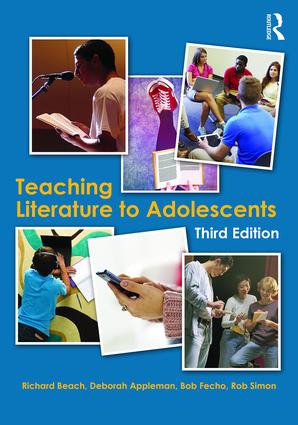
My good friend Rob Simon is one of the co-authors of the third edition of Teaching 9781138891241Literature to Adolescents. Co-authored with Richard Beach, Deborah Appleman, and Bob Fecho this is an amazing new text. As a professor of literacy methods courses I (Clare) am always on the lookout for texts that go beyond the typical plodding through various topics. This text appealed to me because it emphasizes a critical approach to reading and interpreting text. The aim is to engage students with authentic issues. Well done Rob and your fellow authors. This text will be a staple on my bookshelf. Here is the link to the Routledge site: https://www.routledge.com/products/9781138891241

Below is a summary of the book.

This popular textbook introduces prospective and practicing English teachers to current methods of teaching literature in middle and high school classrooms. It underscores the value of providing students with a range of different critical approaches and tools for interpreting texts and the need to organize literature instruction around topics and issues of interest to them. Throughout the textbook, readers are encouraged to raise and explore inquiry-based questions in response to authentic dilemmas and issues they face in the critical literature classroom. New in this edition, the text shows how these approaches to fostering responses to literature also work as rich tools to address the Common Core English Language Arts Standards.

Each chapter is organized around specific questions that English educators often hear in working with pre-service teachers. Suggested pedagogical methods are modelled by inviting readers to interact with the book through critical-inquiry methods for responding to texts. Readers are engaged in considering authentic dilemmas and issues facing literature teachers through inquiry-based responses to authentic case narratives. A Companion Website [http://teachingliterature.pbworks.com] provides resources and enrichment activities, inviting teachers to consider important issues in the context of their current or future classrooms.


Social Justice Study at AREA

I was once again thrilled to attend the AERA conference this past week.  It is such a remarkable opportunity- so many knowledgeable and committed educators from around the world.  Quite inspiring.  At the conference this year, one consistent theme emerged in the sessions I attended: Know your students. One particular study in a session entitled Preparing Preservice Teachers to Teach for Social Justice, resonated with me quite profoundly.  The study was called Candidate Change in a Community -Engaged Teacher Education Program and was led by Patricia Clarke from Ball State University.  Patricia maintained, ” a good teacher must understand the context in which a child lives grows and learns.”

Her team conducted a study which examined: preservice teacher candidates’ attitudes towards diversity and community, and how they changed over the course of a semester-long community-engaged experience. As teacher candidates came to know the community in which they were working, their expressed attitudes and beliefs changed from explicit statements of bias and stereotype to ones that sought community involvement and social action. 

This teacher education program at Ball University emphasized community involvement by holding classes in local community centers (as opposed to the university).  Student teachers also attended the local church on Sundays to be part of the community gatherings.  The teacher educators arranged for “community ambassadors” to welcome the student teachers to their neighborhood and guide the student teachers throughout their weeks in the school.  The results were remarkable.  The student teachers moved from “being nervous” and “afraid” in the neighborhood to feeling like a community member.

Patricia closed her session with a sweet anecdote shared by one of her student teachers, which I will share with you here. The student teacher was working in a class of grade two students and asked the children to share the markers.  She handed the basket of markers to the child beside her who seemed a bit confused.  Remembering what she had experienced the previous Sunday when she  attended the community church with the children, she said, “pass the basket like you do at church.” The child nodded, and said “Hallelujah!”  all the of the children immediately responded with “Praise be the Lord!” and they promptly passed the basket of markers around the circle. The student teacher was somewhat surprised by the response, but because of her inclusion in the community completely understood why the children responded they way they did.  She smiled, nodded, and continued on with the lesson.

basket

The commitment of the teacher educators in this program was outstanding and quite inspirational.  I sincerely hope teacher education programs worldwide can learn from not only this study, but the model of teacher education Ball University has implemented.