Category Archives: literacy

Phoning vs Texting

I (Cathy) really like texting.  The post Clare shared with us last week entitled Texting is Killing Language really rang true for me.  It is a wonderful tool of communication.  My own children will text me regularly in lieu of using the phone.  Usually it’s fun, definitely like passing a note in class.  However, it also has its limits.  When should someone use a phone instead of a text message?    Following is a texting conversation between myself and my son while I was away on vacation…

in emerg

Y?

anorism?

CALL ME

Interesting how the  simplistic message spoke volumes and was loaded with emotion, yes? I have been told repeatedly not to use CAPS, because it is the equivalent of shouting.  In this incident I felt perfectly justified.

This incident reminded me of Hemmingway’s six word novel:

Baby shoes

For sale

Never worn

We can say sooo much with so little and texting is the perfect tool for this- within limits

Btw, number one son is fine.  Wasn’t an aneurysm- thank goodness.  But, I nearly had a heart attack while waiting for the call.  Sometimes, texting just isn’t enough, at least not for this mom.

Guest Blog: Monica McGlynn-Stewart

Hungry Caterpillar

Dual Language Texts

In my (Monica) preservice ECE class this week I had the most amazing experience. The Monica McGlynn-Stewartclass had been given the task of finding a dual language picture book for young children that was inviting and enticing and would support the language and literacy learning of children whose home language was not English. My students were encouraged to choose books that represented their own home languages. We have a wonderfully diverse class and they took up the challenge with enthusiasm. If they couldn’t find a dual language picture book in their home language, they translated a text and added it alongside the English text. For those (like me!) who only speak English, they were encouraged to choose a text that represented the language of children in their placement. They needed to develop six pedagogical strategies that they would employ when using the book with young children. I gave them a fabulous article by Gillanders and Castro (2011) the journal Young Children entitled “Storybook Reading for Young Dual Language Learners” as inspiration.

http://www.naeyc.org/files/yc/file/201101/GillandersR_Online0111.pdf

On Tuesday, they came with their picture books and their strategies, eager to begin. In small groups they took turns sharing their books, props they had made, teaching each other words in other languages, and practicing their strategies such as doing a “picture walk” through the text and pre-teaching key words or phrases that the children could chime in with during the reading. I had never seen the class so alive and so engaged. There were a dozen languages in the air. My students who were English Language Learners themselves, who were generally quiet and shy, were confidently sharing their expertise in their home languages. What I learned was the use of dual language texts can benefit not only young learners, but can also be an opportunity for dual language preservice students to value their home languages as a rich resource that they bring to their teaching.


When Caring Fuels Creativity

Students at a public school in Brampton Ontario are developing an app to help one of their classmates with autism learn math. One of the young developers, Priya Joshi explained that her classmate’s struggle with math was “our inspiration” so “we asked him some questions and that’s how everything started.” The FIRST Lego League, an international science and technology competition for young people, recognized the students’ design achievement with the rookie team award. Next month the students travel to Waterloo Ontario for the provincial level of the competition. Watch these inspiring students discuss the project at: http://www.cbc.ca/m/news/canada/toronto/sir-isaac-brock-students-make-autism-math-app-1.2934090


“The Long Shadow”: The fortification of socio-economic class

A mere 4 percent of the first-graders Alexander and Entwisle had classified as the “urban disadvantaged” had by the end of the study completed the college degree that’s become more valuable than ever in the modern economy. A related reality: Just 33 of 314 had left the low-income socioeconomic status of their parents for the middle class by age 28.

A 25 year long study named The Beginning School Study out of John Hopkins University explores “disadvantaged” populations in Baltimore. The researchers observed and interviewed first graders into their adult lives over the course of twenty-five years. The evidence shows there is little upward mobility.

http://www.washingtonpost.com/blogs/wonkblog/wp/2014/12/27/what-your-first-grade-life-says-about-the-rest-of-it/

I am troubled by a comment made in the article: The families and neighborhoods these children were born into cast a heavy influence over the rest of their lives, from how they fared in the first grade to what they became as grownups. 

In my (Yiola) opinion, the perspective of family and community as the influence and determinant of health and success is short sighted. How a society and government collectively and resourcefully (or not) engage with families and neighbourhoods is by far the greater influence as is illustrated when the journalist explains:

The findings, meanwhile, accumulated in dozens of journal articles. Alexander and Entwisle helped establish that young children make valuable subjects, that their first-grade foundations predict their later success, that more privileged families are better able to leverage the promise of education. Also, disadvantaged children often fall even further back over the summer, without the aid of activities and summer camps.

These findings are not about the influence of family or neighbourhood; they seem more the result of the influence of quality of education, resources, opportunities that are available to populations, all of which surround socio-economic class. The structures and systemic values and institutions in place are not equal between those of high and low economic status: for example, inner city schools do not have the same resources as the schools in affluent areas – this is not the fault of the families nor the neighbourhoods nor the teachers.

We like to think that education is an equalizer — that through it, children may receive the tools to become entrepreneurs when their parents were unemployed, lawyers when their single moms had 10th-grade educations. But Alexander and Entwisle kept coming back to one data point: the 4 percent of disadvantaged children who earned college degrees by age 28.

“We hold that out to them as what they should work toward,” Alexander says. Yet in their data, education did not appear to provide a dependable path to stable jobs and good incomes for the worst off.  

My question then become  WHAT CAN BE DONE WITHIN EDUCATION and POLICY to allow education to be a dependable pathway?

It is not only a question of class but race certainly factors into the discussion as the researchers also discovered the following:

Alexander and Entwisle found one exception: Low-income white boys attained some of the lowest levels of education. But they earned the highest incomes among the urban disadvantaged.

They were able, Alexander and Entwisle realized, to tap into what remains of the good blue-collar jobs in Baltimore. These are the skilled crafts, the union gigs, jobs in trades traditionally passed from one generation to the next and historically withheld from blacks. These children did not inherit college expectations. But they inherited job networks. And these are the two paths to success in the Beginning School Study.

The findings confirm what we have known all along, that is classism and racism are an integral and embedded piece of our policies and existence. The idea that families and neighbourhoods are the influence is not accurate. Families and neighbourhoods are the circumstances caused because of the structures/policies/beliefs of society.

I cannot help but think of the book “The Short and Tragic Life of Robert Peace” a biography that Clare recommended some time ago here on the blog. Robert Peace grew up much like the urban youth in Baltimore. He was a genius and thrived in school so much so that he found himself a Yale graduate. However, he could not escape the drug-dealing life and was ultimately murdered in the neighbourhood where he grew up. Moving upward in socio-class is not only a matter of doing well in school or acquiring money (although these elements too are extremely difficult today). Education and money are not indicators of moving outside one’s class. There seems to be fortress like walls around different classes of our given society and only with extreme leaps and bounds and circumstances can one truly cross the borders.

The research methodology of this study is fascinating. 25 years of observation and interviews, of relationship building and reporting. The work of the researchers is exciting and so very interesting.

Creating an Audit Trail

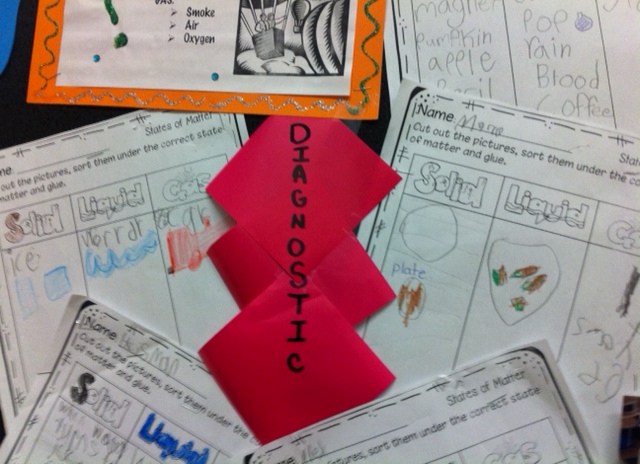
During one of my final practicum visits, I (Cathy) was excited to see one of my student teachers had created an audit trail.   When I mentioned this to her, she replied, “I thought  it was just a bulletin board.” But it was far more than ‘just a bulletin board’.   The student work Melissa had beautifully displayed represented an entire science unit of learning from pre-diagnosis to final summaries.

Audit trails were popularized by Dr. Vivian Vasquez, in her ground breaking critical literacy work with 3-5 year olds.  Vasquez says,                                                                                                             An audit trail or learning wall, as my three to five year old students called it, is a public display of artifacts gathered together by a teacher and their students that represents their thinking about different issues and topics.  This strategy is useful for creating spaces for students to re-visit, reread, analyze, and re-imagine various topics or issues. It is also a powerful tool for connecting past projects or areas of study to newer projects or areas of study. Further, it can be used as a tool for building curriculum as it visibly lays out the journey of the group’s thinking and learning over a period of time.

http://hwcdn.libsyn.com/p/c/f/3/cf355fe54466c4e0/Audit_Trail.pdf?c_id=4270455&expiration=1418946485&hwt=2cc91c9a05310c5ca082ae4a61c9c725

more walldiagnostic molecules

Txtng is killing language. JK!!!

I (Clare) am sure you have heard the moanings and groanings that texting is ruining English? Well think again. I watched this amazing Ted Talk by Iphone John McWhorter who argues that texting is another form of communication. Here are some excerpts from his talk.

We always hear that texting is a scourge. The idea is that texting spells the decline and fall of any kind of serious literacy, or at least writing ability, among young people in the United States and now the whole world today. The fact of the matter is that it just isn’t true, and it’s easy to think that it is true, but in order to see it in another way, in order to see that actually texting is a miraculous thing, not just energetic, but a miraculous thing, a kind of emergent complexity that we’re seeing happening right now, we have to pull the camera back for a bit and look at what language really is, in which case, one thing that we see is that texting is not writing at all. What do I mean by that?

What texting is, despite the fact that it involves the brute mechanics of something that we call writing, is fingered speech. That’s what texting is.

But the fact of the matter is that what is going on is a kind of emergent complexity. That’s what we’re seeing in this fingered speech. And in order to understand it, what we want to see is the way, in this new kind of language, there is new structure coming up.

So we have a whole battery of new constructions that are developing, and yet it’s easy to think, well, something is still wrong. There’s a lack of structure of some sort. It’s not as sophisticated as the language of The Wall Street Journal.
And so, the way I’m thinking of texting these days is that what we’re seeing is a whole new way of writing that young people are developing, which they’re using alongside their ordinary writing skills, and that means that they’re able to do two things … If somebody from 1973 looked at what was on a dormitory message board in 1993, the slang would have changed a little bit since the era of “Love Story,” but they would understand what was on that message board. Take that person from 1993 — not that long ago, this is “Bill and Ted’s Excellent Adventure” — those people. Take those people and they read a very typical text written by a 20-year-old today. Often they would have no idea what half of it meant because a whole new language has developed among our young people doing something as mundane as what it looks like to us when they’re batting around on their little devices.
…  if I could go into the future, if I could go into 2033, the first thing I would ask is whether David Simon had done a sequel to “The Wire.” I would want to know. And — I really would ask that — and then I’d want to know actually what was going on on “Downton Abbey.” That’d be the second thing. And then the third thing would be, please show me a sheaf of texts written by 16-year-old girls, because I would want to know where this language had developed since our times, and ideally I would then send them back to you and me now so we could examine this linguistic miracle happening right under our noses. Thank you very much.

If you want to hear the whole talk, click on: http://www.ted.com/talks/john_mcwhorter_txtng_is_killing_language_jk
It is only 13 minutes long and worth every second.

Exploring Literature Circles with Student Teachers

Yesterday with our pre-service PJ and JI literacy classes we explored the use of literature circles as part of a literacy program. The student teachers had read the novel Joey Pigza Swallowed the Key by Jack Gantos and in small groups took up the literature circle roles outlined by Harvey Daniels. After the student teachers had completed the literature circle activity the class came together again as a large group to consider and discuss the following questions: what did the student teachers think about the literature circle approach, would they use literature circles in their classroom teaching, what reactions did they have to the novel selected, and would they consider using this particular novel with their students. The student teachers engaged in an insightful and serious discussion of the questions posed. Reaction to the novel was mixed. Many of the student teachers appreciated the authors attempt to narrate the story from the perspective of a child labeled with an exceptionality (ADHD). However, student teachers also voiced their discomfort with various aspects of the novel such as the depiction of the young protagonist Joey’s interactions with various adults in the text, the issues of labeling and medicating children, the portrayal of abuse, alcoholism, and dysfunctional family dynamics in the novel.

Over the past few years Clare and I have intentionally selected this novel for use in the literacy course, in part, because the novel raises a number of serious issues teachers face in a classroom context. Each year student teachers communicate diverse reactions to the reading of this novel. For instance, we have had both student teachers who themselves have been diagnosed with an exceptionality, as well as, student teachers who as the parent of a child with an identified exceptionality tell us that aspects of novel truly resonated with their experience. In contrast, we have also had student teachers communicate their dislike and discomfort with aspects of the novel. At the end of class yesterday Clare and I reflected upon the rich class discussion, and once again asked ourselves if we should continue to use this novel with student teachers in the literacy courses. Our answer was yes. We do understand how and why the topics dealt with in the novel and the author’s portrayal of child-adult interactions are contentious and troubling. Yet, we also recognize the value of asking student teachers, who as educators will be work closely with children and families, to deeply consider the difficult and complex dimensions of a teacher’s role. As Lisa Delpit astutely reminds us “we do not really see through our eyes or hear through our ears, but through our beliefs.” As educators we must continue to challenge our beliefs about what it means to teach and to learn.


Inspiration: A compulsory component of being a teacher

I (Yiola) think about education… the endless complexities and barriers to just getting to good teaching and the kind of learning that leaves children feeling alive, fulfilled and competent.  What makes good teaching such a challenge? Government cuts, a culture of standardization, and a lack of appreciation for developing what I will call the tools of inspiration (the Arts, creative thinking, inquiry) are just a few of the challenges at the forefront of my thinking lately.

I believe most teachers begin their careers filled with excitement and determination to “make a difference”. However, without support and nourishment for inspirational teaching, teachers burn out. If teachers burn out, there is little hope for inspirational student learning.

An interesting link below talks about the need for teacher support. Let me ask you, what do you think teachers need in order for them to be, not only competent, but inspirational, creative, and “house on fire” kinds of educators?

http://www.creativitypost.com/education/apathetic_uncooperative_coals_wont_burn

Visiting the Rishi Valley School…Part 2

IMG_8033

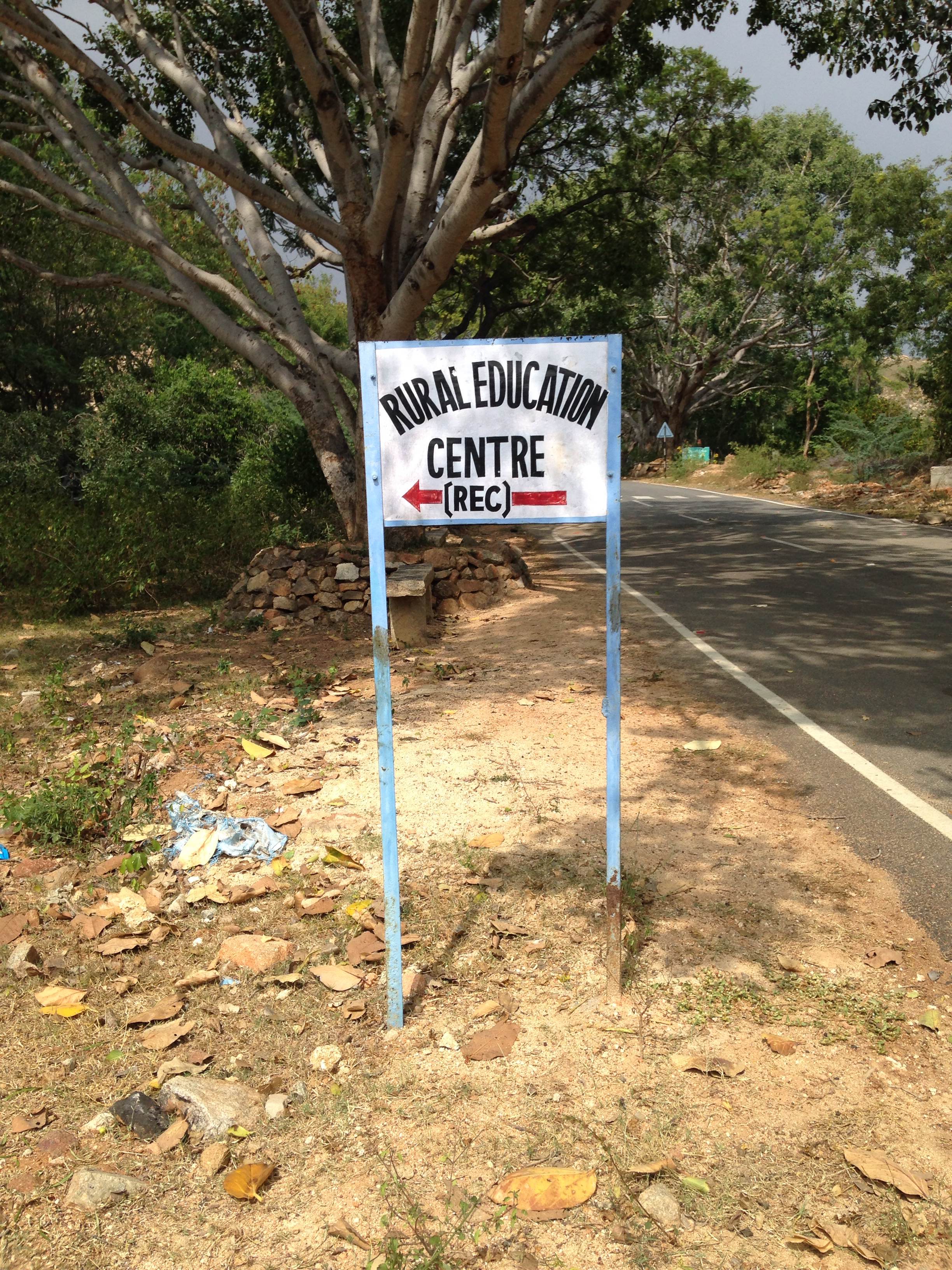
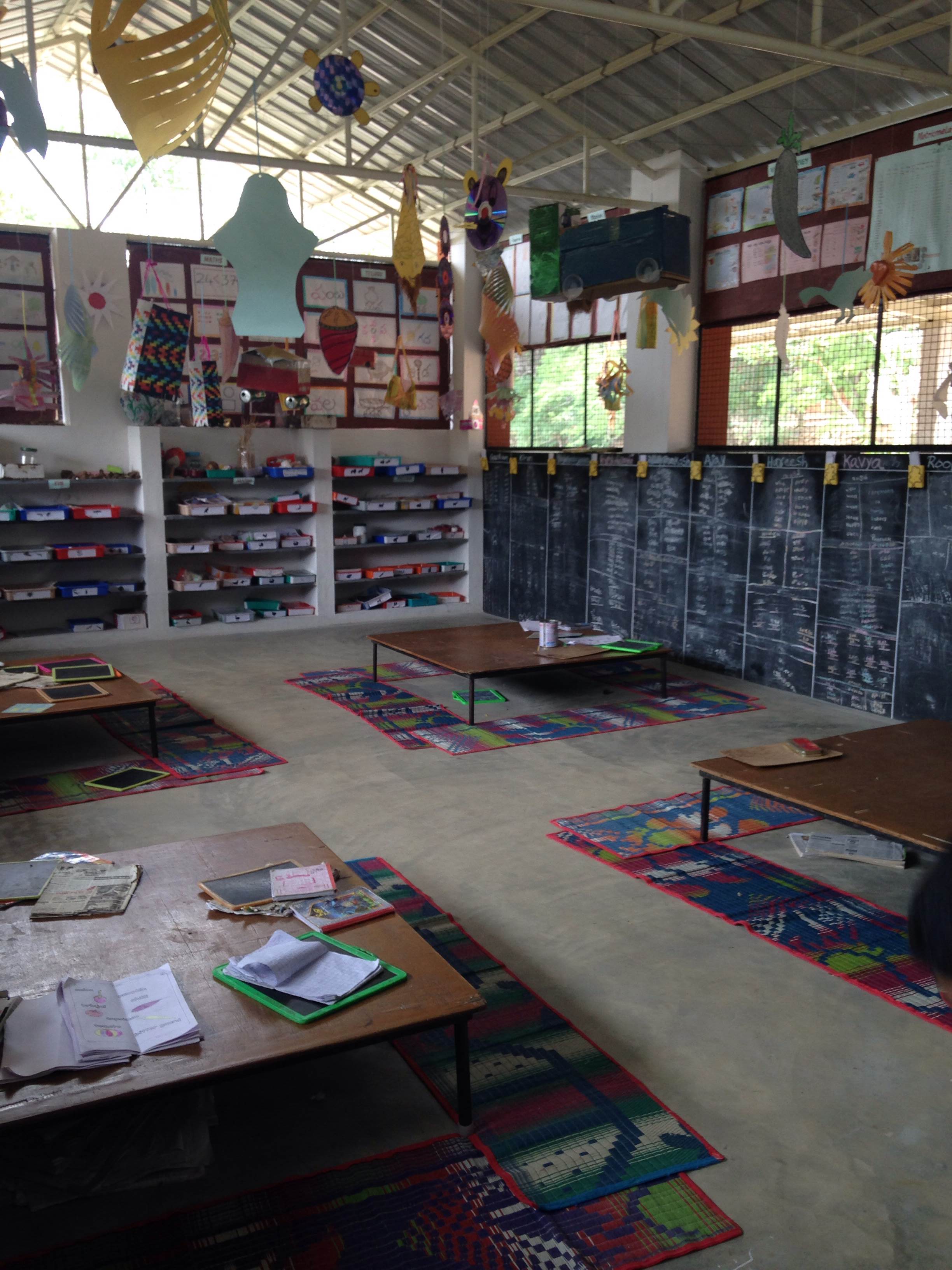
While at the Rishi Valley School I had the opportunity of visiting the Rishi Valley Institute for Education Resources (RIVER), a teacher training and development wing of Rishi Valley Rural Education Centre. The school serves children from the surrounding rural communities, several of which are impoverished. At first glance the RIVER school appears to be like many rural schools in India; one large classroom, one teacher, twenty-five students spanning across 5 grades. However, after spending an afternoon in the classroom it became clear that this classroom was not like the others. First, there are no desks or chairs; rather, there are four large tables with students purposefully seated at them. Second, Kala, the classroom teacher, does not do any stand-up teaching. Instead, she moves from table to table working with small groups of kids or one-on-one with a child with laminated graded cards. Kala is using the multi-grade, multi-level methodology which the Rishi Valley School has spent years developing, and she has spent years perfecting. At the RIVER school a “community-based curriculum is taught…where the academic curriculum is graded for individual levels of learning, grounded in up-to-date information, and framed in the local idiom, and…where the curriculum is integrated with activities.” (http://www.rishivalley.org/rural_education/RIVER.htm)

IMG_8031

The classroom

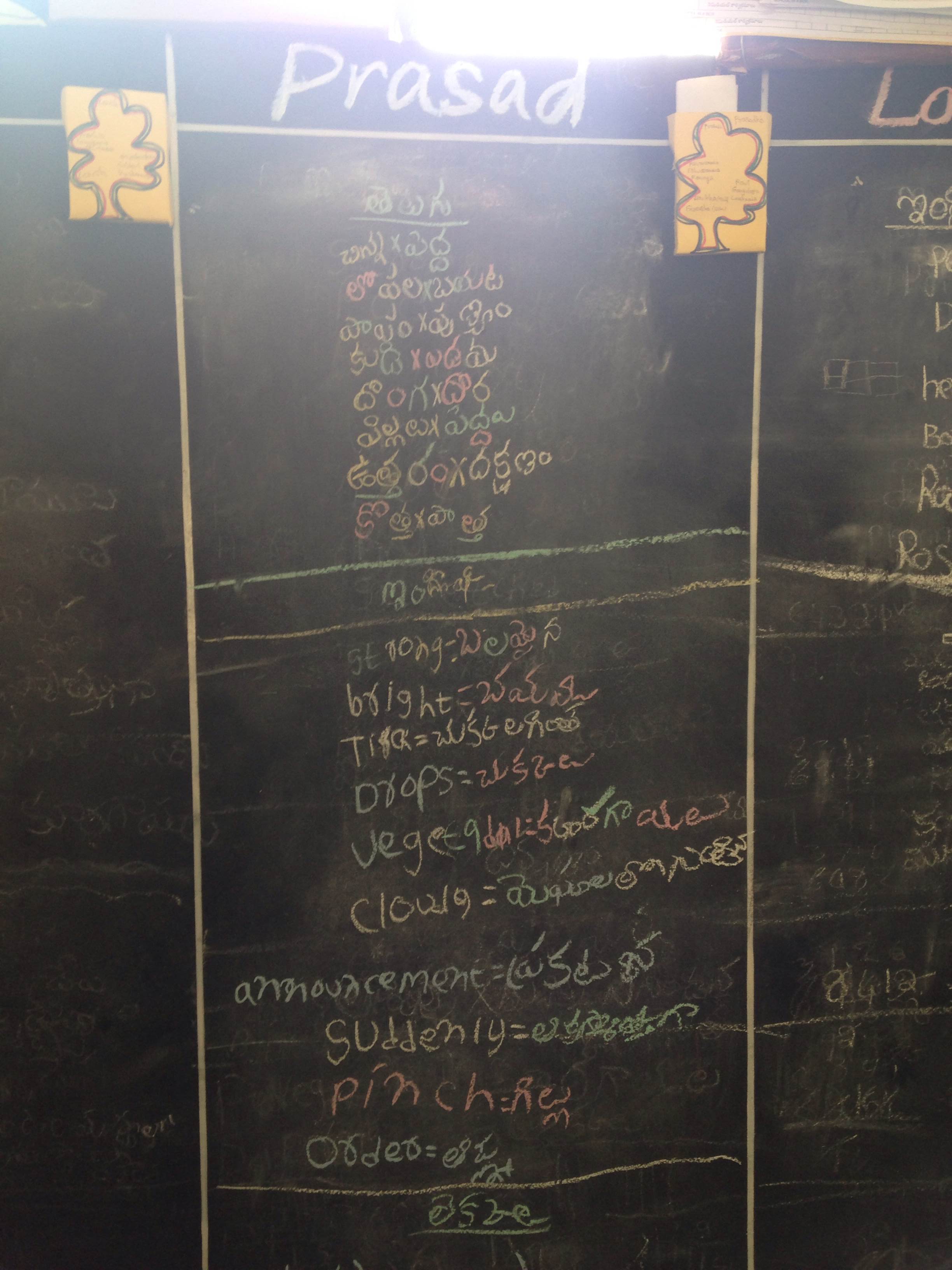
I was most interested in the pride the students took in their graded cards they had completed, as well as their designated space on the wall to record their progress (pictures below). They were all very aware of what level they were at for each of their subject. The graded cards are part of an educational kit the RIVER school has created.

This is how the educational kit works:

The education kit, a series of carefully graded cards, replaces textbooks in the area of language, mathematics and environmental science. Each card in the graded series is marked with a logo (rabbit, elephant, dog) and mapped on to a subject-specific “Learning Ladder”, a progress guide which traces out the learning trajectory for students.

Spaces on the Ladder are sub-divided into a set of milestones. These milestones consist of  cards that explain a concept;  the applications of the concept;  evaluation of students’ understanding and, finally, provide means of testing, remediation or  enrichment. A student identifies her own place on the ladder, and creates, within the broad confines of the milestones,  her own path from grade one to grade five. 

Blank spaces on the ladder allow teachers to introduce independent content into the learning process. Indeed the Ladder can be designed in flexible ways to allow for multiple trajectories between which teachers and students are able to choose so long as the sequencing required by the academic disciplines is maintained.(Source: http://www.rishivalley.org/rural_education/RIVER.htm)

 Although I only spent an afternoon in the classroom, it left a lasting impression on me. The MGML approach seemed to really have been working, and effectively addressing the prevalent issue of mutli-grade classroom across rural India. The MGML approach is being used in rural school across Andhra Pradesh, and has been adopted by many school in the state of Tamil Naidu. The creators are advocating for the approach in several other states in India. Take a look at some photos below!

IMG_8024

Kala (the teacher) working with the students. 

Screen Shot 2015-01-12 at 8.30.28 PM

Students working on Math problems at their own individual levels. 


IMG_8025
The Milestones Chart

IMG_8020

Student progress for the week. 

The Power of Children’s Voices

My (Yiola) first blog post of the year. Happy new year friends and readers. Over the course of the holidays I developed a list of interesting topics and ideas that I am excited to share here on the site. Just as I was about to select one of my ideas to share, a student teacher sent this video my way today and it took precedence.  The messages may be imperfect yet the voices of children ~ of young adolescent women ~ make it so incredibly powerful for me. The energy and the passion and the inspiration rising from literacy make it a worthwhile share.  The rhythm alluring, the tone inspiring, the messages thought-provoking, the effort immense.  If literacy inspires young people to speak in such passionate ways about such timely issues, then I say BRING ON LITERACY TEACHING.

Enjoy.