Category Archives: literacy

World Book Day

I (Clare) just found out that Thursday March 3 is World Book Day. What a wonderful event Image_WorldBookDayto celebrate. Check out this site from England: http://www.worldbookday.com which has lots of suggestions for activities for the day.

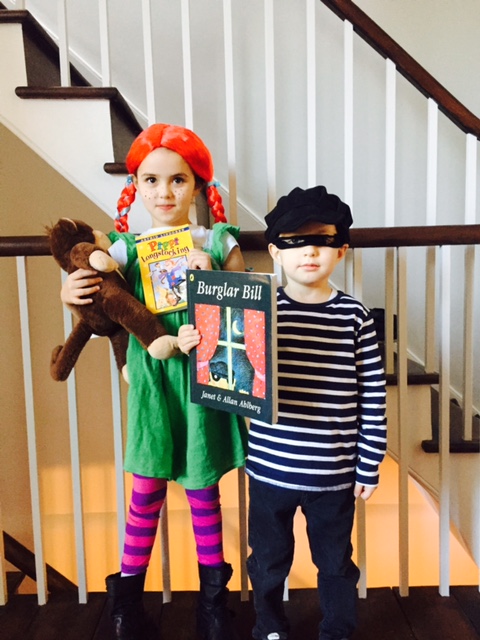
Thought you would like this picture of children dressed up as Pippi Longstocking and Burgler Bill!

Anxiety And Depression In The Classroom: What Educators Can Do To Assist Students

I (Clare) have been involved in a number of discussions re: children and anxiety. I thought I would share with you this upcoming event. For those in the Toronto area you might consider attending.Image_CECflier

IMG_1236

Teaching with Technology- A Constant Challenge


trust technology1


This cartoon reminded me (Cathy) of an incident from when I was teaching grade four.  The math problem for the day was:

A man went to bed at 11:00 p.m. and got up at 7:00 a.m. the next day.  How many hours did the man sleep?

One of my students just couldn’t figure it out it.  He usually didn’t have problems with mathematics, but he just couldn’t “see it”. In an effort to guide him, I told him to draw a clock and count the hours in between 11 and 7.

Sometime later I noticed he was sitting at his desk just staring at his notebook.  I walked over to see what he was staring at. This is what he had drawn:11


I guess my technology wasn’t matching up with his technology.  It’s a constant challenge!

International Literacy Association

The International Literacy Association (ILA) has its annual Conference coming up in Boston in July. An inspiring organization that works to build global capacity in the area of literacy, pre-service and experienced teachers alike have much to gain from learning about ILA and attending the conference.

Check out the website for more information and be inspired!

http://www.literacyworldwide.org/why-literacy

I am inspired by the advocacy piece: http://www.literacyworldwide.org/our-community/educators

From local issues to global issues ILA provides resources for professional development.

Check it out!


Teacher Education for High Poverty Schools

Jo Lampert and Bruce  Burnett have recently edited an amazing text,Teacher Education for High Poverty Schools. The text is available from Springer.

http://www.springer.com/us/book/9783319220581Image_LampertBookcover

This volume captures the innovative, theory-based, and grounded work being done by established scholars who are interrogating how teacher education can prepare teachers to work in challenging and diverse high-poverty settings. It offers articles from the US, Australia, Canada, the UK and Chile by some of the most significant scholars in the field. Internationally, research suggests that effective teachers for high poverty schools require deep theoretical understanding as well as the capacity to function across three well-substantiated areas: deep content knowledge, well-tuned pedagogical skills, and demonstrated attributes that prove their understanding and commitment to social justice. Schools in low socioeconomic communities need quality teachers most, however, they are often staffed by the least experienced and least prepared teachers. The chapters in this volume examine how pre-service teachers are taught to understand the social contexts of education. Drawing on the individual expertise of the authors, the topics covered include unpacking poverty for pre-service teachers, issues related to urban schooling as well as remote and regional area schooling.

Our (Clare) research team contributed a chapter to the text which focused on six literacy teacher educators who purposefully prepare student teachers to work in high poverty schools. Here is the chapter: TchingforHighPovertySchools

Entering a new communication paradigm

I (Cathy) have recently found myself in a new communication predicament. Diagnosed with vocal cord nodules, I have been instructed not to speak for 8 weeks. So here I am, and after only two weeks into my ‘treatment,’ I have observed some interesting things about peoples’ communication patterns.

  1. Since I can’t talk, people often whisper to me. I’m not sure why, but they do, or…
  2. They get MUCH LOUDER. I can hear just fine, but for some reason this is the reaction.
  3. People gesture wildly. Again, I can hear them, but they clearly need to emphasize what they are saying.

I could theorize about the reasons why they do this: a need overcompensate for my sake; empathy perhaps; or they are just plain uncomfortable with the situation. But wait, there is more…

I started carrying a note pad to write messages to communicate and discovered these patterns:

  1. If the message is longer than two sentences, people get restless. The common quip is “Are you writing a novel?”
  2. Once I start to write an answer, if they don’t want to wait, they answer their posed question for me! I am always fascinated by ‘my response.’
  3. Some people prefer me to print as opposed to write, so I have to rewrite/print the message. My son actually told me to “just text him” at the dinner table. (BTW, my handwriting has improved dramatically due to the necessity of being understood)

In an effort to be more current and efficient, I started using the “speak feature” on my iPad and iPhone, but this has its own set of complications:

  1. The response process: typing, highlighting the text, and then tapping the ‘speak’ feature, takes less time than it does for me to write a note in longhand, yet people are less patient with the electronic process. I suspect they feel it should be immediate.
  2. Most people have trouble understanding the electronic voice. They frequently say, “I didn’t get that.” I think it’s because the intonation is usually off. I often have to repeat the message. (I have totally given up on using a ‘cool’ voice app as people can’t understand the regular voice. I was hoping to use the Stephen Hawkings app).
  3. Instead of listening to the voice again, often people reach for my iPhone to read the message in print for themselves, but sometimes the print is too small for them to read, so I have to enlarge it- which takes even more time.
  4. Interestingly, people often want to type their response on my iPad instead of speaking back to me. They take the iPad right out of my hands to do this. I also tried using the chat feature on Skype so I could respond to the person on the screen, but the other person only wanted to type in chat too. Although they were right there in front of me, and were perfectly capable of talking- they didn’t! This leads me to believe that people are getting more comfortable communicating through print  than speaking.

Finally, I play a large role in this and am just a quirky:

  1. I often try to mouth the words which becomes a great game of “guess what Cathy is trying to say.”
  2. As I am familiar with rudimentary sign language, having taken several courses to communicate with my niece and having taught in a total language classroom, that is my default. I sign to people, which of course they don’t understand because it is another language! One friend told me “I have no idea what you are saying, but I love to watch.”

Sadly, my friends and colleagues who are ELL totally empathize with me, as they tell me this is all too familiar for them. I truly feel for them now.

All in all, this is a fascinating study in multimodal communications. Mostly, I just listen. I was told that people pay a great deal of money to attend ‘silent retreats,’ so I am trying to treat this like a gift in self-discovery. Apparently, I have a lot to learn.


Ode to Children’s Writers

I (Cathy) finished my third Kate Morton novel yesterday, The Forgotten Garden. Intriguing style. Here is the synopsis shared on http://www.austcrimefiction.org

When thirty-eight year old Cassandra Ryan discovers her grandmother Nell’s secret – that she was not the biological child of her parents, but a foundling – she is intrigued. Inside the suitcase found with the abandoned child at the Port of Brisbane in 1913 Cassandra finds a package of letters, a children’s storybook, and a coded manuscript belonging to Eliza Makepeace Rutherford: the Victorian authoress of dark fairy-tales who disappeared mysteriously in the early twentieth century. And so begins the quest to solve a century-old literary mystery.

I found the story line more interesting than some of Morton’s other books, partly because it was about a woman- Eliza Makpeace (Authoress)- who wrote fairy tale stories for children. The stories were included in the novel as chapters: The Cuckoo’s Flight, The Crone’s Eyes, and The Golden Egg. I particularly enjoyed the Crones Eyes. Deliciously dark!

As a collector and teller of traditional folk lore (I love the collections of Lang, Grimm and particularly, Jacobs), I found her stories strikingly similar to the old folk tales of Europe- frightening and heroic. People often died in those, not like in the Disney versions of today (e.g., in the original Andersen version of The Little Mermaid, the mermaid dies). As I was mulling this over, I happened to come across Morton’s acknowledgements:

I would also like to pay tribute here to authors who write for children. To discover early that behind the black marks on white pages lurk worlds of incomparable terror, joy, and excitement is one of life’s great gifts. I am enormously grateful to those authors who’s works fired my childhood imagination and inspired in me a love of books and reading that has been a constant companion. The Forgotten Garden is in part an ode to them.                                               Kate Morton

I was warmed by this acknowledgement. I think the stories of our youth live in us forever. If you enjoy traditional lore as much as I, I highly recommend reading The Forgotten Garden. For my part, I plan to write to Kate Morton’s publisher to obtain permission to tell them. They would make a delightful set at a festival and would hopefully fire the imaginations of the children (and adults) who listen.

garden

Second Wave Change

Every once and a while I check online to see if my favorite literacies scholar, Allan Luke, has presented something new I can learn from.

Allen

Although not ‘new’, this time I happened upon a  short and poignant video called Second Wave Change.  It’s a succinct  explanation of  the kind of substantive content our students need to be discussing and thinking about to change our world.  This is a perfect video for student teachers.

So worth watching, but Allen Luke always is.


Is Texting Killing Language?

Image_JohnMcWhorterOn Sunday Clive posted a blog Short or Long Form Writing? I (Clare) also wonder/worry about our new forms of communication and what is happening to “English.” John McWhorter did a fabulous Ted Talk  asking is Texting Killing Language. http://www.ted.com/talks/john_mcwhorter_txtng_is_killing_language_jk

It is truly worth listening to because he gives us a different perspective. He notes:

We always hear that texting is a scourge. The idea is that texting spells the decline and fall of any kind of serious literacy, or at least writing ability, among young people in the United States and now the whole world today. The fact of the matter is that it just isn’t true, and it’s easy to think that it is true, but in order to see it in another way, in order to see that actually texting is a miraculous thing, not just energetic, but a miraculous thing, a kind of emergent complexity that we’re seeing happening right now, we have to pull the camera back for a bit and look at what language really is, in which case, one thing that we see is that texting is not writing at all. What do I mean by that?

Casual speech is something quite different. Linguists have actually shown that when we’re speaking casually in an unmonitored way, we tend to speak in word packets of maybe seven to 10 words. You’ll notice this if you ever have occasion to record yourself or a group of people talking. That’s what speech is like. Speech is much looser. It’s much more telegraphic. It’s much less reflective — very different from writing. So we naturally tend to think, because we see language written so often, that that’s what language is, but actually what language is, is speech. They are two things.

What texting is, despite the fact that it involves the brute mechanics of something that we call writing, is fingered speech. That’s what texting is. Now we can write the way we talk. And it’s a very interesting thing, but nevertheless easy to think that still it represents some sort of decline. We see this general bagginess of the structure, the lack of concern with rules and the way that we’re used to learning on the blackboard, and so we think that something has gone wrong. It’s a very natural sense.