Category Archives: Teacher education

Jo Lampert: National Exceptional Teachers for Disadvantaged Schools Program

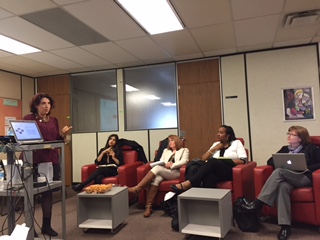
IMG_0339I (Clare) invited Jo Lampert from Queensland University of Technology to talk to our research group about IMG_0340the National Exceptional Teachers for Disadvantaged Schools Program which she and Bruce Burnett direct. This is an amazing program which aims to prepare student teachers to work in high needs schools.

The Faculty of Education developed the National Exceptional Teachers for Disadvantaged Schools (NETDS) program in 2009 to address the significant social issue of educational disadvantage through a teacher education program that explicitly focused on the preparation of high-quality teacher graduates. NETDS ensures that the best suited pre-service teachers are equipped to teach and encouraged to select employment in low socio-economic status school settings.

Each year we identify our highest-quality pre-service teachers who participate in a specialised curriculum that better prepares them to teach within low socio-economic status schools. We’ve partnered with the Queensland Department of Education, Training and Employment and key low socio-economic status schools to help channel these exceptional pre-service teachers into sites where they can have the greatest impact.

Jo LampertWe learned:

  • Approximately 90% of NETDS graduates have secured employment with schools below the Australian mean Index of Community Socio-Educational Advantage level of 1,000.
  • Many graduates secure full-time employment in low socio-economic status schools before they graduate.
  • School partners have grown from 3 in 2009 to approximately 50 in 2014.
  • We’ve developed distinctive workshops focusing on ‘real world’ issues related to disadvantage.

For more information go to their website: https://www.qut.edu.au/education/about/projects/national-exceptional-teachers-for-disadvantaged-schools

Another school year coming to an end in teacher education

Many universities have their last week of classes this week. The message I (Yiola) end my courses with and what I hope resonates with my student teachers is the message that, at the end of the day,  teaching is ultimately a relational act.  Teaching is about building relationships and fostering a sense of care — having students build a love, respect and belief in themselves and a concern for and desire to learn and achieve. As teachers, we play a significant role in that belief.

In my courses we explore instructional methods: lesson planning, learning environment, creative teaching, and so many curriculum areas. We frame these practices in critical pedagogy and a pedagogy of care. I do my best, in the weekly / bi-weekly class structure of the university, to model what I outline above.

inspiring

I came across this ad on social media and it caught my attention. It made me think of all those  I work with, teach, and care about.

To you I encourage: question thoughtfully, think critically, read intently, and teach confidently.

Wishing everyone a happy end of the school year.

Lin Goodwin Video Now Available: Experts Speaking about Teacher Education

Last year I (Clare) received a grant for the project: Rethinking Literacy Teacher Education Lin Goodwinfor the Digital Era: Teacher Educators, Literacy Educators, and Digital Technology Experts Working Together. One of the main activities of the project was to bring together 16 experts from three fields and 4 countries (Canada, US, UK, and Australia) to address the following questions.
• How is our understanding of literacy evolving in light of the new ways we communicate?
• How can literacy/English teacher educators (LTEs) prepare student teachers to develop and implement literacy programs that capitalize on digital technology (DT)?
• What teacher education curriculum changes are required to better prepare future teachers to integrate technology in their own teaching?
• What professional learning support do LTEs need to develop courses that will integrate and make greater use of DT?

We held a Symposium in London England in June. Click on the link https://literacyteaching.net/connection-grant/ for more info on the Symposium and for some photos.

At the Symposium we interviewed the participants which we video taped. These videos are now available. They are incredibly interesting, informative, and short. Teacher educators can use these in their courses/presentations. Click on https://literacyteaching.net/connection-grant/powerpoint-presentations-and-videos/

(or the box to the right of this post).

I want to bring your attention to the second video which is of Lin Goodwin from Teachers College, Columbia University. She addresses:

First video: A key insight she has had about education

Second video: Recommendation to improve teacher education

Lin’s powerpoint presentations are also included. Lin is the Vice President of Division K Teaching and Teacher Education for AERA. She is an outstanding researcher who has recently conducted systematic research on teacher educators. Attached is a recent article she co-authored: What Should Teacher Educators Know and Be Able to Do? Perspectives From Practicing Teacher Educators Goodwin_-_WhatShouldTeacherEducatorsKnowandBeAbletoDoPerspec[retrieved_2015-03-28]

Enjoy!

Videos Now Available: Experts Speaking about Teacher Education

Last year I (Clare) received a grant for the project: Rethinking Literacy Teacher Education for the Digital Era: Teacher Educators, Literacy Educators, and Digital Technology Experts Working Together. One of the main activities of the project was to bring together 16 experts from three fields and 4 countries (Canada, US, UK, and Australia) to address the following questions.
• How is our understanding of literacy evolving in light of the new ways we communicate?
• How can literacy/English teacher educators (LTEs) prepare student teachers to develop and implement literacy programs that capitalize on digital technology (DT)?
• What teacher education curriculum changes are required to better prepare future teachers to integrate technology in their own teaching?
• What professional learning support do LTEs need to develop courses that will integrate and make greater use of DT?

We held a Symposium in London England in June. Click on the link https://literacyteaching.net/connection-grant/ for more info on the Symposium and for some photos.

At the Symposium we interviewed the participants which we video taped. These videos are now available. They are incredibly interesting, informative, and short. Teacher educators can use these in their courses/presentations. Click on  https://literacyteaching.net/IMG_2599 (the box to the right of this post). I want to bring your attention to the first video which is of Bethan Marshall from King’s College London. She addresses:

First video: A key insight she has had about education

Second video: Recommendation to improve teacher education

Enjoy!

Heather Has Two Mommies

Heather Has Two Mommies, Lesléa Newman’s trailblazing picture book is celebrating a 25-year milestone. Many years ago advice from an acquaintance motivated Newman to write the book. She explained, “an acquaintance, who happened to be a lesbian mom, had stopped me on the street and as we were talking she said, ‘There are no books that show a family like ours. You should write one.’ ” Newman recalled. “I decided to take it seriously. I knew how those kids felt. When I grew up in the 1950s there were no books about a Jewish girl eating matzoh ball soup with her bubbe on Shabbat. I definitely felt like an outsider. It struck a chord with me.” Publisher Candlewick is celebrating by publishing an all-new illustrated edition of the book. See the link below to read more about how the book was initially received and some of the controversy surrounding the picture book: http://www.publishersweekly.com

Heather

How educators understand poverty: One teacher’s perspective

More and more,  poverty awareness is coming up in my teacher education classes. Perhaps this is because I (Yiola) am gaining more confidence about how to frame, discuss, and process the issues associated with teaching poverty awareness.  Or perhaps it is because students are seeing issues of poverty play out in their placements and are comfortable to raise questions in our class.  Whatever the cause for the awareness I am glad this discourse has made its way into my classes.

Ultimately the questions lead to, what can teachers do? I teach two levels of teacher education courses this year: I teach at the Masters level and I am also teaching a first year undergraduate teacher education course.  I can safely say that most student teachers care about poverty awareness and I can also safely say most student teachers do not know what to do about it.

Then a student in my Masters level course shared this link with us:

The video is of one teacher beautifully expressing the trials and tribulations of one student in her class. It is a very sad story. It is depressing. But it is much more than that. The narrative presents a perspecitve that all teachers must have; an understanding that poverty makes life hard… BUT… this is not the fault of the child. The teacher’s acknowledgement that her student is smart and capable and kind is central to this discourse. Many scholars acknowledge that teachers must hold affirming views of their students. And, I sense that most students teachers shrug this concept off as “yah yah, of course. That is obvious. Of course I will like all my students.”  but to move beyond the circumstances and consequences of poverty to see that a child who is experiencing that plight IS capable, smart and kind is not so obvious.
When we viewed the video in class many of us were near tears.  I questioned whether this was a good thing or not. It is important to raise awareness but such awareness cannot  just hang out there in agony and leave students feeling despair. Awareness must move beyond understanding to the “what can I do? As a teacher what am I going to do?”.  Here the video stops short but our discussions continued.  Student teachers began to blend theory with their placement practice to try to make sense of how they could possible make “carrying the one” manageable so students living in poverty can make gains in their learning and their lives.  This is no easy feat. We set out some steps for our work as teachers: The first step is teacher awareness, the next step is having students know they are cared for and believed in, and the step after that to critically assess our own practices so our methods are accessible, manageable, and achievable so students feel success.  Each of these steps require intense reflection, listening, thinking, studying and experience.  I haven’t touched on levels of community or institutional activism and that is with intention. In my experience, student teachers need to understand that work for themselves first.
To have student teachers think and teach in these ways is activism.  Some student teachers are there in their understanding and are leaders… most are not. My goal is to support student teachers’ learning and further their understandings of the social determinants of educational success so they have the knowledge and skills to deal with issues in their classroom.
The video I share above is powerful. There are thoughtful, powerful descriptions in her narrative about her student(s), their families, and schooling that help illustrate just what it means to be a student living in poverty.

Powtooning about Powtoon

I (Cathy) made a Powtoon about making a Powtoon.  Just follow the link below:

http://www.powtoon.com/show/dK9qzPurSC7/intro-to-powtoon/#/

If you are not familiar with Powtoon, it is an animated on-line presentation software tool that creates explainers, videos and presentations.  If you can create a power point, you can create a  Powtoon.  Only a Powtoon is much more interesting and fun!  It is an effective  tool for flipped classrooms and they make great multimodal assignments for students.  You can find many how-to videos on youtube.  My favourite was  on script writing (for powtoons):

https://www.youtube.com/watch?v=lyB1Y9xkSec

The Powtoon web site also hosts a set of tutorials to help you get started:

http://www.powtoon.com/tutorials/#prettyPhoto

The Powtoon I created was through a free account.  In that account I have access to  five minutes of Powtooning, 10 tunes and 11 animation styles.  Cant wait to make another.

Hope you give it a try!


Dewey meets Delpit: Bringing theory to life in teacher education

Last week I (Yiola) tried something in my teacher education course that was less safe. I brought together divergent theorists,  multiple contexts and eras and encouraged practicum connections in ways that are not typical.  I was unsure of the outcome: would the student teachers understand? connect? appreciate? Just as I encourage our students teachers to take risk, I took a risk in hope new understandings, connections and realizations about teaching and learning would occur.  At the end of class students applauded… when does that ever happen? The comments and reactions at the end of class indicate that students appreciated the class content and left class with much to think about.

I have recently re-read Dewey’s Education and Experience (1938) and was inspired to share the ideas with my class, namely what is miseducative practice? And how do traditional and progressive models of education play out in classrooms today? We discussed how both models are quite transparent in today’s classrooms. We also explored Dewey’s recommendation of a theory of education that is based on a philosophy of experience. Student teachers felt that the notion of experience is now more commonly understood and a desired practice in teaching. We discussed how finding a coherent theory of education based on a philosophy of experience would require transcending the notion of “either/or” traditional or progressive models and moving into integrative reasoning. So this is all quite typical… and then I introduced Delpit.

In Delpit’s work Other People’s Children  (1988) Delpit described herself as “a product of skills-oriented approach to writing and a teacher of process oriented approaches”.  Her amazing chapter, The Silenced Dialogue,  illustrates Dewey’s request to have educators think deeply about the either/or debate between models of education and the implications of our practice on student learning. Delpit explains the following about her chapter, “My charge here is not to determine the best instructional methodology… Rather, I suggest that the differing perspectives on the debate over “skills” versus “process” approaches can lead to an understanding of the alienation and miscommunication, and thereby to an understanding of the “silenced dialogue”… this is precisely what Dewey asked of us fifty years prior, that as educators we must go deeper than thinking across methods; we must use a philosophy of experience to deepen our understanding of the best ways to teach children. For Delpit, the experiences are those of Children of colour and children who experience poverty.

Exploring Dewey’s concepts through the lens of power and Delpit’s context of literacy was remarkable. The process of grounding Dewey’s theories in Delpit’s work provided grounding for both scholars in ways that I wasn’t yet unprepared. Students were excited to talk about a philosophy of experience by looking as social context as a foreground for understanding models of education; for understanding why certain methods may work well and not well and how to move our practice forward so all students are not only learning but are successfully learning in ways that are empowering them.

The final layer of discussion in class was to connect the ideas to their own placements. To tell stories of methodological challenge and to explore how to address those challenges thinking about what Dewey suggests and what Delpit illustrates. Again, students were speaking in detail on the gaps and the glories in their classrooms and schools.  The result of this class: discussion sophisticated and practices validated.

We finished the discussion by reading aloud the last paragraphs of Delpit’s chapter; as a reminder of the enormous but yet delightful task we have as teachers if we truly wish to create learning for all:

We must keep the perspective that people are experts in their own lives. There are certainly aspects of of the outs tide world of which they may not be aware, but they can be the only authentic chroniclers of their own experience. We must not be too quick to deny their interpretations or accuse them of “false consciousness”…And finally, we must be vulnerable enough to allow our world to turn upside down in order to allow the realities of others to edge themselves into our consciousness…  

By doing what Delpit suggests and with keeping Dewey’s foundational perspectives in mind we as teachers can begin to understand how models work in classrooms.