Category Archives: Uncategorized

Rescue Time

Self tracking applications (e.g. Fitbit, Sleep Cycle, Moodpanda, MyFitnessPal) have gained much popularity over the past few years. People want to track how many calories they are consuming; how many steps they are taking; how many hours of deep sleep they are getting.

I was recently introduced to another self-tracking application, Rescue Time. This application monitors your computer and tracks usages such as hours spent on e-mail, hours spent writing, and hours spent on facebook (too many!) According to their website (https://www.rescuetime.com), Rescue Time believes their application can help you be the most efficient with your time:

Image taken from Rescue Time's website
Image taken from Rescue Time’s website (https://www.rescuetime.com)

On one hand, with so many possible distractions at play while working, I see that Rescue Time could be a useful tracking tool. However, on the other hand, I wonder if Rescue Time could add to my already long list of possible distractions!?

Has anyone used this application? What have been your experiences? I would love to hear from you!

Chronicles of a Parent & Teacher Educator on Full Day Kindergarten

Last Thursday was “Kindergarten Parent Information Night” at the school my Sylvia Clare is going to attend in September. I (Yiola) hugged my children goodnight at 6:45pm and I made my way over to the local elementary school. As I walked to the school I felt excited and interested to attend the information session and to hear about the priorities of the school.  I know there are going to be at least 5 kindergarten classes; so, 5 x30 children equals 150 sets of parents… that makes for a room full of curious listeners.  I walked into the school just past 7:00pm and was greeted in the front lobby by the principal. In the gymnasium sat about 80 parents and in the course of one hour we heard from the principal and all 5 kindergarten teams (teacher and early childhood educator).

Parts of the presentation that stood out  :

1) Emphasis on Intentional Play – The principal provided wonderful examples and rationale of what play-based learning is about and why it is a powerful approach for early learning.

2) Emphasis on Inquiry – The principal spoke a lot on inquiry as part of the play-based program and that through intentional play children are engaged in inquiry

3) Outdoor time – Children explore, inquire and play outside everyday, for a good part of the day.

As an experienced pedagogy researcher and a teacher educator I was happy to hear all that was shared and felt that “in theory” this school has the elements that are not only in keeping with Ontario Ministry guidelines but are also evidenced-based best practice.  I was hoping to hear more about the balance and connection between literacy and numeracy development and intentional play and inquiry. The principal spoke about how students develop language and literacy skills through intentional play but I also wanted to hear about time spent on phonics and phonemic awareness and whether or not these fundamental skills were taught with focus.

The teams of teachers shared rules and routines for kindergarten and the early years schedule. The schedules will go something like this:

Open Entry 8:40 – 8:55

Outdoor Play 9:00 – 9:30

Intentional Play/Inquiry 9:30 – 11:30

Lunch and Outdoor Play 11:30 – 1:00

Intentional Play / Inquiry 1:00 – 3:00

Outdoor Play 3:00 – 3:25

During the intentional play 6 curriculum areas are covered: Language, Mathematics, Science/Technology, Health and Physical Education, the Arts, Personal and Social Development. Again, how lovely it was for me to see a schedule that was designed for authentic integration of curriculum.

I then had the opportunity to tour the classrooms. Gone were bright primary colours and in their place were neutral tones and a good amount of natural and wood materials. Very little plastic. No “toys”. I sensed a good deal of Waldorf influence in the aesthetics of the room. I was able to see that the child is at the centre of the classroom — student work displayed throughout in tasteful and meaningful ways. Almost everything in the classroom, including the alphabet was student made, not store bought. Images of the children, their photos were also present in the room. The classrooms, 4 out of 5, were bright, spacious and inviting.

Next step: a letter is to arrive in the mail with details of an interview. Sylvia Clare and I are going to meet with her new teacher and be introduced to her classroom. This is to happen in August.

Overall I was impressed with what I heard and saw. I enjoyed speaking with the principal and some of the teachers.  I am going to look into scholarly articles that discuss literacy development and intentional play so I am better prepared for what to expect in the daily life of the classroom. I am also going to write articles based on my own research — coming soon!  Parents/grandparents/teachers/principals/teacher educators with early years/kindergarten experience — share your insights of FDK and interesting articles that connect FDK with literacy development.


Challenges with Travelling Digitally

While packing for a recent trip , I (Cathy) noticed a change in my travel necessities.  Here is what was on the top of my list:

Iphone & charger  (for photographs, facebook, texting& directions)

Ipad & charger   (for Skype, games and bill payments)

Ipod & charger, earphones  (for novels and music)

Camera & charger (the Iphone only goes so far!)

Portable battery and cable (what if there is no outlet in the airport???)

As little as one and one half  years ago I never would have listed such items.  Times have changed.  As convenient as these items may be to bring, I discovered  a glitch in travelling digitally…5 devices but only one electrical adapter.  Which one needs to be charged first?  Now I have to prioritize my necessities!

digital

Full Day Kindergarten in Full Swing

Tis the season for parents  with children turning 4 years old to become acquainted with formal schooling and the Full Day Kindergarten (FDK) expectations. Ontario, Canada has implemented full day Kindergarten for all students across the province.  I (Yiola) am experiencing first-hand the excitement and apprehension of sending my child, a darling, vulnerable, sensitive, sweet girl (Sylvia Clare), to school for 6.5 hours a day, 5 days a week.

Jumping online, I have read reviews — some for and some against — FDK and many focusing on children’s language and literacy development.  See below for some examples:

Full-day kindergarten children score highest in vocabulary, self-regulation

http://www.theglobeandmail.com/news/national/education/full-day-kindergarten-offers-no-academic-advantage-study-says/article17715532/

As a parent, my worry is not so much if my Sylvia Clare’s academic achievement will be more or less. As a parent, my worries are related to her well-being. Will she be happy? Will she love herself even more? Will she make friends and learn how to work/play with others well? Will she come home each day and share stories of interesting things she did and learned.   I most certainly want to her read and write, but in good time. I feel there is no rush and I want a pressure-free learning environment for her.

In a recent article  http://www.mykawartha.com/news-story/4397024-why-full-day-kindergarten-has-better-prepared-our-kids-for-grade-1/,  educational consultant Joan Ruf comments:

“One of the wonderfully positive things about full-day kindergarten is the appreciation of the whole child,” she said, explaining the program is successfully marrying the concepts of academic and emotional growth. “So it’s not just about reading and math. It’s about how are they doing. What are they doing for themselves.”     This statement gives me some comfort.

Schools in Ontario are now inviting parents to attend FDK information sessions in order to prepare ‘us’ for the year ahead.  I will be writing about my experiences going through this process and journaling Sylvia Clare’s experiences as she begins FDK in September.

As a professor of education, through the researching and teaching and writing and sharing,   what lies at the centre of my work  are the children and their development as happy, healthy, thoughtful, literate human beings.

The issues surrounding FDK: its purpose, process, and outcomes are vast. With a political election looming the topic of FDK is front and centre and how it will be managed and maintained is up in the air.

The Canadian Society for the Study of Education

conference

This week The Canadian Society for  the Study of Education (CSSE) is being held in St. Catharines, Ontario at Brock University.

The team, Clare, Clive, Lydia, Cathy, Pooja, and me (Yiola) will be sharing a number of presentations over the course of the week. Some of these presentations include the following titles:

Teachers’ Professional Identity Development Over Their First 8 Years, With Implications for Preservice and Inservice Teacher Education

Teachers’ Ongoing Learning over Their First 8 Years, with Implications for In-Service Professional Education

Exploring literacy teacher educators’ negotiations of a critical stance in pre-service teacher education

Teachers’ critical literacy practices in the early years classroom

Instructional Practices of Critical Literacy within an Inquiry-Based Learning Environment

Presenting at conferences is a great way to share research with the community.  For more information about the CSSE conference click here:  

Conference


Spending Too Much Time On Your Phone?


photoLike most, I (Pooja) find myself engaged with my smart phone too much. I often make attempts to limit my usage. I tell myself things like “I won’t check Facebook until it’s time for bed”, but these promises I make myself are hardly ever kept. Perhaps a doggy cone is not such a bad idea!

Social Media 101

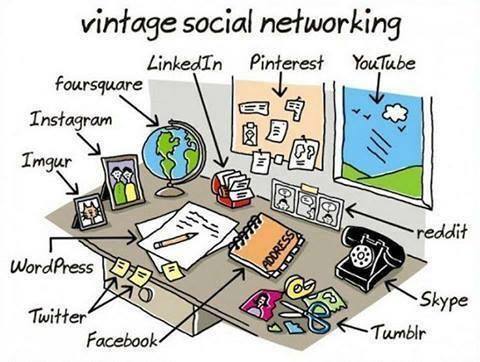
I (Yiola) came across this while on social media and found it playful… and true!

10259931_10152488203689175_8001628699976626381_n copy


A great explanation of social media and their functions.   I often think about the degree of necessity of each of these forms of communication — what they offer and their implications for communication and social interactions.  I am contemplating the pros and cons and beginning to explore literature that shares findings of the implications of our newer forms of communication.

Engaging with Suffixes

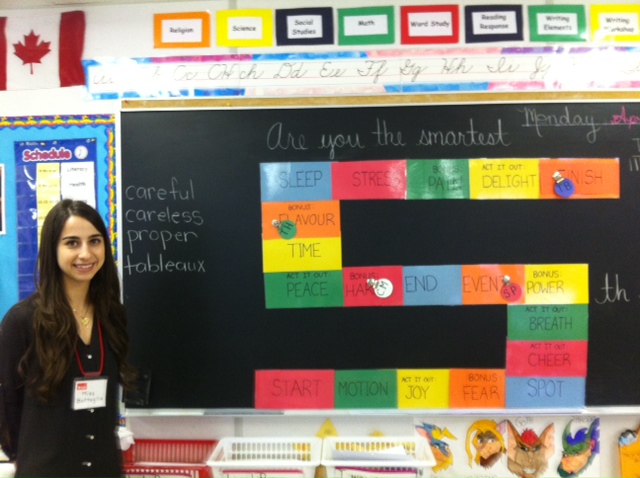
“How to engage students in the understanding and use of suffixes?” was the pressing question on my (Cathy’s) student teacher’s mind. Erica told me she mulled this over for several days, trying to get the pieces to fit together just right.    Her final creation – a suffix game. The wonderfully large, colourful game board alone was enough to grab her grade five students’ attention. Played in teams, each group had to role a gigantic die to move their magnetic counter on the board.   Some spaces on the game board depicted words (e.g. effort, bonus, time) which each team had to add either the suffix ‘less’ or ‘full’ to, and then write each word correctly in a sentence. Small white boards were provided to each team for this task.   Other spaces on the board instructed the teams to create a tableaux depicting the new meaning of the word once the correct suffix was added. A few  spaces on the board provided bonus points.

I have always had a concern about student teachers being focused on ‘fun’ over learning and wondered about the level  of learning these students would experience with this game. This concern, however, was mollified when I witnessed the mistakes the teams were making which forced them to rethink their answers.  The animated group discussions regarding which was correct were very interesting to observe.  When the nutrition bell rang and the grammar lesson came to an end, there were groans and moans of protest. Imagine, grade fives liking grammar. Erica wisely told them they could play again soon.

Erica's Game


A Mighty Girl

mightygirl

My twin niece and nephew are 4 years old. They both have loved books for as long as I can remember. They are currently learning how to string together sounds from the alphabet. As a super-involved aunt and literacy teacher, I try to expose them to a wide variety of texts. I want them to be exposed to texts which promote inclusivity, challenge stereotypes, and inspire creativity. For this reason I was delighted to find out about the Mighty Girl website.

“A Mighty Girl is the world’s largest collection of books, toys, and movies for parents, teachers, and others dedicated to raising smart, confident, and courageous girls.”

The Mighty Girl collection of books aims to disrupt the status quo of how girls are represented in fairytales. The collection of books strives to break the ‘damsel in distress’ mold, and so feature girls in alternative fairytales who are courageous, smart, and daring! I know I’ll be picking up a few of these books to read with my four-year-old niece and nephew! Some of the book titles include:

  • Not All Princesses Dress in Pink (Yolen & Stemple, 2010)
  • Dangerously Ever After (Slater, 2012)
  • Thunder Rose (Nolen, 2007)
  • The Seven Chinese Sisters (Tucker, 2003)

A full list of fairy/folktales on the Might Girl site:

http://www.amightygirl.com/books/fiction/fairy-tales-folktales

Photo Highlights from AERA 2014

The 2014 American Educational Research Association (AERA) conference took place this year in Philadelphia. I was able to attend some fascinating paper sessions, poster sessions, and symposiums during my time there. I also managed to make it to the memorable museum district area of Philadelphia. Here are some photo highlights below:

My dear friend and research colleague, Cathy Miyata, presenting her paper Negotiating Multiliteracies Pedagogy in International Preservice Teacher Education:

photo6

A fascinating panel titled Defending, Reforming and Transforming Teacher Education: The Future of Teacher Education in the United States. This panel’s members included Linda Darling-Hammond, Timothy Knowles,  Kwame Griffith, and Kenneth Zeichner.

photo3

An important symposium on ways teacher education programs around the world  are preparing preservice teachers for marginalized students. The symposium entitled Building Infrastructure and Capacity Research Innovations Worldwide That Prepare Teachers for 21st Century Schools That Service Marginalized and Poor Students in Transnational Contexts. Below is a photo of Dr. Clare Kosnik sharing findings from our international study on Literacy Teacher Educators:

photo5

A relaxing dinner with our research group, Becoming Teacher Educators.

photo4

Finally, a photo from the museum district which is looking south on Benjamin Franklin Parkway. I was standing on the iconic steps where Rocky trained while taking this photo!

photo2-3