Category Archives: Uncategorized

More Than a Princess

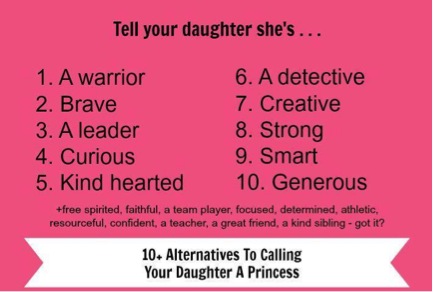
Earlier this year I (Pooja) blogged about a series of books from Mighty Girl which focus on disrupting the gender stereotypes placed on young women. The Mighty Girl site recently shared blogger Carla Molina’s blog about what to call your daughter besides (or in addition to) a ‘princess.’ In her blog, Molina notes, “we are not anti-princess in our home. We are mindfully selective of these royal ‘role models’ and how they influence our daughters.”

Check out some of the suggestions:

 notaprincess

Read the entire blog entry here:

http://allofmenow.com/2013/07/ten-alternatives-to-calling-your-daughter-a-princess/

Get ‘er Done

While preparing for my (Cathy’s)class on assessment and evaluation, I came across this video.  I loved it. The title of this excerpt is Toxic Grading Practices, but I have re-titled it  “Get ‘er Done”, for this blog post in honor of a terrific line Dr. Doug Reeves  uses in his presentation.  The reason I found this video in the first place, was in answer to a question one of my student teachers posed in class.  She asked, “What should we do  if our students simply will not do the work assigned?”   Dr. Reeves suggestions are both refreshing and amusing.  It makes for a great conversation about accountability.  Just follow the link…

https://www.youtube.com/watch?v=jduiAnm-O3w

How was your day? And more inspiring ways to ask Children about school

We know that if we ask children, “How was your day?” Often we will hear the response “Fine”… or if we ask “What did you do at school today?” Often we will hear the ever so painful response “nothing”.

I (Yiola) came across this list of questions to ask children as a way to stimulate conversation about their schooling experience. I will be sharing this list with my student teachers this year as I find it to be a helpful tool to share with parents.

1) What was the best thing that happened at school today? (What was the worst thing that happened at school today?)

2. Tell me something that made you laugh today.

3. If you could choose, who would you like to sit by in class? (Who would you NOT want to sit by in class? Why?)

4. Where is the coolest place at the school?

5. Tell me a weird word that you heard today. (Or something weird that someone said.)

6. If I called your teacher tonight, what would she tell me about you?

7. How did you help somebody today?

8. How did somebody help you today?

9. Tell me one thing that you learned today.

10. When were you the happiest today?

11. When were you bored today?

12. If an alien spaceship came to your class and beamed someone up, who would you want them to take?

13. Who would you like to play with at recess that you’ve never played with before?

14. Tell me something good that happened today.

15. What word did your teacher say most today?

16. What do you think you should do/learn more of at school?

17. What do you think you should do/learn less of at school?

18. Who in your class do you think you could be nicer to?

19. Where do you play the most at recess?

20. Who is the funniest person in your class? Why is he/she so funny?

21. What was your favorite part of lunch?

22. If you got to be the teacher tomorrow, what would you do?

23. Is there anyone in your class who needs a time-out?

24. If you could switch seats with anyone in the class, who would you trade with? Why?

25. Tell me about three different times you used your pencil today at school.

*****

The list came from: http://www.huffingtonpost.com/liz-evans/25-ways-to-ask-your-kids-so-how-was-school-today-without-asking-them-so-how-was-school-today_b_5738338.html

Researchers in the area of parenting and parent involvement have offered the same advice to parents for speaking to their children about school.

http://www.theglobeandmail.com/life/parenting/back-to-school/how-to-help-your-kids-succeed-in-school-talk-talk-talk/article4524102/
Meet Generation Z: Guest Blog Monica McGlynn-Stewart

http://www.slideshare.net/sparksandhoney/generation-z-final-june-17?utm_source=slideshow&utm_medium=ssemail&utm_campaign=weekly_digest

Monica McGlynn-StewartAs post-secondary programs get up and running this fall, a new generation will be entering our classrooms- Generation Z. The oldest of this generation is turning 18 this year and the youngest are 8. According to this fascinating collection of statistics available on Slideshare, they are either the opposite or extreme versions of Generation Y. They have lots of disposable income, like to shop online, and use 60% less illicit substances than those just a few years older. These kids grew up in the shadow of 9/11 and 60% want to positively impact the world. As educators it is important for us to know that they appear to be more resourceful, collaborative, and more self-directed than Millennials. They use the Internet and social media for research and are comfortable multi-tasking across five screens. They can process more information at faster speeds than ever before. However, it can be difficult to get and keep their attention and their speedy processing is sometimes at the expense of precision or depth of understanding. It is hard to slow them down as they suffer from FOMO (fear of missing out)! How can I (Monica) embrace their skills and perspectives and engage them so that I can support them in their goal of creating a better world?

First impressions of Junior kindergarten (JK) and big hopes for a successful start

In a previous post I (yiola) shared information about  my experience as a parent with a child entering Full Day Kindergarten (FDK).

https://literacyteaching.net/2014/06/16/chronicles-of-a-parent-teacher-educator-on-full-day-kindergarten/

A letter did arrive from the school in early August that shared information about my Sylvia Clare’s school, classroom and teachers. Drop off and entry routines routines, school hours, suggestions for snacks and lunches, back packs and what to have in them, and kinds of shoes and clothing were all listed in the letter.  The letter was detailed and comprehensive; enough information to get us started and feeling confident. We were also informed that Sylvia Clare’s first day of school is Friday September 5th (a staggered start for the JKs).  Oh the first day of school…. there are so many perspectives, feelings, emotions connected to the first day of school.

sylschool

My family visited the school earlier this week to meet the teachers and check out the classroom.  We walked into the school and were greeted by the vice-principal. “Well hello and welcome! What is your name sweetheart?” asks the vice-principal.  Sylvia Clare rushes to hide her face behind my legs and says “NUFFING!'” (nothing)… I turn a soft shade a red and try to encourage my daughter to say her name… she digs deeper into my back for cover.

We made our way to the classroom. It is the smallest classroom of the five I wrote about earlier. The room will host 30 students.  This concerns me. The teachers greeted us and we had some time to explore the classroom together. Everything, according to my teacher education self, looked fantastic: neutral, calm colours, brand new wooden materials and furniture, accessible shelves, colourful and plentiful picture books, walls free of borders and posters ready for students to share their learning.

The classroom teacher showed Sylvia Clare where she would enter and how she was expected to arrive into the classroom. We went into the “cubby room” where there were 20 cubbies for 30 expected students. Here Sylvia Clare will need to drop off her jacket and backpack, unload her lunch bag into the cubby above the hook and put on her indoor shoes. We then went to the carpet area where the teacher explained some of the basic school routines: school entry, attendance, outdoor play or physical education, followed by ‘free play’.

In terms of literacy development the early childhood educator (ECE) explained it would be taught subtly. For example, children’s names would be shared on the board and students, together, identify their names and the first letter of their names. It would be done through games and in ways that were free of pressure. This delighted me. I was assured that there would not be the pressure of the ‘sit down, work sheet’ style of learning literacy and numeracy.  The teachers explained that student inquiry will drive the program. While students freely explore the materials in the classroom and build and share their ideas and interests teachers will design the content.  Language and vocabulary will be built based on student interest. It was also explained to me that one-on-one and small group time would be developed so literacy lessons could take place with one of the teachers while the other teacher would work with the larger group on my inquiry/play based programs. 

Sylvia Clare drew for her teachers a picture as we spoke about assessment (there is a new provincial report card coming out this year!), portfolios, field trips, volunteer opportunities, and the importance of validating and appreciating Sylvia Clare’s ‘uber’ long last name.  

I’m not entirely sure how Sylvia Clare felt about her very first visit. She hasn’t said too much about it either way. I want Sylvia Clare to feel happy. I want her to jump out of bed every morning and say “Hurry mom! Let’s go to school”. I want her to make friends and to play freely and securely each day. If these things happen in the first months of JK,  my hopes for my Sylvia Clare will have been met.

Her first day is this Friday and again, I will share from time to time what I am seeing and learning about literacy teaching in the early years from a parent (and teacher educator) perspective.

Self-portraits and sparkling feet: Communication & representation in the early years

It seems my (yiola’s) blog posts run parallel to the foci in my life. This makes good sense as it seems the blog genre, whether an MAB or personal, pulls from the writer their interests, latest happenings and experiences. This past month I have had the privilege of  spending a great deal of time with my two young children; hence the sharing of teaching and learning and literacy in the early years in many of my posts.

My four year old has been busy communicating, sharing and representing. Through her drawings she expresses her feelings and is able to share stories and ideas.

In March she drew and spoke about our family:

family

Her most recent self portrait:

selfportait

Note the addition of the ears and arms that are now present in every drawing she creates.

For me, these developments are huge; for ECE researchers and educators these drawings are nothing new:

http://www.learningdesign.com/Portfolio/DrawDev/kiddrawing.html

And yet, I still marvel at my child’s ability to communicate and represent in such meaningful ways.  My daughter expressed the other day  “momma, my feet are sparkling”… I did not bother to explain that wasn’t the case, that instead, her “feet fell asleep” because really, is one expression more accurate than the other?

An interesting and short description of stages of art development:  http://www.artjunction.org/young_in_art.pdf

What caught my attention from the article was the statement below:

Of course, what children seem to do naturally and what they are capable of doing are entirely different matters. It is likely that teachers will find that students within their classrooms are at varied points in their graphic development since some have had abundant prior experiences with art, whereas others, may have had limited creative opportunities. Thus, teachers should avoid the temptation to place children at a particular stage simply because of their age or grade level.

… and how true this is of exposure to all subject/school related matter.

As I read about child development and literacy I appreciate  the stages of development. As a teacher (and now parent) I have seen the stages unfold; however, as I read and observe the effects of providing opportunities for creative development and the use of multi literacies with young children I am more excited about the possibilities for language and literacy development  in areas such as: creative thinking, communication, problem solving and representation.

In keeping with ‘you teach who you are’, I cannot help but think about these areas of interest for my work.  As I prepare my courses for the coming year I am searching for readings and experiences for student teachers that will encourage discussion about creative thinking/problem solving and the implementation of various kinds of opportunities for pupil’s acquiring literacy both in and out of classrooms.


Prank it Forward

I (Cathy) had never heard of “Prank It Forward” until today.  It is heartwarming.  If you want to feel good about people this is long weekend, watch the following video.   https://www.youtube.com/watch?v=p2zUf06iy1A

This ‘prank’ reminded me of a project one of my students started last year in her classroom during her practice teaching.  She called it Spread the Joy.  Everyday she initiated an event that would make a student happy and challenged the class to spread the joy.  It was one of the most powerful things I have ever seen happen  in a classroom.   She turned the class around.

Big or small, giving a car or a compliment, we can make a difference.


“Too Fast For the Truth”

This made me (Pooja) laugh.  A New York Times Article from 1858 wonders if transatlantic telegraphs were necessary, or “too fast for the truth?”

“Superficial, sudden, unsifted,” is how news via telegraph were described in this article. Sound familiar!? I guess the more things change,  the more they stay the same.

telegraph2


Read Adrienne Lafrance’s article on the evolution of communication mediums here:

http://www.theatlantic.com/technology/archive/2014/07/in-1858-people-said-the-telegraph-was-too-fast-for-the-truth/375171/

Building New Habits

I (Pooja) am always looks for new strategies to build good habits (and break bad ones). An article by James Clear in Business Insider visually represents a few strategies for building new habits. I find these images to be simple yet effective as a daily reminder. They are already on my fridge 🙂

Here are two I particularly liked. To see the rest click on the link below.

Increase your habit in very small ways.

Success is a few simple disciplines, practiced every day; while failure is simply a few errors in judgment, repeated every day. —Jim Rohn

tiny-gains

When you slip, get back on track quickly.

The best way to improve your self-control is to see how and why you lose control.
—Kelly McGonigal

never-miss-twice

Read the entire article here:

http://www.businessinsider.com/how-to-successfully-build-a-new-habit-2014-7?utm_content=bufferc2d44&utm_medium=social&utm_source=facebook.com&utm_campaign=buffer


Happy Canada Day!!!

Happy Canada Day!

Today, Canada is 147 years old! 

happy canada day

Some fun facts about Canada(#5 is my favourite!):

1. Canada holds the record for the most gold medals ever won at the Winter Olympics, since taking 14 Golds at the 2010 Vancouver Winter Olympics.

2. There are nearly 2.5 million caribou in Canada.

3.  Canada is  home to the longest street in the world. Yonge Street in Ontario starts at Lake Ontario, and runs north through Ontario to the Minnesota border, a distance of almost 2000 kilometres.

4. There are more doughnut shops in Canada per capita than any other country.

5.  A bear cub named Winnipeg was exported from Canada to the London Zoo in 1915. A little boy named Christopher Robin Milne loved to visit Winnipeg (or Winnie for short) and his love for the bear cub inspired the stories written by his father, A.A. Milne, about Winnie-the-Pooh.


Fun facts provided courtesy of:

http://www.1stcontact.com/blog/social/funstuff-social/20-interesting-facts-canada/

http://www.hikebiketravel.com/18950/145-weird-fun-interesting-facts-canada/