Category Archives: Uncategorized

A Beautiful Example of Digital Technology Used to Re-Imagine Literacy

I (Pooja) read a blog post I wanted to share with you all. Lee Bessette, a college instructor, shared an experience of how technology was used as a tool to “re-reading, re-teaching, realizing.” Bissette, while teahcing the works of Thomas King (Indigenous writer), had students use their laptops, smartphones, and tablets to make real-time connections with the text. She explained:

…all of my students have laptops or tablets or smartphones, so instead of me telling them who the actors are and why it matters, I have them use google. And find pictures. And look at the shows and history. And who W.P. Kinsella is and why he is being referenced. And then they can collaboratively annotate the text.

We didn’t come up with any hard answers, but just explored theories, including one reference to the first lines of Paradise Lost that a student found by googling “garden, heaven, seat, Eden.” And many of my students are still struggling with this level of discourse around literature. But, as I told them today in an email (I know, SO OLD SCHOOL OF ME), that these readings that we did today around the setting of the garden were completely new to me, too, even after reading and teaching this story countless times. And that it has taken 20 years of practice to have a DUH moment like that one I had before class about said garden.

But the moment wouldn’t have come if it hadn’t been for the integration of technology in active and productive ways in my classroom practice. I could have the students find and collect the information needed to begin to make meaning in the text and focus on taking that process of meaning-making to the next level. They still don’t believe me when I tell them to “google it” and require them to annotate together, but I think after today we are all finally heading in the right direction.

Bessette demonstrates how all the smart technology brought into class on a daily basis could be used in a truly meaningful way. She used technology to enhance student learning by digging into a text in multimodal ways. By having student collaboratively annotate the text, she had them learn from one another and in turn gain deeper insights. A great model for using digital technology to re-imagine literacy!

Read the whole blog post here:
https://www.insidehighered.com/blogs/college-ready-writing/re-reading-re-teaching-realizing-technology

Teacher Diversity: Study Reveals a Decline in Teachers of Colour Across the U.S.

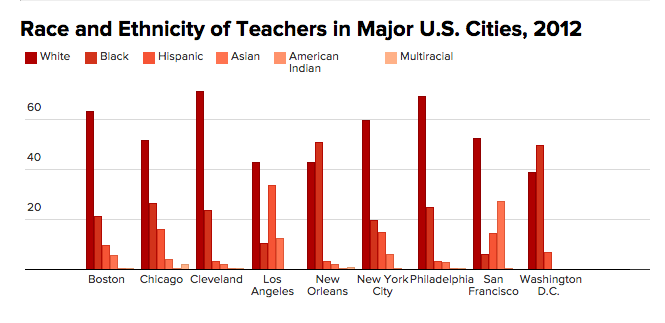
The Albert Shanker Institute recently released findings from their study titled: The State of Teacher Diversity in American Education. The examined teacher diversity from 2002 to 2012 in nine major American cities: Boston, Chicago, Clevland, LA, New Orleans, New York City, Philadelphia, San Francisco, Washington D.C.

Findings from the study revealed that the number of teachers of colour has dropped over the past decade across all nine cities. Albert Green from The Atlantic noted “Despite the fact that more students of color will be filling classrooms at increasing increments every school year, it’s a well reported fact that almost 80 percent of their teachers are white—and it doesn’t appear that that will change any time soon.” Green concludes his article asking pertinent questions in attracting and retaining effective teachers of colour. He says:

It is no longer a question of, do we need teachers of color? There is no shortage of data that shows that minority teachers not only help improve the outcomes of ​students who share their background, but also that of academic performance of students of all races are improved. The questions now are: What can be done to curb the high-attrition rates for minority teachers, and will addressing hiring disparities for black and Hispanic teachers do enough to equalize students’ attainment levels?

Source: http://www.theatlantic.com/education/archive/2015/09/teacher-diversity-viz/406033/

The Albert Shanker Institute reports outlines a number of recommendations on a local, state, and national level. Some of these recommendations include:

  • To increase the number of highly qualified minority teachers—and particularly Black, Hispanic and American Indian teachers—entering the profession, the U.S. Education Department and the state departments of education should invest in and support high-quality teacher education programs at historically Black colleges and universities (HBCUs), the nation’s Hispanic-serving institutions (HSIs), tribal colleges and universities (TCUs) and public colleges and universities serving large numbers of minority students.
  • To ensure that novice teachers are well prepared to enter the classroom and receive the mentoring and support they need to be successful, the U.S. Education Department and the state departments of education should establish incentives for close partnerships between colleges of education, on the one hand, and school districts and charter networks, on the other hand. Particular attention needs to be paid to providing adequate mentoring, support and training in culturally responsive practices to novice teachers—of all races and ethnicities—working in the challenging conditions of high-poverty, de facto racially segregated schools
  • Urban school districts, district schools, charter networks and charter schools should develop close partnerships with colleges of education to ensure that an increased supply of well-qualified Black and Hispanic teachers are prepared to teach in city schools.

The Albert Shanker Institute Study:

http://www.shankerinstitute.org/sites/shanker/files/The%20State%20of%20Teacher%20Diversity%20%283%29_0.pdf

The Atlantic Article:

http://www.theatlantic.com/education/archive/2015/09/teacher-diversity-viz/406033/

Collaborative practice is the way to go: Growing as a Teacher Educator

Somehow, since the beginning of my teaching career, I have found myself in collaborative teams:

As a classroom teacher, I found amazing ‘teaching partners’. As a doctoral student, I was an apprentice in Clare’s literacy courses where collaborative practice was modelled. As a beginning teacher educator I looked to my mentors and found support through our strong research groups. Now, as a teacher educator I have developed strong partnerships with colleagues and have invited doctoral students to co-instruct my courses. How wonderful it feels to not only be a mentor but to learn from others while modelling good practice.

This year I am working with a doctoral student who has experience in teaching with technology. Not only am I learning a lot about practical use of technology in classrooms, and the theoretical underpinnings, but my students are benefitting from our partnership.  My course has gone from limited technology to a rich and authentic integration of technology. Let me share some examples:

  1. Developing a sense of Social Media/Digital Citizenship: We now have a class Twitter account and hashtag. We are composing tweets as a class, or as individuals which share what we are learning in the course.  This link helps those who do not know how to use twitter (i.e. me) get started: https://www.smore.com/x97w-the-14-day-twitter-challenge
  2. Improving communication: We now have the class connected with Remind, a communication app that many schools and teachers use to communicate with parents/students.
    1. When we first established this system our students raised the concern about access — what if parents do not have the technology to communicate in this year? What if they do not have the language to do so?  We had thoughtful, critical discussions about access and inclusion
  3. Demonstrating connected learning: My teaching partner is going to blog about the course, as a model for how teachers can do this.  She is walking us through the process of setting up a blog, including asking all the students to sign a permission form as a teacher would ask parents. If not all students sign the form to agree, she will model how to handle this in their future classrooms.
  4. Building our Digital Footprint: We are having students create About.Me or LinkedIn pages so when searched on Google, a professional reference to them, their work, and their values, will appear.  
    1. This experience will link closely to the course content. In our course we explore our Ministry’s Heath curriculum. The curriculum documents looks at teaching children about making good decisions when confronted with online challenges.  We explore how important it is to model good decision making online and to think about ourselves as professionals.
  5. Learning about online tools for teachers: Have one week with a Backchannel discussion tool. https://todaysmeet.com
  6. Connecting to a broader community: Our course looks at teaching the Arts. We are going to have a few students volunteer to look for arts integration projects on the crowdfunding site https://myclassneeds.ca/en/, present them to the class, and then have the class vote on which one we could support. Each person could donate a Loonie, and we could contribute $30 to a classroom in need somewhere near our community, or somewhere in Canada.

I am extremely excited about infusing these elements into my course. I have realized from our beginning classes that it is so much more than the actual doing and integrating of the technology that becomes important. I am learning that the discourses around the infusion is equally, if not more, relevant to developing good pedagogy.  I cannot say enough just how wonderful and beneficial collaborative practice can be.

I will let you know how it all plays out. I am anticipating a heightened program and learning experience for the students and me.

An Educator’s Guide To “Minding Our Digital Footprints”

In an article titled “Minding our Digital Footprints” the Edmodo blog outlined 9 elements of digital citizenship they use to frame their work. Edmodo is a K-12 social learning network which focuses on “connecting all learners with the people and resources they need.” I believe these elements can be applied to the work any educator is doing with their classes in digital technology spaces (e.g., class blog, class wiki).
Within each element questions are posed. Educators at all levels pose these questions to guide students as digital citizens while making them reflective of their own citizenship. The 9 Elements are listed below and are accompanied by some questions developed by Edmodo:
1. Digital Access
Does everyone in our community have equal access to digital resources? Think about the ways Internet use affecrts your daily social life and your school work: how might it change your life if you did not have access to it?
2. Digital Commerce 
What are smart precautions to take when buying and selling goods online?
3. Digital Communication
List as many tool you can think of that we use to communicate digitally as 21st century citizens. What are the appropriate decisions we need to make with these tools?
4. Digital Literacy
How do you use technology to learn? How do you learn about technology? What kind of information literacy skills do we need?
5. Digital Etiquette
What are best practices for responsible conduct in shared digital spaces?
6. Digital Law
When we are online, what are some laws and ethical/moral rules we should be aware of and follow?
7. Digital Rights and Responsibilities
What are the rights we have as digital citizens  that no one can take away from us? What are the responsibilities we have as digital citizens?
8. Digital Health and Wellness
What are some ways that using the Internet can be good for our health? How can it hurt us?
9. Digital Security
What are smart ways to protect our digital information?
Check out the full article here:

Course Design and Development — Hoping the changes work out!

——————–

A poem I wrote today to try to relieve some first day jitters:

T’was the night before a new school year and all the through the house

Papers were flying and textbooks arouse

The course syllabi posted online with such care

In hopes that the students soon would be there

The readings updated and carefully writ

Ensuring inquiry, equity and technology fit

And I in excitement yet dutifully prudent

Wait for the joy of engaging with each student….

——-

Revising university courses is not a simple task. I (Yiola) have spent several weeks reworking my courses and developing new ones for the coming year.  While my courses have been consistently well received by students I felt they needed updating: readings, perspective, pedagogy as though the domino effect could not be more evident.  Piecing together what to share and how to share it so that student learning is not only deeply enjoyable but also optimal is no easy feat. As teacher educators we need to model good practice — after all, how can you spend an entire 3 hour class talking about the importance of inquiry pedagogy with power point presentations and lecture notes and expect students to understand and transfer their learning to the classroom?  And then, on the other hand, how does a Masters level instructor justify spending hours having Masters level students “inquire” as children would in their elementary classrooms?

Finding the balance between theory and practice, between scholarship and the “daily grind” of classroom life, between academic rigour and child centred practice is, for me, an exceptional challenge.  I want student teachers to know what to do when they enter their elementary classrooms and I want to model it for them in our class (i.e. small group activities, equitable practices, varied experiences, and direct instruction) and I also want students to understand WHY we do it (i.e. research based literature and engaging discourse). I want students to be self-directed learners (to share their ideas, to bring news to the classroom, to extend their own learning outside our class time) and I also want to provide students with connections between best practice and what they see out there (use of technology, positive learning environments, etc…)

Some changes I have made to my courses this year:

  • more use of technology (in my teaching, in my teaching of, and in students experience with)
  • lessened the number of assignments but deepened the expectations of the ones included
  • varied the nature of the assignments (included presentations, group and individual assignments, concept maps, papers)
  • updated my methods of assessment: to reflect/model practices used in our school system, to include students in the process itself
  •  continue to invite guests to the class (classroom teachers, doctoral students, school administrators) as co-presenters as a means for sharing knowledge and modelling collaborative practice
  • Updated the readings to better reflect the issues of 21st century teaching

Researching teaching education, speaking with colleagues who are deeply invested in teacher education and knowing what other great educators are doing not only keeps me motivated but is one of the best professional development tools out there.

I wish all teachers and teacher educators and wonderful school year!

Celebrate the Start the School Year!

As we begin another year (or new year) of teaching, I (Cathy) thought you would enjoy this video of a marvelous Flash Mob created for the West Des Moines Community School District to celebrate the start of a new school school year.  The flash mob was published on Youtube Aug 23, 2015.
Descriptor:

“While the West Des Moines Community School District Superintendent was beginning her speech to the staff of WDMCS at the district-wide welcome back meeting, the teachers of the district created a flash mob to the enjoyment of their unsuspecting colleagues. With only one more day of preparation left, the teachers shared their talents by performing a parody of the song, “One more day” from Les Miserables.”

Enjoy!  And have a terrific year!

The Smartest Kids in the World And How They Got That Way: An Exploration of the Schools in PISAs top Achieving Countries

1307-toch-white_bk_article  My (Yiola) summer has been filled with reading, writing, and a lot of play with my two young children.  From Curious George to Jane Yolan, we covered a lot of ground… and then there was some time for me. One of the texts I read this summer was an interesting report by journalist Amanda Ripley. In her book, The smartest kids in the world and how they got that way Ripley tracks three American high school students who went on exchange to three of the top performing PISA countries: Finland, Korea, and Poland.  What I like about the text is that the three countries Ripley selects could not be more different in culture, and systems.

While there is much controversy about the PISA test and its effects, the details outlined in the book are interesting and insightful. I found the following key points interesting:

The countries that score high on PISA value academic and take academic learning seriously:

“The question then was not what other countries were doing, but why. Why did these countries have this consensus around rigor? In the education superpowers, every child knew the importance of an education. These countries had experienced national failure in recent memory; they knew what an existential crisis felt like. In many U.S. schools, however, the priorities were muddled beyond recognition. Sports were central to American students’ lives and school cultures in a way in which they were not in most education superpowers. Exchange students agreed almost universally on this point. Nine out of ten international students I surveyed said that U.S. kids placed a higher priority on sports, and six out of ten American exchange students agreed with them. Even in middle school, other researchers had found, American students spent double the amount of time playing sports as Koreans.”

Countries whose students who did well on the PISA value early childhood education:

“In most countries, attending some kind of early childhood program (i.e., preschool or prekindergarten) led to real and lasting benefits. On average, kids who did so for more than a year scored much higher in math by age fifteen (more than a year ahead of other students).”

Parental involvement IS important:

“Parents who read to their children weekly or daily when they were young raised children who scored twenty-five points higher on PISA by the time they were fifteen years old. That was almost a full year of learning. More affluent parents were more likely to read to their children almost everywhere, but even among families within the same socioeconomic group, parents who read to their children tended to raise kids who scored fourteen points higher on PISA. By contrast, parents who regularly played with alphabet toys with their young children saw no such benefit.”

What I appreciated the most when reading the book was the message that teachers in the high scoring countries are deeply valued members of society. From university admissions through to classroom practice, teachers are carefully selected, very well educated, and they maintain high standards in their practice.

I like the contrasts it provides between nations that have high test scores. As I read I kept comparing Canada, and more specifically the Ontario context to the countries (mainly Finland) and was feeling rather optimistic about the direction we are going.

Creating Interactive Content

I recently learned about a useful digital technology app I am sure I will be using this upcoming school year. Riddle is an app which let’s you easily and quickly create:

  • opinion polls
  • lists
  • quizzes
  • personality tests
  • commenticles (commenting on articles)

Riddle allows you to customize your content by adding images,YouTube videos, animated gifs, articles from the web, personal photos, etc. Once your interactive social content (opinion poll, list, quiz, test, commenticle) is created, there are several ways to share it. You can embed the content into your own blog or website. Or you could e-mail the link out to your class. You can also share your created content through Facebook or Twitter.

I spent 30 minutes playing around on this site and came up with so many great ideas on how to use it in my classroom. Using the opinion polls, I will create an ice-breaker activity and e-mail it out to my class and show the results on the first day of class. Also, if I want my class to discuss an article, I will use the commenticle feature. Below is a commenticle I made on Riddle:

Screen Shot 2015-08-18 at 11.39.34 AM

To learn more about RIddle and make your own interactive content this school year, check out the link:

http://www.riddle.com/