
The Best Teacher Are …. Not What You Think
I (Said) recently read an article in the Toronto Star about Ontario’s new two-year teacher education program that left me a little disappointed https://www.thestar.com/yourtoronto/education/2016/06/08/double-trouble-for-teachers-college-expansion.html. The recent move by Ontario’s Ministry of Education intends to “help address an oversupply of graduates, enabling Ontario’s qualified teachers to find jobs in their chosen field” (Ontario Ministry of Education, 2013). However, the lack of pedagogical renewal, combined with condensed courses, increasing class sizes, and fundings cuts are characteristic of reform that does not signal improvement.
The extra year of training, while providing more classroom experience, will not necessarily produce better teachers. Some may argue that more time can be spent on areas such as mathematics and special education, but this approach assumes that candidates enter the programs with deficiencies that need to be remedied before they become practicing teachers. A more sensible approach would seek to redesign the admission process, thereby selecting the best-suited candidates for the profession. By identifying qualities relevant to good teaching and utilizing an approach that can highlight them in applications, we can improve the quality of our candidates, even if the process becomes tougher (Kosnik, Brown, & Beck, 2005).
The decision to increase the length of the program, followed directly by finding strategies to help students graduate as fast as possible is an indicator of a system that wants to continue to rapidly produce teachers rather than emphasize the quality of the education that it is providing. Topics such as the micro-politics of teaching continue to be ignored despite the well-known fact that there exists a large disparity between what candidates learn in teacher education and the realities of the classrooms they end up teaching. As a result, beginning teachers will continue to suffer in a profession that “eats its young” and has a hard time retaining young, innovative teachers who are struggling to find employment.
In their chapter on reform efforts in teacher education, Kosnik, Beck & Goodwin (2016) present a constructivist vision of teaching and teacher education that ultimately promotes human well-being and rejects “reforms that stifle dialogue and impose a crassly political or narrowly economic agenda” (p. 294). Unfortunately, teacher education reform in Ontario has leaned towards the latter, but gradual progress will hopefully convince policymakers and the general public that short-sighted solutions will not unlock the potential that the teaching profession has to change the world.
References:
Kosnik, C., Beck, C., & Goodwin, L. (2016). Reform efforts in teacher education. In J. Loughran & M.L. Hamilton (Eds.). Handbook on Teacher Education (pp. 267-308). Dordretcht: Springer Academic Publishers.
Kosnik, C., Brown, R., & Beck, C. (2005). The preservice admissions process: What qualities do future teachers need and how can they be identified in applicants? The New
Educator, 1(2), 101-123.
Ontario Ministry of Education (2013). Modernizing Teacher Education
in Ontario. Retrieved from http://news.ontario.ca/edu/en/2013/06/modernizing-teacher-education- in-ontario.html
As summer vacation time draws nearer and schools in Ontario prepare for the summer break, teachers often think of ways to encourage children to read over the summer. Inspiring students who ‘hate to read’ can be quite a challenge. The authors of the blog teachingauthors.com highly recommend graphic novels. (Graphic novels are not to be confused with Manga novels which are a genre unto themselves). Graphic novels are similar to comic books in that they rely heavily on illustrations to convey meaning and the text is short.
Author Mary Ann Rodman suggests the following novels for students:
Young Adult
Drowned City: Hurricane Katrina and New Orleans—Don Brown
Honor Girl: A Graphic Memoir–Maggie Thrash.
Nimona-Noelle Stevenson
In Real Life–Cory Doctorow
Middle school
Anything by Raina Teigemeier (e.g., Drama)
The Dumbest Idea Ever!–Jimmy Gownley
Roller Girl–Victoria Jamieson
Sunny Side Up–Jennifer L. Holm and Matthew Holm
Into the Volcano–Don Wood.
Flora & Ulysses–Kate DiCamillo, K.G.Campbell
The Hidden: A Child’s Story of the Holocaust–Loic Dauvillier.
The Lost Boy–Greg Ruth
If you haven’t read a graphic novel, I (Cathy) suggest you try one. The experience may surprise you. The content can be quite sophisticated and intense. When I taught a teacher education focused children’s literature course, I used the book Persepolis to introduce my teacher candidates to graphic novels. Persepolis is an autobiographical graphic novel by Marjane Satrapi depicting her childhood up to her early adult years in Iran during and after the Islamic revolution. (The title is a reference to the ancient capital of the Persian Empire, Persepolis). The book depicts religious, political, and economic struggle. Simplistic, but powerful.
Try one this summer!
http://www.teachingauthors.com/

Teachers are wrapping up report cards and teacher educators are recovering from the intense end of year marking. We are now shifting gears. Another great year ~ filled with challenges and obstacles and experience and fun ~ is just about to come to close.
What will you be doing to fill the summer months? Many will take courses, teach summer school, read, write. I hope you find time to relax and rejuvenate the spirit.
I look forward to a long stretch of writing. I will be writing about some of the incredible findings from our research on teacher education and literacy education. I look forward to sharing articles on the topics of pedagogies of literacy, and assessment of literacy, and examining the learning trajectory of a literacy teacher.
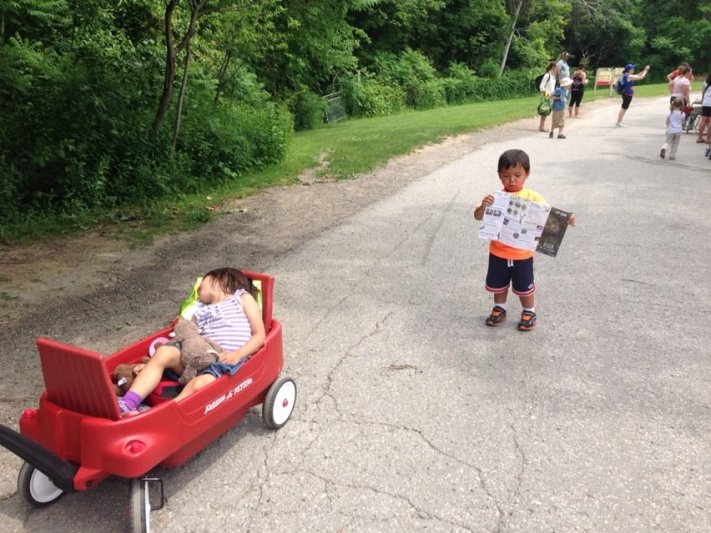
I also look forward to some time with my family; playing with my children, helping them develop their literacy skills. Here is my young son “reading” and “navigating” the Metro Zoo map. What sophisticated literacy skills already! And, my daughter in the wagon patiently waiting for her brother to figure out the way to the Polar Bears! Without a doubt, he will figure it out!
A wise mentor reminded me the other day that all the work that we do, the commitments we make and the challenges we face should lead us to happiness. It was a heart warming and encouraging reminder. I wish you all: teachers, researchers, teacher educators and friends a happy of the school year!
I (Clare) read this article in TC Record and I thought is sums up the dilemma so many teachers face. Teach skills but also teach critical thinking. They are so often set up in opposition that many teachers are left thinking they have to choose one or the other. We need to both! http://www.tcrecord.org/Content.asp?ContentID=20557
by Amanda Mattocks — May 10, 2016
The current educational environment has left teachers trapped between the accountability mandates of high stakes testing and the desire to provide an authentic, skills-based curriculum that is rich in critical thinking activities. As the Every Student Succeeds Act (ESSA) is implemented nationwide, teachers and districts should seize the opportunity to develop alternative assessment tools that incorporate more authentic measurement of students’ critical thinking skills.
HIGH-STAKES TESTING OR CRITICAL THINKING
The tension between high-stakes testing accountability and an authentic, skills-based learning environment infused with critical thinking has made the assessment of student learning a challenge for even the most experienced education professionals. Classroom teachers need to be both public servants responsible for aggregate student growth, and inspirational role models tasked with shaping future minds. The recently sunsetted No Child Left Behind (NCLB, 2002; U.S. DOE, 2002) narrowed the definition of learning to concepts found on multiple choice examinations that require mass data collection, equated student growth to test score improvement, and instigated punitive measures when schools do not meet national proficiency standards. In theory, the numerical data generated from the annual standardized assessment has held teachers accountable, but this has come at the cost of adequate curriculum depth, appropriate real-world skills, and deep critical thinking skills which are less easily measurable but arguably more important to foster. Tension remains between generating trackable measures of growth and providing learning filled with critical thinking activities. This tension may soon lessen given that measuring student growth and providing authentic skills-based learning are not mutually exclusive anymore; both can be accomplished simultaneously by working within the new assessment guidelines of ESSA.
EVERY STUDENT SUCCEEDS ACT
The Every Student Succeeds Act (ESSA, 2015) has the potential to diffuse the tension between high-stakes annual testing and authentic skills-based learning. ESSA calls for the systematic collection of data of a different nature than that aggregated by traditional standardized testing. According to the federal ESSA website, “Assessments must involve multiple measures of student achievement, including measures that assess higher-order thinking skills and understanding, which may include measures of student growth partially delivered in the form of portfolios, projects, or extended performance tasks” (NCLS, 2015). ESSA will be fully implemented across the United States by the end of 2017 and public school teachers will have the opportunity to develop high-quality assessments involving critical thinking that mirror an authentic, skills-based classroom with a curriculum rich in performance tasks measuring higher-order thinking. While the job of developing authentic assessments for measuring skills-based learning and critical thinking is daunting, the educational community is already fertile ground for the ESAA’s requirements. Due to the fact that ESSA allows teachers to report data from interim assessments based on higher-order thinking skills, each localized educational community has the opportunity to establish the relevant criteria on teacher-designed rubrics and create skills-based performance tasks as long as the result is high-quality measurable data.
ASSESSING CRITICAL THINKING
After watching my students critically discuss complex themes like the American Dream and income inequality during Socratic-styled seminars, I became convinced that understanding and critical thinking are most evident when assessments incorporate real-world problems and performance tasks. Evaluating classroom discussion is challenging but worth the effort because of its curriculum relevance, authenticity, and rigor. Stanford Professor Sam Wineburg calls for students to think like a historian by “understanding that each of us is more than a handful of labels ascribed to us at birth” (Wineburg, 2001, p. 7). In order to reach this deeper understanding, students need to develop critical thinking skills, defined by the American Philosophical Association (APA) as “purposeful, self-regulatory judgment which results in interpretation, analysis, evaluation, and inference, as well as explanation of the evidential, conceptual, methodological, criteriological, or contextual considerations upon which that judgment is based” (Facione, 1990). Traditional social studies assessments that measure names, dates, and events have their place in education but cannot measure “higher-order thinking skills and understandings” as required by ESSA. A curriculum that includes skills-based activities have the potential to also measure critical thinking. Instead of testing students on factual recall, Wineburg required high school students, college students, and professors to read documents out loud, pause to interject their thoughts, and analyze the material they just assimilated (Wineberg, 2001, p. 7). Wineburg measured the interview transcripts for the presence of critical thinking using established criterion and then norm referenced the interviews to determine the depth of critical thought to assess the performance activity (2001).
Peter Boghossian, an educator in the correctional system, also created measurable data derived from performance activities. In order to promote the merits of Socratic seminars to colleagues, Boghossian analyzed transcriptions of his discussions about morality using a rubric designed from the APA’s definition of critical thinking. His students demonstrated their ability to think critically by evaluating, interpreting, inferring, and analyzing by engaging in these types of activities (Boghossian, 2006). By crafting a numerical rubric around skills-based performance tasks, teams of teachers can collect data on student critical thinking ability. Wineburg and Boghossian used two completely different alternative assessments designed to measure critical thinking and both performance tasks yielded helpful data regarding student abilities. Stanford’s History Education Group develops free content through their project called Beyond the Bubble which is aptly named for its goal to move assessments away from multiple-choice examinations (Wineburg, Smith, & Breakstone, 2016). The organization, led by Sam Wineburg, provides critical thinking assessments utilizing primary sources with numerical proficiency rubrics and scored example assessments (Wineburg et al., 2016). With localized numerical data generated from rubrics, teachers can collaborate and strategize pedagogical shifts to promote student growth and then report the relevant and longitudinal information to the state under ESSA, instead of the state collecting a single high-stakes examination and subsequently passing the data to teachers.
CALL TO ACTION
By creating rubrics for critical thinking performance activities, teachers can collaborate to generate meaningful data that can be reported to the state for accountability purposes. This means that nurturing a skills-based classroom rich in critical thinking and reporting achievement goals can happen simultaneously, which is an exciting prospect for both teachers and local communities. However, for change to take place in the classroom, departments and districts need to design rubrics based on higher-order thinking skills using performance assessments. As states implement ESSA in the next couple of years, teachers and districts should seize the opportunity to develop alternative sources of data that incorporate authentic assessments of critical thinking skills.
References
Boghossian, P. (2006). Socratic pedagogy, critical thinking, and inmate education. Journal of Correctional Education, 57(1), 42–63.
Every Student Succeeds Act, Pub. L. No. 114-95 (2015).
Facione, P. A. (1990). Research Findings and Recommendations. Newark, DE: American Philosophical Association.
National Conference of the State Legislature (NCLS) (2015). Summary of the every student succeeds act, legislation reauthorizing the elementary and secondary act. Washington DC: NCSL. Retrieved from http://www.ncsl.org/documents/capitolforum/2015/onlineresources/summary_12_10.pdf
No Child Left Behind Act of 2001, Pub. L. No. 107-110, • 115, Stat. 1425 (2002).
United States Department of Education (2002). The No Child Left Behind Act of 2001 executive summary. Washington DC: The U.S. Department of Education. Retrieved from http://www2.ed.gov/nclb/overview/intro/execsumm.pdf
Wineburg, S. S. (2001). Historical thinking and other unnatural acts: Charting the future of teaching the past. Philadelphia, PA: Temple University Press.
Wineburg, S. S., Smith, M., & Breakstone, J. (2016). Beyond the bubble. Stanford, CA: Stanford History Education Group. Retrieved from https://beyondthebubble.stanford.edu/
| Cite This Article as: Teachers College Record, Date Published: May 10, 2016 http://www.tcrecord.org ID Number: 20557, Date Accessed: 6/11/2016 7:14:01 PM |

A friend of mine (Clare) send this to me and I thought it was so much fun I thought that I would share it with you.
See if you can figure out what these seven words all have in common
1. Banana
2. Dresser
3. Grammar
4. Potato
5. Revive
6. Uneven
7. Assess
Are you peeking or have you already given up?
Give it another try….
Look at each word carefully. You’ll kick yourself when you discover the answer. This is so cool…..
No, it is not that they all have at least 2 double letters.
Let me know if you work it out – I didn’t!
Answer is below!
Answer:
In all of the words listed, if you take the first letter, place it at the
end of the word, and then spell the word backwards, it will be the same word. Did you figure it out? No? Then send this to more people and stump them as well. Then, you’ll feel better too.
Allegory as a literary device is a powerful tool in literacy development. Beginning in the early years teachers use allegory to explore moral lessons and critical issues. How often do we read books with animal characters who experience significant challenges and how well do children respond to the texts?… very well!
Last week I (yiola) took my children to a birthday party at the movie theatre where they watched The Angry Birds.

I had no idea what the movie was about although my 4 year son mentioned it had to do with birds protecting their eggs from pigs. Hmmmm, sounds… interesting. As I sat in the movie theatre I watched and chuckled at the community of birds and enjoyed the simple characters of each bird… and then I watched as ships sailed onto “Bird Island” and a King Pig with a small entourage befriended the birds, showering them with gifts and new ‘treasures’ that were unfamiliar to the birds. Slowly the pigs began to take over the island and they stole all the birds’ eggs. The birds then tried to rescue their eggs. Lines such as: “They stole our kids… who DOES that?” and later when the birds invaded “Piggie Island” to rescue the eggs the “King Pig” exclaimed, “what are you doing here? This is a civilized brunch” left me sinking in my seat and feeling uncomfortable. Without doubt The Angry Birds, to me, is an allegory of colonialism. After viewing the movie I began researching articles and critiques and while I found several interpretations very few note colonialism.
To my surprise, many an in-depth discussions have occurred over The Angry Birds. From story line to historical facts to critical literacy to media literacy, I am pleased to see how an animated film could spark such interesting discussion. Now, imagine how using popular culture like the popular video game The Angry Birds and combining it with popular media like a Hollywood movie and applying analysis and interpretation of the use of allegory in a middle school or high school setting to discuss critical social issues like Aboriginal history or immigration. Narratives are such powerful tools for thinking about life. Allegory as a literary device has the potential to raise significant awareness and heighten a love for literacy.
The Presidents of 21 Canadian Teachers’ organizations – national, provincial, and territorial – have released a belief statement and call to action developed at their May 29-June 1, 2016 Meeting. The statement arose out of “overwhelming concerns about education reform, inclusive education, austerity budgets and teachers’ mental health and wellness.”
 Receiving the statement courtesy of the Ontario Teachers’ Federation, I (Clive) was truly blown away by it. It is brief, to the point, and timely, and ties in with so much of what researchers and practitioners around the world are concluding about teaching and schooling today.
The five-point Belief Statement is as follows:
The Call to Action calls on governments across Canada to take immediate action to address the above concerns.http://www.otffeo.on.ca/en/news/presidents-of-canadian-teachers-organizations-release-belief-statement-and-call-to-action/
Some may argue that public funds are becoming scarcer today and everyone must cut back. However, assessment of students by teachers rather than by standardized tests (point 4) would save a lot of money and make schooling more effective: less time would be spent on test preparation. As for the adequate funding of public education, in the long run that pays for itself in terms of student success, economic productivity, societal well-being, and teacher retention and effectiveness.
A major reason for the past and present success of Canadian schooling – as seen in its solid PISA rankings – has been the relatively high status and funding of teaching in Canada. This has helped attract able people to the profession and keep them there. It is incredibly important not to erode this advantage. Let’s stand with the teachers’ organizations as they pursue this line of action.
I (Cathy) have always appreciated and valued how technology, particularly Skype, can enrich our lives. I have used it and other forms of real time communication (e.g., Face time, Zoom) in research to conduct interviews; in classrooms to allow my students to meet authors; and in my personal life to stay in touch with my children while traveling. But this week, Skype took on a whole new level of personal meaning for me when my daughter prematurely gave birth, on the other side of the country. Within a few hours of the birth, I could ‘see’ my daughter and knew she was all right. Then my husband and I watched our new granddaughter. It wasn’t a still photograph, it was her in real time, moving and stretching, even crying. What a gift. To be able to be a part of something so precious, even when so far away. As a child I envisioned such things through The Jetsons cartoon. I can’t even imagine what darling baby Everley will witness when her grandchild is born. Beam me up, Scottie? Perhaps. Right now I am content to experience Skype and appreciate the joy it brings into our lives.
. 
 Literacy Teaching and Teacher Education