Tag Archives: 21st century communication

Collaborative practice is the way to go: Growing as a Teacher Educator

Somehow, since the beginning of my teaching career, I have found myself in collaborative teams:

As a classroom teacher, I found amazing ‘teaching partners’. As a doctoral student, I was an apprentice in Clare’s literacy courses where collaborative practice was modelled. As a beginning teacher educator I looked to my mentors and found support through our strong research groups. Now, as a teacher educator I have developed strong partnerships with colleagues and have invited doctoral students to co-instruct my courses. How wonderful it feels to not only be a mentor but to learn from others while modelling good practice.

This year I am working with a doctoral student who has experience in teaching with technology. Not only am I learning a lot about practical use of technology in classrooms, and the theoretical underpinnings, but my students are benefitting from our partnership.  My course has gone from limited technology to a rich and authentic integration of technology. Let me share some examples:

  1. Developing a sense of Social Media/Digital Citizenship: We now have a class Twitter account and hashtag. We are composing tweets as a class, or as individuals which share what we are learning in the course.  This link helps those who do not know how to use twitter (i.e. me) get started: https://www.smore.com/x97w-the-14-day-twitter-challenge
  2. Improving communication: We now have the class connected with Remind, a communication app that many schools and teachers use to communicate with parents/students.
    1. When we first established this system our students raised the concern about access — what if parents do not have the technology to communicate in this year? What if they do not have the language to do so?  We had thoughtful, critical discussions about access and inclusion
  3. Demonstrating connected learning: My teaching partner is going to blog about the course, as a model for how teachers can do this.  She is walking us through the process of setting up a blog, including asking all the students to sign a permission form as a teacher would ask parents. If not all students sign the form to agree, she will model how to handle this in their future classrooms.
  4. Building our Digital Footprint: We are having students create About.Me or LinkedIn pages so when searched on Google, a professional reference to them, their work, and their values, will appear.  
    1. This experience will link closely to the course content. In our course we explore our Ministry’s Heath curriculum. The curriculum documents looks at teaching children about making good decisions when confronted with online challenges.  We explore how important it is to model good decision making online and to think about ourselves as professionals.
  5. Learning about online tools for teachers: Have one week with a Backchannel discussion tool. https://todaysmeet.com
  6. Connecting to a broader community: Our course looks at teaching the Arts. We are going to have a few students volunteer to look for arts integration projects on the crowdfunding site https://myclassneeds.ca/en/, present them to the class, and then have the class vote on which one we could support. Each person could donate a Loonie, and we could contribute $30 to a classroom in need somewhere near our community, or somewhere in Canada.

I am extremely excited about infusing these elements into my course. I have realized from our beginning classes that it is so much more than the actual doing and integrating of the technology that becomes important. I am learning that the discourses around the infusion is equally, if not more, relevant to developing good pedagogy.  I cannot say enough just how wonderful and beneficial collaborative practice can be.

I will let you know how it all plays out. I am anticipating a heightened program and learning experience for the students and me.

Metaphors for Teaching Literacy

I (Cathy)  recently asked literacy teacher educators (LTEs) to complete this statement,  “Being a literacy teacher educator in the 21st century is like…”   As a researcher and teacher educator, I was profoundly struck by the power behind their words and the images they selected to represent them.   Before peeking at the three responses  provided below, consider how you might complete the statement.

Being a literacy teacher educator in the 21st century is like…

…“Green Eggs And Ham…it’s not what you expect, it’s a reciprocal journey, and you can’t just try it one way. Nothing tastes better than when you’ve seen them try it, like it, and beg for more!”

green eggs

“a futuristic video game – visually exciting, fast paced, limitless possibilities, not knowing what may be next, all the time wondering if you are going to be able to keep up!!”

.  Tron

…“keeping candles lit on a breezy night. Challenging but possible… delicate but powerful… romantic but necessary… not so much ‘constant work’ as it is diligent work… It requires focus and awareness of the ‘current’”.

 Candle in the wind

The literary representations of these three LTEs displayed a profound sense of excitement, overshadowed by trepidation as they enter an unknown territory, with unproven results.  The uncertainty and vulnerability of their roles were clear.  What do your words and image say about your views of teaching literacy in these fast changing and tumultuous times?


Course Design and Development — Hoping the changes work out!

——————–

A poem I wrote today to try to relieve some first day jitters:

T’was the night before a new school year and all the through the house

Papers were flying and textbooks arouse

The course syllabi posted online with such care

In hopes that the students soon would be there

The readings updated and carefully writ

Ensuring inquiry, equity and technology fit

And I in excitement yet dutifully prudent

Wait for the joy of engaging with each student….

——-

Revising university courses is not a simple task. I (Yiola) have spent several weeks reworking my courses and developing new ones for the coming year.  While my courses have been consistently well received by students I felt they needed updating: readings, perspective, pedagogy as though the domino effect could not be more evident.  Piecing together what to share and how to share it so that student learning is not only deeply enjoyable but also optimal is no easy feat. As teacher educators we need to model good practice — after all, how can you spend an entire 3 hour class talking about the importance of inquiry pedagogy with power point presentations and lecture notes and expect students to understand and transfer their learning to the classroom?  And then, on the other hand, how does a Masters level instructor justify spending hours having Masters level students “inquire” as children would in their elementary classrooms?

Finding the balance between theory and practice, between scholarship and the “daily grind” of classroom life, between academic rigour and child centred practice is, for me, an exceptional challenge.  I want student teachers to know what to do when they enter their elementary classrooms and I want to model it for them in our class (i.e. small group activities, equitable practices, varied experiences, and direct instruction) and I also want students to understand WHY we do it (i.e. research based literature and engaging discourse). I want students to be self-directed learners (to share their ideas, to bring news to the classroom, to extend their own learning outside our class time) and I also want to provide students with connections between best practice and what they see out there (use of technology, positive learning environments, etc…)

Some changes I have made to my courses this year:

  • more use of technology (in my teaching, in my teaching of, and in students experience with)
  • lessened the number of assignments but deepened the expectations of the ones included
  • varied the nature of the assignments (included presentations, group and individual assignments, concept maps, papers)
  • updated my methods of assessment: to reflect/model practices used in our school system, to include students in the process itself
  •  continue to invite guests to the class (classroom teachers, doctoral students, school administrators) as co-presenters as a means for sharing knowledge and modelling collaborative practice
  • Updated the readings to better reflect the issues of 21st century teaching

Researching teaching education, speaking with colleagues who are deeply invested in teacher education and knowing what other great educators are doing not only keeps me motivated but is one of the best professional development tools out there.

I wish all teachers and teacher educators and wonderful school year!

A Blog About Blogging

I (Clare) cannot get over how much I enjoy blogging! I found this great article on Teachers College Record about using blogging in the classroom. Since we have a blog I thought I would share the link with you. http://www.tcrecord.org/Content.asp?ContentID=18070

An excerpt of the article is below.

Advances in Technology Pave the Path to Actual Learning: Using Blogging as a Learning Tool

by Toni Ann Brzeski — August 17, 2015

Do you know what the most common electronic device that college student’s possess? According to Joshua Bolkan, a multimedia editor for Campus Technology and The Journal, “85% of college students own laptops while smartphones come in second at 65%”. If technology is becoming a common practice among our students, what are we doing as professors to incorporate it into our classrooms? How can students use technology to reflect on their work? How can instructors use technology as a supplement in reading and writing courses? How can technology be used to deepen our student’s critical thinking skills? These are questions we should be asking ourselves in a world where technology is paving the way to learning.

INTRODUCTION

After attending school, working at part time jobs and internships, participating in extracurricular activities and spending time with family, it might seem that college students are too busy to fit all of their activities into the hours of the day. Given the hustle and bustle of their everyday lives, most students simply do not have the time to reflect on any part of their day, let alone what they learned in their college courses (Sharkov, 2012). It is our responsibility as educators to keep up with our students, to understand them, and to make reflection on course work a priority. If our students are not reflecting on their learning as a part of their everyday lives, then we are not really doing our jobs as educators.

In order to get to the bottom of this issue, and make reflection a priority, we must ask ourselves what we are we doing inside of our classrooms to promote reflection outside of the classroom. What are we doing in our classes to develop better reading, writing, and critical thinking skills?

MAKING A CONNECTION WITH TECHNOLOGY

Each semester, students step foot into my classroom with needs and interests different from those students with whom I worked before. Every semester, it is my job to take needs and interests and learn how to integrate them into my courses. While every semester is different and challenging, I have found that today’s advances in technology have been the key to bridging the gap between my students’ needs and the course curriculum.

Four years ago, during my first semester at Bronx Community College, I asked my reading students to purchase the book Tuesdays with Morrie by Mitch Albom. At that time my students purchased the book from an actual bookstore or an online source and came to class with a paperback copy. In the fall of 2012 I asked my students to purchase the same book. What they did next surprised me: my students took out their Kindles and iPads and immediately purchased the book. It was simple: given the speed with which these electronic devices allowed my students to purchase the book, we were prepared to start reading it the following week.

There was not one student waiting on a delivery or taking time out of their busy lives to purchase it at the bookstore. What I learned from this experience is that we are in a world where our daily activities are rooted in our electronic devices. Kindles, iPads, and smartphones are devices that our students are not only actively using, but using comfortably. This is just about the time when I discovered blogging.

If my students were using technology to complete very ordinary tasks, such as buying a book for their college course, I then asked myself what other ordinary tasks my students are using technology for. At first I was hesitant—call me old fashioned—but I didn’t believe students would become better readers and writers by posting their reflections online. I continued to question myself. What good is this? Aren’t journals a place for reflecting and expression?

BLOGGING AND THE BENEFITS TO THE COLLEGIATE COMMUNITY

WHAT IS BLOGGING ANYWAY, AND HOW IS IT BENEFICIAL FOR THE COLLEGE STUDENT?

As stated by George Couros, the Principal of Innovative Teaching and Learning at Parkland School Division in Alberta, Canada, “We want students to think critically about what they write. They are more likely to do this when they write for a larger audience as opposed to simply [writing] for the teacher. [Blogging] gives students the ability to archive their work for many years to come.” Therefore, having the “ability to [blog] [and] write for a worldwide audience has made an impact on many of our students” (Couros, 2013). Like Couros, I have found that blogging has had a significant impact. In fact, blogging is the very form of technology that has helped bridge the gap between my students’ interests and required course work.

Blogging gives those students an outlet for expressing their own ideas and reflecting on what they learned in class from the comfort of their own homes. As less interactive students continue to exercise their writing skills through blogging, re-reading, and building on their blog posts, their writing gradually improves over the semester. The fact that students can go back to previous blog posts and add thoughts or reflect on their own blogs—thereby, revising their work on their own without being told to do so by their teacher—is extremely beneficial and rewarding (Sharkov, 2012).

Blogging can be done on a train, bus, or even in a student’s own bedroom. Blogging doesn’t require the school library, or even pen and paper. A student can simply use a smartphone to connect to the world through blogging. When you present this type of accessibility to the busy student, he or she has the opportunity to engage with classmates beyond the short period of time that the student spends sitting in the classroom before heading out to a job or internship.

I have witnessed the benefits of blogging first hand. Last semester, I posted a question as a homework assignment on my blog site regarding a reading on Edgar Allan Poe. Within an hour of my students leaving class, they started to write blog posts on the site. My students were responding to my question, expressing their views, and in turn completing their homework assignment, while commuting home from school.

As I read my students’ blog posts, I was amazed at the level of insight that they were expressing in their entries. I had created a place where my students’ voices could be heard, and a place where they were able to interact and discuss a topic outside of the classroom using information that they learned while inside of the classroom. In essence, my students were taking time to reflect on what they learned in class, even with their busy schedules. In the past I would have taken a more conventional approach to this homework assignment by passing out comprehension questions on white paper and telling students to answer and bring them back to class the following week.

Blogging is beneficial to the teacher as well. For example, in my EDU 10 class, our class blog page contains all our work and posts can be found in one place with easy access. I find my students accessing our blog page from their cellphones, which tells me that they are able to complete assignments from anywhere—very convenient for them.

As a professor, I can easily assess my students’ reading, writing, and critical thinking progress by observing the improvement in their blog entries. This also keeps the line of communication open between my students and myself, which is helpful since our class only meets twice a week for a little over an hour. This blogging platform keeps the reflection ongoing throughout the week. Further, blogging allows me to learn my students’ point of view on certain topics and demonstrates their level of comprehension on what we are learning in class, in turn, helping me to create a lesson plan for the next class.

Lens Blog and Visual Thinking Strategies

When developing the photo essay assignment for my course, I came across an excellent resource for teachers and students. The New York Times has started a blog entitled Lens: Photography, Video, and Visual Journalism. The topics covered in  the blog posts touch on several critical issues such as immigration, race, and class. The photos  captured in each of the photo essays serve as a great entry point into rich discussion. When using the Lens Blog in my classroom I find myself drawing on skills I developed during workshops many years ago.

When I was a public school teacher, I participated in a fascinating series of professional development workshops called Visual Thinking Strategies (VTS). By analyzing carefully selected images, students were able to develop critical literacy skills as well as visual literacy skills. Teachers were facilitators in this process and asked three open-ended questions:

1. What’s going on in this picture?

2. What do you see that makes you say that?

3. What more can we find?

I found myself using the VTS approach when presenting students the photo essays from the Lens blog. Students in my class really engaged with the photos and rich discussion took place as a result. I will definitely be using this blog for years to come in the classroom.

Below are some powerful images from photo essays on  the Lens Blog.

Photo Essay: Garifuna Immigrants in New York
Photo Essay: Connecting with Syrian Refugees
Photo Essay: One Year Later, Remembering Eric Garner

Link to VTS site: http://www.vtshome.org/

Link to NYT Lens: http://lens.blogs.nytimes.com/

The Power of Photo Essays

I have just started teaching a unit on media, specifically social documentaries. So far we have studied the important work of American photographer Dorothea Lange related to the rise and significance of “concerned photography” (also known as “compassionate photography”). Students have engaged deeply with the photos and answered questions adapted from New York Times Critical Lenses guide such:

  • What feelings does this photograph create for you, the viewer?
  • How personal/impersonal is this photo? What elements make it this way?
  • Why do you think this photograph was taken?
  • Is this photo timely? Does it have a timeless quality? Why or why not?

Photos of Lange’s we analyzed in class:

Migrant Mother, Photographed By: Dorothea Lange
Richmond, CA Photographed By: Dorothea Lange

Beyond studying the background of photo journalism, students will learn  the basic principles of photography (e.g., rule of thirds, movement, lines, etc.). Following this, students will have the opportunity to create their own social documentary in the form of a photo essay. Students are still thinking through topics, but they are to tell an “untold story” from their lives. Topics which we have brainstormed so far have included: The shifting landscape of the Regent Park neighbourhood in Toronto, Canada; Cultural traditions of the First Nations people in Ontario, Canada; and A Day in the Life of the Pan Am Games 2015.

I am looking forward to seeing what stories students decide to tell. I will keep you posted on the process! I am learning so much along with my students!

Fuji Kindergarten

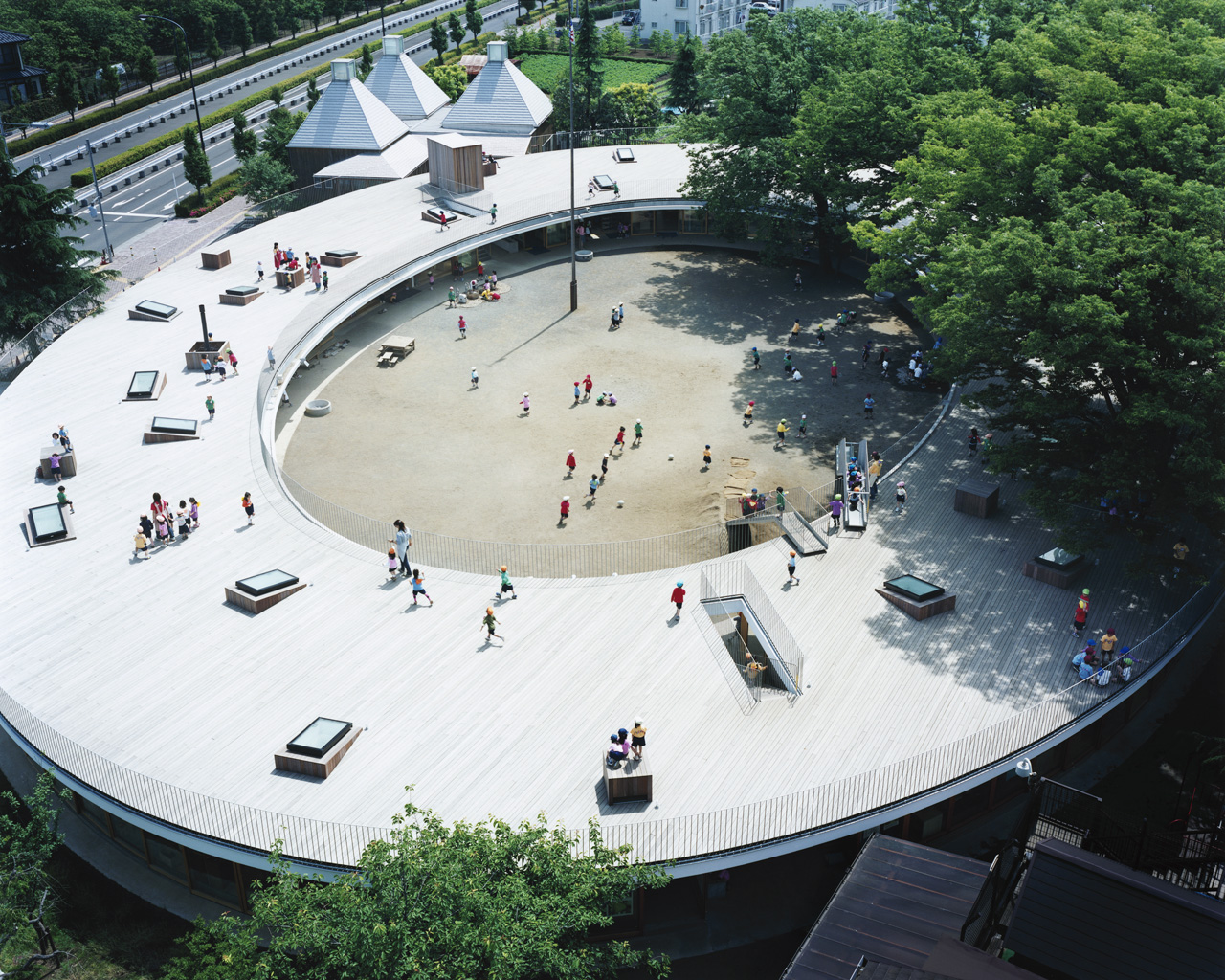
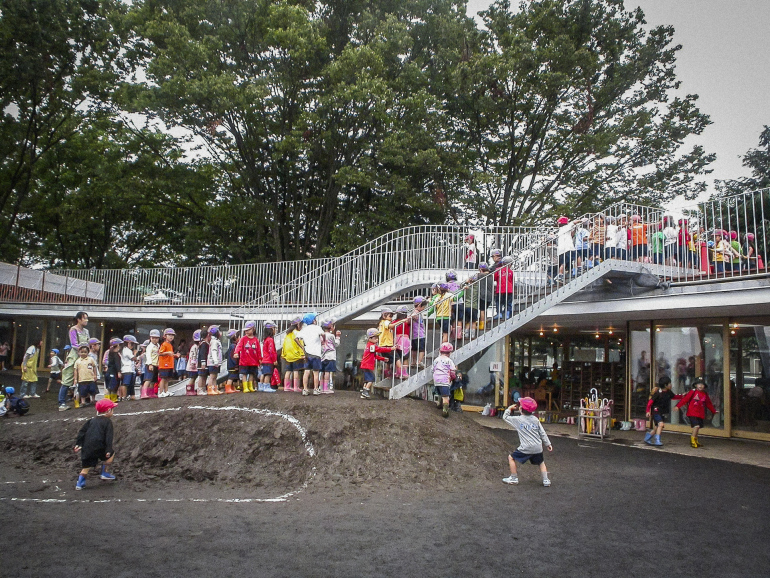
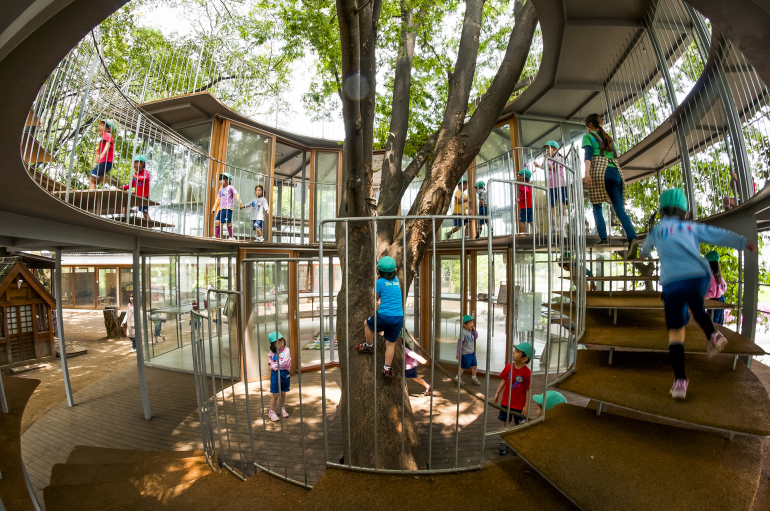
Takaharu Tezuka is the architect behind Fuji Kindergarten, deemed by some as the best Kindergarten in the world. Tezuka followed around his own young children to inform his school design. He designed a school which encourages pupils to move, play, dream, imagine, and grow.

Thu-Hoang Ha, author from Ideas.Ted.Com describe the schools’ most notable features:

  1. Circular playground lets the kids run forever

“We designed the school as a circle, with a kind of endless circulation. When we started, I had no preconceived notions. Studying other kindergartens was like looking in the rearview mirror of a car: Even if you look very closely, you can’t see anything in front.”

fujicircle

  1. Pupils can slide to class

slide to class

  1. Pupils can climb to class

climb to class

  1. Intentional Distractions

“The kids love to look through the skylights from the roof. ‘Where’s my friend?’ ‘What’s going on underneath in class?’ And when you look down, you always see kids looking up from below. Here, distraction is supposed to happen. There are no walls between classrooms, so noise floats freely from one class to the other, and from outside to inside. We consider noise very important. When you put children in a quiet box, some of them get really nervous.”

11

Read more here: http://ideas.ted.com/inside-the-worlds-best-kindergarten/

Watch a video on the Fuji School here: https://www.youtube.com/watch?v=Rd7mR3lb3yg

“Tech isn’t a shortcut”

Source: http://blog.markitx.com/2012/08/13/ipads-in-the-classroom-and-their-continued-growth/

An article in Time Magazine makes an interesting case for why iPads should be left out of the classroom. Author Jervey Tervalon from Los Angeles argues that his school district (and perhaps several others) after spending millions “saw the iPad as a magic talisman that could just about transplant knowledge into students’ brains directly, bypassing teachers.” Through classroom teaching experience, Tervalon understands that “teaching isn’t always efficient. Often it’s messy, and because it’s messy, the process can produce epiphanies, and sparks of creative thinking.”

Tervalon warns that technology isn’t a shortcut to major educational reforms:

“An iPad is an amazing device but it isn’t so amazing without content or the right pedagogical context. School reform isn’t expensive tech and high-stakes testing; it’s the incredibly difficult task of creating highly functioning, transformative educational communities.

Link to the article: http://time.com/3926875/ipad-use-classroom/

Creating “Legible” Cities

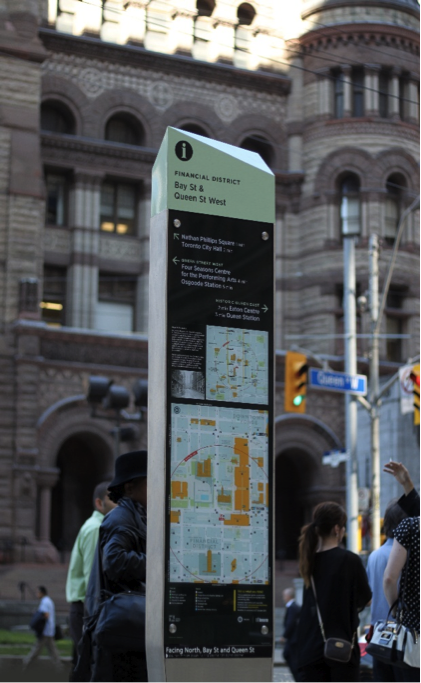
In preparing for the 2015 PanAm games, Toronto is installing new signage to make the city an easier place to navigate. A wayfinding approach is being used which is defined on Wikipedia as: “ the ways in which people and animals orient themselves in physical space and navigate from place to place.” In addition to traditional maps, the wayfinding strategy uses multimodal approaches to make a city more “legible.” Landmarks, new media, public art, and street furniture are examples of ways the wayfinding strategy uses multimodalities. The project is currently being piloted in 21 locations around the Toronto.

Below are examples of Wayfinding signage in cities:

Interactive signage up currently up in Toronto, Canada
publicfurniture
Wayfinding public furniture in a London, U.K. shopping centre.

Brent Raymond, a partner at the design firm responsible for the new signage, commented on in the Globe and Mail on the wayfinding approach:

“It isn’t just about signs. It’s about helping people navigate space. The best examples are always places like airports. People who aren’t familiar with a place at all, they need to be able to find information quickly and feel confident about their environment.”

Read more about this approach to city living here:

http://www.theglobeandmail.com/news/toronto/new-signage-about-to-make-navigating-toronto-on-foot-a-whole-lot-easier/article24951383/

http://www1.toronto.ca/wps/portal/contentonly?vgnextoid=8057524d63f02410VgnVCM10000071d60f89RCRD&vgnextchannel=d90d4074781e1410VgnVCM10000071d60f89RCRD