I’ve been striking it lucky with my pick of children’s literature lately. Because of Mr. Terupt is a juvenile fiction novel well worth reading to a junior level class. Also perfect as a sample novel for student teachers experiencing literature circles. This touching story, by Rob Buyea, brings up many discussion points regarding what makes a good teacher, plus many other school issues: diversity, inclusion, forgiveness, and bullying just to name a few. Terrific resource for ‘hot seat’ /role playing explorations. A must read for children’s literature fanatics like me!
Monthly Archives: June 2014
Guest Blog: Living the Inter-generational Novice/Expert Flip Flop
My (Monica) husband and I live with our two teenaged children. Anyone who is or has lived with teenagers knows that it can be challenging at times. I imagine that this dynamic has been difficult for many generations, yet I think this generation is living through a unique twist on an old problem. Teenagers have always been experts in their own world as compared to their parents. They know what is cool to say, wear and do, and their parents definitely do not. Traditionally, they knew a great deal less about the world their parents inhabited. However, now teenagers are also experts in aspects of their parents’ worlds. For example, just last week our 16-year-old daughter helped her dad with his business website, and our 13-year-old son taught me how to use Google docs for my research. In some ways, they are quite proud to be able to teach their parents something (to be the experts), and proud that we are doing our best to keep up with technical innovations in communication (eager novices), but they are also irritated when we ask them for technical help. Partly I think they are just annoyed that we are taking them away from whatever they were doing, but I also think they are a little uncomfortable dealing with their parents as novices. On the other hand, they are not too happy when we are experts either. They get annoyed when we are better able to navigate material that they have so expertly found on the internet. Our “expert” old-school skills of skimming for relevant information, synthesizing and evaluating material leave them exasperated. How dare we understand more about their world than they do! When I asked my kids how they would rate themselves and us on a scale of 1-10 regarding proficiency with ICT, they rated themselves a 10 and us a 4!
Recently (May 8, 2014), CBC’s The Nature of Things ran a fascinating documentary called Surviving 🙂 The Teenage Brain. They present a great deal of interesting research on teenagers and conclude that, “Today marks the first time in history when children are an authority on something really important – the digital revolution. With social media, human social evolution is unfolding before our eyes and under the leadership of teenagers.” Check it out: http://www.cbc.ca/natureofthings/episodes/surviving-the-teenage-brain
Rescue Time
Self tracking applications (e.g. Fitbit, Sleep Cycle, Moodpanda, MyFitnessPal) have gained much popularity over the past few years. People want to track how many calories they are consuming; how many steps they are taking; how many hours of deep sleep they are getting.
I was recently introduced to another self-tracking application, Rescue Time. This application monitors your computer and tracks usages such as hours spent on e-mail, hours spent writing, and hours spent on facebook (too many!) According to their website (https://www.rescuetime.com), Rescue Time believes their application can help you be the most efficient with your time:

On one hand, with so many possible distractions at play while working, I see that Rescue Time could be a useful tracking tool. However, on the other hand, I wonder if Rescue Time could add to my already long list of possible distractions!?
Has anyone used this application? What have been your experiences? I would love to hear from you!
Chronicles of a Parent & Teacher Educator on Full Day Kindergarten
Last Thursday was “Kindergarten Parent Information Night” at the school my Sylvia Clare is going to attend in September. I (Yiola) hugged my children goodnight at 6:45pm and I made my way over to the local elementary school. As I walked to the school I felt excited and interested to attend the information session and to hear about the priorities of the school. I know there are going to be at least 5 kindergarten classes; so, 5 x30 children equals 150 sets of parents… that makes for a room full of curious listeners. I walked into the school just past 7:00pm and was greeted in the front lobby by the principal. In the gymnasium sat about 80 parents and in the course of one hour we heard from the principal and all 5 kindergarten teams (teacher and early childhood educator).
Parts of the presentation that stood out :
1) Emphasis on Intentional Play – The principal provided wonderful examples and rationale of what play-based learning is about and why it is a powerful approach for early learning.
2) Emphasis on Inquiry – The principal spoke a lot on inquiry as part of the play-based program and that through intentional play children are engaged in inquiry
3) Outdoor time – Children explore, inquire and play outside everyday, for a good part of the day.
As an experienced pedagogy researcher and a teacher educator I was happy to hear all that was shared and felt that “in theory” this school has the elements that are not only in keeping with Ontario Ministry guidelines but are also evidenced-based best practice. I was hoping to hear more about the balance and connection between literacy and numeracy development and intentional play and inquiry. The principal spoke about how students develop language and literacy skills through intentional play but I also wanted to hear about time spent on phonics and phonemic awareness and whether or not these fundamental skills were taught with focus.
The teams of teachers shared rules and routines for kindergarten and the early years schedule. The schedules will go something like this:
Open Entry 8:40 – 8:55
Outdoor Play 9:00 – 9:30
Intentional Play/Inquiry 9:30 – 11:30
Lunch and Outdoor Play 11:30 – 1:00
Intentional Play / Inquiry 1:00 – 3:00
Outdoor Play 3:00 – 3:25
During the intentional play 6 curriculum areas are covered: Language, Mathematics, Science/Technology, Health and Physical Education, the Arts, Personal and Social Development. Again, how lovely it was for me to see a schedule that was designed for authentic integration of curriculum.
I then had the opportunity to tour the classrooms. Gone were bright primary colours and in their place were neutral tones and a good amount of natural and wood materials. Very little plastic. No “toys”. I sensed a good deal of Waldorf influence in the aesthetics of the room. I was able to see that the child is at the centre of the classroom — student work displayed throughout in tasteful and meaningful ways. Almost everything in the classroom, including the alphabet was student made, not store bought. Images of the children, their photos were also present in the room. The classrooms, 4 out of 5, were bright, spacious and inviting.
Next step: a letter is to arrive in the mail with details of an interview. Sylvia Clare and I are going to meet with her new teacher and be introduced to her classroom. This is to happen in August.
Overall I was impressed with what I heard and saw. I enjoyed speaking with the principal and some of the teachers. I am going to look into scholarly articles that discuss literacy development and intentional play so I am better prepared for what to expect in the daily life of the classroom. I am also going to write articles based on my own research — coming soon! Parents/grandparents/teachers/principals/teacher educators with early years/kindergarten experience — share your insights of FDK and interesting articles that connect FDK with literacy development.

The Future is Here: Social Media in the 21st Century
Our Symposium was held at Tug Agency http://www.tugagency.com
Founded by Nick Beck Tug Agency is “a search marketing led agency, specialising in pay per click
advertising, biddable display, search engine optimisation, affiliates and
social media marketing.” (If this is a new world to you, definitely check out their website.)
A HUGE benefit of having the Symposium at Tug was the opportunity
to interact with some of the amazing staff. Nick found time to join our informal discussions on digital technology and teacher education. Luckily, two of his staff who specialize in social media found time to discuss their work with us. Eoin O’Neil and Simon Jenkins talked about “how” social media “works,” how search engines can use our past searches to “predict” what we might look at next, the complex formulas used by companies to identify patterns, and so on. Hearing from experts on the power and use of social media contributed to our discussion on place of digital technology in teacher education. Nick, Eoin, and Simon clearly showed that the “future is here” and we need very tech-savvy teachers who understand being digital citizens and the place of digital technology in education. We definitely made connections between teacher education and search engine optimization!
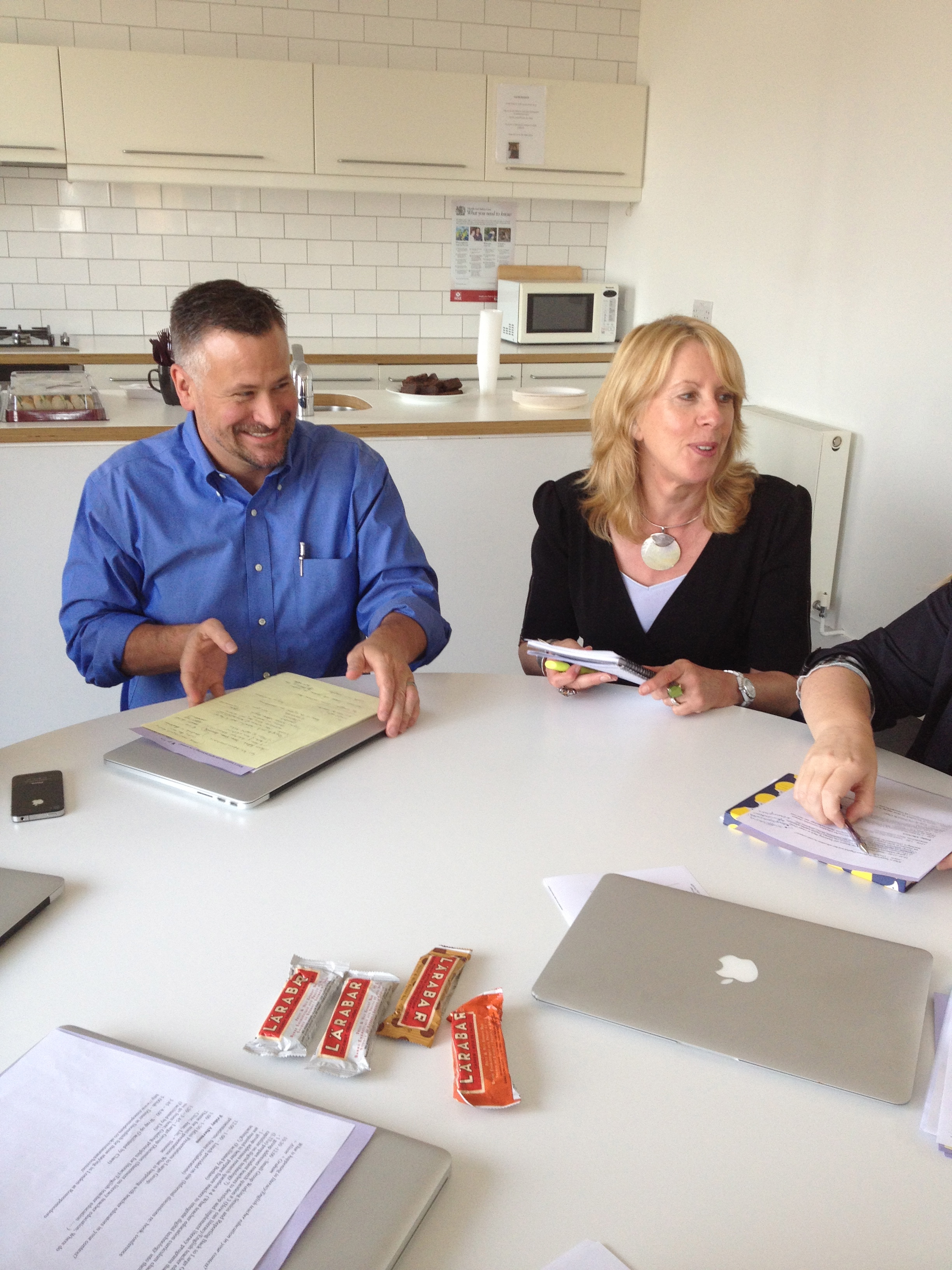
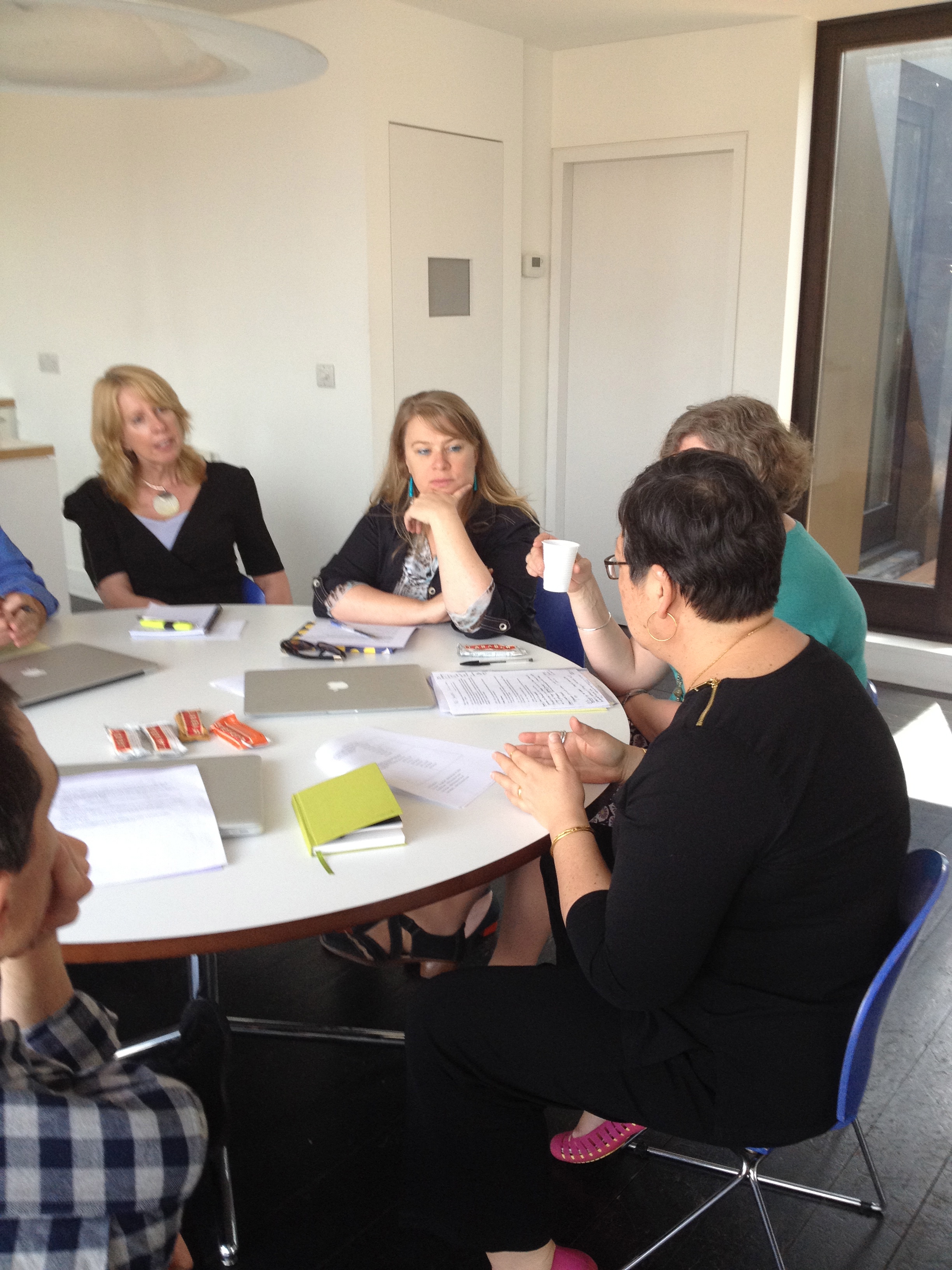
Please note that under the Connection Grant tab I (Clare) have added a photoarray from the Symposium; some of the ppt presentations; and some scholarly articles. More to follow.
Our Symposium: A Model for Teacher Educator and Policy Development
Our Symposium was amazing. For those who have read the blog posts
about it, I (Clare) am sure you got the sense that it was very interesting and productive. One of the words I would use to describe it is dynamic. There was such enthusiasm to discuss and grapple with the issues that we moved so beyond where we started (how to integrate digital technology into teacher education). Given that most people did not know each other, came from different countries, and had different areas of specialization (digital technology, teacher educators, teachers, policy) these differences did not divide us but they somehow brought us together to form a community. Not wanting to sound sentimental or superficial, I feel that something “magical” happened at the Symposium. The barriers melted away instantly and learning happened. Jean Murray’s “speed dating” opening activity immediately got us talking to each other. The laughter as we discovered interesting facts each other (e.g., John was fired as a gravedigger) raised the noise level to a crescendo. From there the Symposium developed into a committed group of educators focused on learning.
The two-day event was not like anything I have never experienced in my life – there was no posturing, there was careful listening, comments were relevant, questions were thoughtfully phrased, and there was commitment to something larger than individual research agendas. The interactions were respectful and genuine. I had assumed we would learn much about each other’s research and national contexts, I did not think that we would become a little community of teacher educators looking at the larger questions of education within a changing world. The level of enthusiasm was still sky high at the end of two intense days. There was no rush to leave or end the discussion.
So often in academia, department meetings are monopolized by issues such as timetabling. Conferences presentations are often more monologues that discussion. We need time to talk about the issues. The structure of the Symposium worked well – mini presentations by each person and time for large and small group discussion. This Connection Grant was not extravagant – we did it on a shoe-string budget. A number of universities contributed small amounts and we stretched our dollars. Given the money spent on university and government-based initiatives there is money for these kinds of events. Governments and universities need to spend their money thoughtfully and carefully – I would say, let’s use our Symposium as a
model of professional development for teacher educators and for policy development – bring the researchers together, devise a format for sharing and discussion, and let them proceed. I suspect the guidelines for education that they develop will be sensible and feasible.
Securing the grant and organizing the logistics were demanding. Our challenge now is to build on what we built and experienced. It is not just that I have much to learn from the amazing colleagues at the Symposium, but I also know that we are much stronger as a group. Teacher education is under siege. Individuals cannot resolve the challenges we face in teacher education but as a group perhaps we can do “something.” There has never been greater need to work together. I feel gratified — all of the work was so worth it. Thank you to the 16 participants who made this unique experience one I will never forget. I am eager to continue our collaborations. This website and blog will provide updates on our continued work together.

Challenges with Travelling Digitally
While packing for a recent trip , I (Cathy) noticed a change in my travel necessities. Here is what was on the top of my list:
Iphone & charger (for photographs, facebook, texting& directions)
Ipad & charger (for Skype, games and bill payments)
Ipod & charger, earphones (for novels and music)
Camera & charger (the Iphone only goes so far!)
Portable battery and cable (what if there is no outlet in the airport???)
As little as one and one half years ago I never would have listed such items. Times have changed. As convenient as these items may be to bring, I discovered a glitch in travelling digitally…5 devices but only one electrical adapter. Which one needs to be charged first? Now I have to prioritize my necessities!
Standards and Standardization in Teaching and Teacher Education
As the participants in the symposium talked about the state of teacher education in our 4 countries, I (Clive) was dismayed at the rapid movement toward requiring everyone (teachers and teacher educators) to teach the same things in the same way.
The cartoon about requiring all animals – elephants, monkeys, birds, fish, etc. – to climb the same tree kept coming to mind. This is madness. In the real world, not only are people different but we need them to be different because of the diverse tasks that have to be performed.
But it’
s problematic to publicly describe standardization as madness, since conservatives have presented their position in terms of raising or maintaining standards, and we may be seen as being soft on standards.

Two strategies have occurred to me: One is to fly under the radar, teaching in a rich and individualized way while also implementing “standards.” We have to learn to DO BOTH, as much as possible.
The other strategy is to develop and publicize the argument – noted above – that diversity is needed in all walks of life, and a society that doesn’t “let a hundred flowers bloom” will not prosper. I don’t think we have been vocal and persistent enough in pressing this
point.
Tug Agency http://www.tugagency.com was a fabulous place to hold the Symposium. The Tug Team are an example of very talented people who have gone far beyond the “standards” of education. They are very able and very creative — what can we learn from them about how to make education relevant and engaging?
Reflecting on my time at the International Symposium for Digital Technology and Literacy/English Teacher Education
I (Lydia) feel fortunate to have had the opportunity to participate in the symposium last week as many of the issues raised resonated with my current research examining student teachers’ experiences with contemporary literacy teaching and learning. The issues highlighted during the individual presentations and accompanying discussions offered rich insights into the status of teacher educational internationally.
I’d like to share a few of the questions raised during the symposium that remained with me and will continue to inform my research in literacy teacher education: What should a curriculum of contemporary teacher education include? In what ways can a curriculum of teacher education provide the space and quality time necessary for student teachers to truly engage as learners? How does power continue to operate in the curriculum? How do digital tools and social media spaces construct reading and writing? What do these digital spaces permit and what do they restrict? How is knowledge constructed, represented, and distributed within digital spaces? What are the pedagogical consequences as students engage with different modes within digital spaces? These are just a few of the questions I continue to consider upon my return from the symposium. Having the opportunity to consider the complexities and issues relevant to teacher education with international scholars was truly inspiring. I look forward to continuing our rich conversations.
International Symposium on Literacy/English Teacher Education: A Focus on Digital Technology
With the symposium a few days behind us, I (Pooja) have had some time to reflect on what was discussed in London, England. Clare wrote a reflection post on day one of the symposium (https://literacyteaching.net/2014/06/06/symposium-day-1-reflections/), so I want to reflect a bit on day two. Day two started off with mini-presentations which asked presenters to focus on a central question: What is happening with digital technology in your context?
Shawn Bullock, assistant professor at Simon Fraser University, raised some interesting issues related to digital technology and education:
- Technological Determinism: A theory which asserts we need to stay current with technology to stay relevant in society; technology determines cultural values and society’s structures
- Digital Publics: The theory that the nature of public space has changed significantly over the past years. The nature of public space has gone from persistent to replicable to searchable in the past few decades:
o Persistent- recording (video, audio) events changed the nature of public space;
o Replicable- recordings became replicable;
o Searchable- today we can search for any recording
(danah boyd)
Understanding how the nature of public space has drastically changed over the years, Shawn posed an important question to the group: What is the role of education in theorizing privacy in the digital age?
As the symposium was coming to a close, we were guided to reflect on the past two days. Many people realized that the rapid increase of standardization and data driven initiatives was happening across all contexts. However, many individuals commented that the conversations over the past two days were “energizing.” Being in conversation about big issues across international contexts made many teacher educators realize they were not alone. In fact, many commented they wanted to keep up the momentum by further collaborating and “making some noise” in teacher education.
Once again, we’d like to thank TUG Agency for so graciously hosting us. TUG provided a vibrant and exciting atmosphere for our symposium to take place. Check out their website at: http://www.tugagency.com
Thank you!!!