Category Archives: teacher educators

Lin Goodwin Video Now Available: Experts Speaking about Teacher Education

Last year I (Clare) received a grant for the project: Rethinking Literacy Teacher Education Lin Goodwinfor the Digital Era: Teacher Educators, Literacy Educators, and Digital Technology Experts Working Together. One of the main activities of the project was to bring together 16 experts from three fields and 4 countries (Canada, US, UK, and Australia) to address the following questions.
• How is our understanding of literacy evolving in light of the new ways we communicate?
• How can literacy/English teacher educators (LTEs) prepare student teachers to develop and implement literacy programs that capitalize on digital technology (DT)?
• What teacher education curriculum changes are required to better prepare future teachers to integrate technology in their own teaching?
• What professional learning support do LTEs need to develop courses that will integrate and make greater use of DT?

We held a Symposium in London England in June. Click on the link https://literacyteaching.net/connection-grant/ for more info on the Symposium and for some photos.

At the Symposium we interviewed the participants which we video taped. These videos are now available. They are incredibly interesting, informative, and short. Teacher educators can use these in their courses/presentations. Click on https://literacyteaching.net/connection-grant/powerpoint-presentations-and-videos/

(or the box to the right of this post).

I want to bring your attention to the second video which is of Lin Goodwin from Teachers College, Columbia University. She addresses:

First video: A key insight she has had about education

Second video: Recommendation to improve teacher education

Lin’s powerpoint presentations are also included. Lin is the Vice President of Division K Teaching and Teacher Education for AERA. She is an outstanding researcher who has recently conducted systematic research on teacher educators. Attached is a recent article she co-authored: What Should Teacher Educators Know and Be Able to Do? Perspectives From Practicing Teacher Educators Goodwin_-_WhatShouldTeacherEducatorsKnowandBeAbletoDoPerspec[retrieved_2015-03-28]

Enjoy!

Powtooning about Powtoon

I (Cathy) made a Powtoon about making a Powtoon.  Just follow the link below:

http://www.powtoon.com/show/dK9qzPurSC7/intro-to-powtoon/#/

If you are not familiar with Powtoon, it is an animated on-line presentation software tool that creates explainers, videos and presentations.  If you can create a power point, you can create a  Powtoon.  Only a Powtoon is much more interesting and fun!  It is an effective  tool for flipped classrooms and they make great multimodal assignments for students.  You can find many how-to videos on youtube.  My favourite was  on script writing (for powtoons):

https://www.youtube.com/watch?v=lyB1Y9xkSec

The Powtoon web site also hosts a set of tutorials to help you get started:

http://www.powtoon.com/tutorials/#prettyPhoto

The Powtoon I created was through a free account.  In that account I have access to  five minutes of Powtooning, 10 tunes and 11 animation styles.  Cant wait to make another.

Hope you give it a try!


Guest Blog: Monica McGlynn-Stewart

Hungry Caterpillar

Dual Language Texts

In my (Monica) preservice ECE class this week I had the most amazing experience. The Monica McGlynn-Stewartclass had been given the task of finding a dual language picture book for young children that was inviting and enticing and would support the language and literacy learning of children whose home language was not English. My students were encouraged to choose books that represented their own home languages. We have a wonderfully diverse class and they took up the challenge with enthusiasm. If they couldn’t find a dual language picture book in their home language, they translated a text and added it alongside the English text. For those (like me!) who only speak English, they were encouraged to choose a text that represented the language of children in their placement. They needed to develop six pedagogical strategies that they would employ when using the book with young children. I gave them a fabulous article by Gillanders and Castro (2011) the journal Young Children entitled “Storybook Reading for Young Dual Language Learners” as inspiration.

http://www.naeyc.org/files/yc/file/201101/GillandersR_Online0111.pdf

On Tuesday, they came with their picture books and their strategies, eager to begin. In small groups they took turns sharing their books, props they had made, teaching each other words in other languages, and practicing their strategies such as doing a “picture walk” through the text and pre-teaching key words or phrases that the children could chime in with during the reading. I had never seen the class so alive and so engaged. There were a dozen languages in the air. My students who were English Language Learners themselves, who were generally quiet and shy, were confidently sharing their expertise in their home languages. What I learned was the use of dual language texts can benefit not only young learners, but can also be an opportunity for dual language preservice students to value their home languages as a rich resource that they bring to their teaching.


Teacher educators living in difficult times

Many of our regular readers of this blog are teacher educators. I (Clare) want to bring to your attention a disturbing development in teacher education in the U.S. Lin Goodwin, Vice-President, Division K of AERA sent the following email. These proposed initiatives could have dire consequences for university-based teacher education. This direction of “inspecting” and assessing teacher ed programs is very similar to what is happening in England. The effects on programs, faculty, and student teachers are profound. I do not think this spread of punitive measures is confined to just a few countries. Below is a summary of the proposed initiatives and a link to the full report. Imagine if the $ spent on assessing teacher ed programs was spent on PD for cooperating/associate teachers and teacher educators or used to create induction programs for new teacher educators or allotted to schools so that cooperating/associate teachers and their student teachers have time to meet during the day. Teacher ed would be greatly enhanced. We teacher educators are living in very difficult times! Teacher educators please speak up.

Dear Division K Colleagues,

I am sure many, if not most, of you have reviewed the Teacher Preparation Regulations proposed by the federal government. They promise to have a detrimental impact on all of us–faculty and students alike– given our work and programs in preservice teacher education. So, I encourage you to submit a comment, submit several comments, comment often and loudly by February 2nd. Please note the advice below–individual, authentic comments are best, versus collective or structured responses.

lin

– –

BOULDER, CO (January 12, 2015) – Recently proposed federal regulations that would impose new mandates on teacher education programs are likely to harm, rather than help, efforts to improve educational outcomes, according to a new review published today.

The draft regulations were reviewed for the Think Twice think tank review project by Kevin K. Kumashiro, dean of the School of Education at the University of San Francisco. The review is published by the National Education Policy Center, housed at the University of Colorado Boulder School of Education.

Kumashiro examined the proposed new Teacher Preparation Regulations, issued under Title II of the Higher Education Act, that the U.S. Department of Education released in the Federal Register on December 3, 2014. The education department has set a deadline of Feb. 2, 2015, for public comments on the regulations.

The draft proposal, Kumashiro explains in his review, enumerates a series of regulations that would be mandated by the federal government but would be enforced by the individual states. The regulations would require states to assess all teacher preparation programs annually and to rate them as “exceptional,” “effective,” “at-risk,” or “low-performing,” based in large part on a test-based accountability approach that would attribute gains in student test scores to teachers and then attribute those teachers’ “scores” to the teacher education programs they attended.

The regulations also would require states to provide technical assistance to programs rated “low-performing,” and those programs would risk losing state approval, state funding, and federal financial aid for their students.

In his review, Kumashiro points to a series of “vital policy concerns” raised by the proposed regulations. They include:

  •  They underestimate the cost and burden of implementing them, which Kumashiro says would be not only “quite high,” but also “unnecessary.”


  • With no foundation in evidence, they blame individual teachers – rather than root systemic causes – for the gap separating educational outcomes of affluent and white students from those of economically disadvantaged students and those belonging to racial minority groups.


  • They rely on an “improperly narrow” definition of what it means for teachers to be ready to teach.


  • They bank on test-based accountability and value-added measurement of teachers in analyzing data about teacher performance – even though those measures and tools have been “scientifically discredited.”


  • They are premised on inaccurate explanations for the causes of student achievement and underachievement, and as a consequence will discourage teachers from working in high-needs schools.


  • They will likely limit access to the teaching profession, especially for prospective teachers of color and from lower-income backgrounds, by choking off federal financial aid.

Finally, Kumashiro warns, the proposed regulations are rooted in “an unwarranted, narrow, and harmful view of the very purposes of education.”

Find Kevin K. Kumashiro’s review on the NEPC website at: http://nepc.colorado.edu/thinktank/review-proposed-teacher-preparation.

The Think Twice think tank review project (http://thinktankreview.org) of the National Education Policy Center (NEPC) provides the public, policymakers, and the press with timely, academically sound reviews of selected publications. NEPC is housed at the University of Colorado Boulder School of Education. The Think Twice think tank review project is made possible in part by support provided by the Great Lakes Center for Education Research and Practice.

Sent by Chester Tadeja, Division K Web Developer on behalf of A. Lin Goodwin, Division K Vice President

Creating an Audit Trail

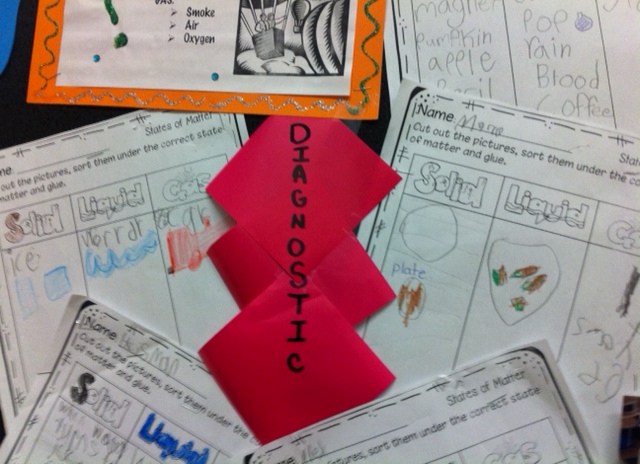
During one of my final practicum visits, I (Cathy) was excited to see one of my student teachers had created an audit trail.   When I mentioned this to her, she replied, “I thought  it was just a bulletin board.” But it was far more than ‘just a bulletin board’.   The student work Melissa had beautifully displayed represented an entire science unit of learning from pre-diagnosis to final summaries.

Audit trails were popularized by Dr. Vivian Vasquez, in her ground breaking critical literacy work with 3-5 year olds.  Vasquez says,                                                                                                             An audit trail or learning wall, as my three to five year old students called it, is a public display of artifacts gathered together by a teacher and their students that represents their thinking about different issues and topics.  This strategy is useful for creating spaces for students to re-visit, reread, analyze, and re-imagine various topics or issues. It is also a powerful tool for connecting past projects or areas of study to newer projects or areas of study. Further, it can be used as a tool for building curriculum as it visibly lays out the journey of the group’s thinking and learning over a period of time.

http://hwcdn.libsyn.com/p/c/f/3/cf355fe54466c4e0/Audit_Trail.pdf?c_id=4270455&expiration=1418946485&hwt=2cc91c9a05310c5ca082ae4a61c9c725

more walldiagnostic molecules

Inspiration from Pinterest

I (Cathy) find one of the most popular social media sites used by my student teachers is Pinterest.  They rave about the interesting and engaging ideas they find on the site for lessons.  I saw evidence of this just recently while visiting a school.   My student teacher, Melissa, had found a writing exercise on the site entitled, If I Was  Trapped in a Snow Globe.  It involved the students creating a snow globe scene inside of a white plastic container and then describing the adventure in writing.   The associate teacher was so excited by the results, she lead me into the hallway to see what  her young students had accomplished.  The associate declared, “This student never writes anything, but look at this!  Two pages!  They loved this writing assignment.”

Often, good writing results by students are the results of a good inspirational ideas. Luckily educators have many more resources to access now, due to social media.  I highly recommend Pinterest for many ideas in variety of subjects.

http://primarypunch.blogspot.ca/2013/01/thank-you-pinterest.html

globesstory

Teaching with a Sense of Humour

The What is Education?  blog for teachers states that having  a sense of humor is, 

 very useful in creating a classroom climate and the development of learning processes that are more healthy and enjoyable. In fact, Melissa Kelly said that a sense of humor is one of the keys to being a successful teacher. According to Melissa, teachers’ sense of humor can relieve tension in the air and can prevent the onset of disruptive student behavior in the classroom, and can be used as a way to attract the attention of students in the class. And most importantly, with its sense of humor, a teacher would show that he/she is a person who has a personality and mental health, to enjoy life, and be able to live a normal life without the stress of his/her career.

http://what-education.blogspot.ca/2013/06/the-importance-of-teachers-using-humor.html

I (Cathy) was delighted to see one of my student teachers, Carolyn,  using her sense of humor throughout her literacy lesson. Her grade one and two students found her quite amusing and would joke along with her.  Sometimes her humor was self-depricating, and sometimes it was as innocent as, “Who me?  I would never do that!”  It was never sarcastic and always made her students smile.  She even used it as a classroom management technique to keep the students focused and engaged.  When I asked her about  her technique, she said it made teaching and leaning more enjoyable.  Then she described an art lesson she had just taught using candle wax and water colours.  She drew a picture on the white paper using a white candle, so it was not visible.  While introducing the lesson she held up the paper and kept telling the students how proud she was of her picture.  When the students kept insisting there was nothing there, she applied the water colours and, of course, the picture magically appeared.  The humor came to play when she allowed each student to play the same joke on her as they created their pictures.  All of the magic pictures were displayed proudly in the hallway of the school.  Carolyn said the students still refer to it and giggle.

I think having a sense of humor is an asset.   We all definitely need to laugh more, especially in our schools.  Carolyn

The First of the last: Happy December

Today is December 1st, the first day of the last month of the year.  I (yiola) have finished teaching for the term as courses have ended and student teachers are wrapping up their final week of classroom teaching placements. I have papers to read and evaluate and grades to report and then my thoughts move into the next term with considerations for how to make my courses and learning experience even better than the last.

It has been a wonderful term. Beyond feeling good about the term, I reflect on what I think has made my courses run smoothly. Below I list some of the elements that stand out as contributing to the making of successful learning experiences in my teacher education courses.

The Students: Hands down the most influential element for fostering successful learning experiences in my courses are the students; their preparedness, willingness to learn, participation in class, positive attitudes and approaches during class discussions, and openness to critically thinking about all they are learning.

Content and Pedagogy:  What to teach and how to teach in teacher education have always made for interesting discussions. As post-graduate education I see the courses as graduate level courses that are also part of a professional program. I ground the readings and my teaching in research and share information that is interesting, accessible, and what I will call connectable.  Connectable meaning bringing together the research with student teachers’ practical experiences and the Ministry curriculum. Research, practice, policy are the three points of my pedagogical content triangle.  The content needs to be current, relevant, accessible and grounded in research. My role is to bring the content to life; to encourage students to think about the content and how it applies to their practice and to student learning; to critique the content and think critically about it, not to criticize but rather to analyze.

Our teacher education classes are three hours long and within those three hours there are a number of pedagogical strategies used to engage and extend our learning:  what I call a lecturette is something I bring to each class ~ a short presentation that addresses and extends key issues based on research and scholarship; small group discussions; whole class discussions; student led presentations; short experiential opportunities. For example, last week as we explored program planning and cross curricular considerations I gave a short lecturette on the concept of program planning using Beck and Kosnik’s work from The Seven Priorities of Teacher Education. The literature we used was liberating in that it presented not only research-based content but also “real life” content of what it meant to consider for program planning. Student teachers were able to relate and think broadly about what it meant to program plan in the elementary classroom and this was evident through the class discussions.  We then moved into exploring some of the concepts presented in the reading and focused on integration and cross-curricular connections. I shared a read aloud Wangari’s Trees of Peace set a context for planning development. I modelled working through the beginnings of a planning process.  The students got into small groups and explored the curriculum looking at ways to integrate and build on what I started.  Students represented their thinking on chart paper which was put up for a gallery walk (that way avoiding every group presenting) and we came back and analyzed the experience of thinking about cross-curricular possibilities  and how it relates back to the broader scope of program planning.

Theory and Practice:  I teach theory. Even when I talk about practice, I am theorizing practice. As a teacher educator in my university classroom it is what I do. I can talk about my practice. I can have students talk about their practice and we can apply practical elements into the classes. These are some subtle ways of connecting theory to practice. What happens in our course that I believe really ties theory to practice is the presence of the practicum coordinator at our classes. The practicum coordinator is the person who sets up the teaching placements, consults with students about their teaching placements, visits the students at their teaching placements and brings to the program all elements of practice. This person also attends my courses. She often sits in on the classes, adds practice teaching suggestions and resources to the discussion and often extends the learning by taking twenty minutes to share insights between what we discuss in class and the teaching placements. The students share their experiences and provide concrete examples from their specific teaching placements.

Snack: Food = community. Food = nourishment. Food = caring.  The learning environment is enriched when there is time for the community to come together over a small snack during the break. This is an essential part of the class.

And then there are elements that run outside the courses  that have had such strong influence on my practice:

Mentorship:  The modelling and care my mentors have shown for teacher education has paved the way for my practice. The opportunity to be a Teaching Assistant in an exemplary teacher educators class during one’s doctoral journey holds much benefit. Clare Kosnik has been my mentor and has demonstrated excellence in teacher education that I have been able to learn. From planning, to content, to pedagogy, and community building I have received mentorship through observation, discussions, sharing, and co-teaching I have been able to extend and build on her amazing work.  Excellence does not happen at the onset of one’s practice but there is no better way to begin one’s practice than to listen, observe and work with an exemplary teacher educator.

Research:  Reading about teacher education, talking about teacher education, researching teacher education, writing about teacher education are at the core of my practice.  When I wonder how to design my assignments, I look to the literature and discuss with my mentor;  when I wonder how student teachers may respond to particular critical content areas, I look to the literature and quickly gain a clear portrait of what to expect and how to approach the potential reactions and experiences my students may face; when I prepare to teach issues of literacy teaching I look to the literature of literacy teacher educators and that allows me to consider my own practice and how to make it better for student teacher learning.

And now with December upon us, today is the first day of the last month of the year,  and the closing of a term is near I wish all teacher educators all the best.

Literacy/English Teacher Educator study

I (Clare) am the Principle Investigator  of a large-scale study of 28 literacy/English teacher educators from four countries. This week I am doing a presentation at the Ontario Ministry of Education where I will give an overview of our findings. Attached is the powerpoint which I thought you might find interesting. MOE LTE 2014

For more information on the study click on the tab  Projects and then click on Literacy Teacher Educators: Their Backgrounds, Visions, and Practices.

Explaining Explain Everything (App)

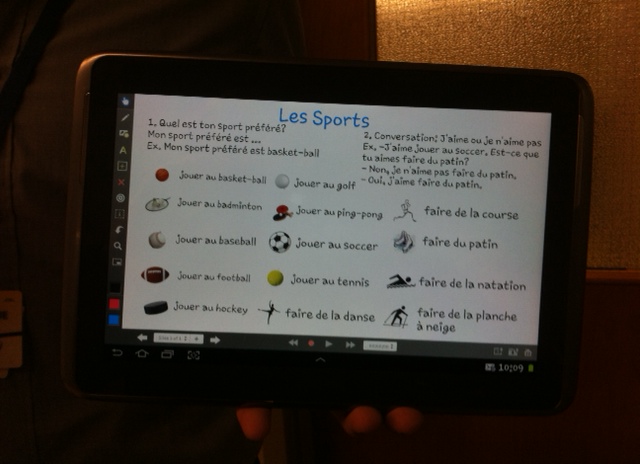
I (Cathy) find that one of the exciting aspects of teaching is learning from my students- especially about digital technology.    One of my student teachers, Drake, taught a lesson last week using Explain Everything.  With the aid of this app he successfully taught  a lesson in French which enabled his grade 6 students to engage in conversations about sports.  How he used the app was definitely key to the success of his lesson and I gave him full credit for cleverly scaffolding the sequence of the questions and answers so that that student conversations were set up for success.  Yet, Drake insisted it was the app that enabled him to teach the lesson so clearly.  Below are pictures of how Drake set up the lesson on his ipad and then mailed it to himself as a handout for his students.  Well done Drake!

Drakeipad

Intrigued, I began to play with this app myself.  I discovered it has a wide range of  applications. It feels like a cross between a power point and a smart board, but completely doable on an ipad.   Very convenient.  Below is an link to a you tube video that demonstrates how students can use the app in a classroom.