The First of the last: Happy December

Today is December 1st, the first day of the last month of the year.  I (yiola) have finished teaching for the term as courses have ended and student teachers are wrapping up their final week of classroom teaching placements. I have papers to read and evaluate and grades to report and then my thoughts move into the next term with considerations for how to make my courses and learning experience even better than the last.

It has been a wonderful term. Beyond feeling good about the term, I reflect on what I think has made my courses run smoothly. Below I list some of the elements that stand out as contributing to the making of successful learning experiences in my teacher education courses.

The Students: Hands down the most influential element for fostering successful learning experiences in my courses are the students; their preparedness, willingness to learn, participation in class, positive attitudes and approaches during class discussions, and openness to critically thinking about all they are learning.

Content and Pedagogy:  What to teach and how to teach in teacher education have always made for interesting discussions. As post-graduate education I see the courses as graduate level courses that are also part of a professional program. I ground the readings and my teaching in research and share information that is interesting, accessible, and what I will call connectable.  Connectable meaning bringing together the research with student teachers’ practical experiences and the Ministry curriculum. Research, practice, policy are the three points of my pedagogical content triangle.  The content needs to be current, relevant, accessible and grounded in research. My role is to bring the content to life; to encourage students to think about the content and how it applies to their practice and to student learning; to critique the content and think critically about it, not to criticize but rather to analyze.

Our teacher education classes are three hours long and within those three hours there are a number of pedagogical strategies used to engage and extend our learning:  what I call a lecturette is something I bring to each class ~ a short presentation that addresses and extends key issues based on research and scholarship; small group discussions; whole class discussions; student led presentations; short experiential opportunities. For example, last week as we explored program planning and cross curricular considerations I gave a short lecturette on the concept of program planning using Beck and Kosnik’s work from The Seven Priorities of Teacher Education. The literature we used was liberating in that it presented not only research-based content but also “real life” content of what it meant to consider for program planning. Student teachers were able to relate and think broadly about what it meant to program plan in the elementary classroom and this was evident through the class discussions.  We then moved into exploring some of the concepts presented in the reading and focused on integration and cross-curricular connections. I shared a read aloud Wangari’s Trees of Peace set a context for planning development. I modelled working through the beginnings of a planning process.  The students got into small groups and explored the curriculum looking at ways to integrate and build on what I started.  Students represented their thinking on chart paper which was put up for a gallery walk (that way avoiding every group presenting) and we came back and analyzed the experience of thinking about cross-curricular possibilities  and how it relates back to the broader scope of program planning.

Theory and Practice:  I teach theory. Even when I talk about practice, I am theorizing practice. As a teacher educator in my university classroom it is what I do. I can talk about my practice. I can have students talk about their practice and we can apply practical elements into the classes. These are some subtle ways of connecting theory to practice. What happens in our course that I believe really ties theory to practice is the presence of the practicum coordinator at our classes. The practicum coordinator is the person who sets up the teaching placements, consults with students about their teaching placements, visits the students at their teaching placements and brings to the program all elements of practice. This person also attends my courses. She often sits in on the classes, adds practice teaching suggestions and resources to the discussion and often extends the learning by taking twenty minutes to share insights between what we discuss in class and the teaching placements. The students share their experiences and provide concrete examples from their specific teaching placements.

Snack: Food = community. Food = nourishment. Food = caring.  The learning environment is enriched when there is time for the community to come together over a small snack during the break. This is an essential part of the class.

And then there are elements that run outside the courses  that have had such strong influence on my practice:

Mentorship:  The modelling and care my mentors have shown for teacher education has paved the way for my practice. The opportunity to be a Teaching Assistant in an exemplary teacher educators class during one’s doctoral journey holds much benefit. Clare Kosnik has been my mentor and has demonstrated excellence in teacher education that I have been able to learn. From planning, to content, to pedagogy, and community building I have received mentorship through observation, discussions, sharing, and co-teaching I have been able to extend and build on her amazing work.  Excellence does not happen at the onset of one’s practice but there is no better way to begin one’s practice than to listen, observe and work with an exemplary teacher educator.

Research:  Reading about teacher education, talking about teacher education, researching teacher education, writing about teacher education are at the core of my practice.  When I wonder how to design my assignments, I look to the literature and discuss with my mentor;  when I wonder how student teachers may respond to particular critical content areas, I look to the literature and quickly gain a clear portrait of what to expect and how to approach the potential reactions and experiences my students may face; when I prepare to teach issues of literacy teaching I look to the literature of literacy teacher educators and that allows me to consider my own practice and how to make it better for student teacher learning.

And now with December upon us, today is the first day of the last month of the year,  and the closing of a term is near I wish all teacher educators all the best.

Happy Birthday Abbey

AbbeyOn our blog we have shared so many of our interests with our readers. Today for Abbeysomething totally different! I (Clare) have a little Yorkshire terrier who is like my little baby. Tomorrow he turns 15 years old. As you can see from the photos he is adorable. There is nothing like coming home from a long day at work and seeing his little face in window. By the time I have unlocked the front door, he is standing in at the top of the stairs, wagging his little tail. In that instant all of the “stuff” from work just 01 02 04 Abbey at the Office 2vanishes. DSC00607A good friend of mine, Ardra Cole, said that everyone writing a thesis should have a dog because of the comfort and love a pet gives. I would extend this – if you have the resources – everyone should have a loving little pet. So happy birthday Abbey!

PD James, queen of crime fiction, dies aged 94

P.D. James is one of my (Clare’s) favourite writers – I love her detective novels and have spent many hours curled up reading her books. She passed PD Jamesaway on Thursday. Her life story is almost one of fiction – from working in the Home Office to being a leading author of detective novels. In the Guardian newspaper there was a wonderful tribute which is copied and pasted below.

http://www.theguardian.com/books/2014/nov/27/pd-james-detective-fiction-dies-aged-94-detective-adam-dalgliesh

Creator of much-loved detective Adam Dalgliesh was one of the most successful British authors of d The writer PD James, who charted the transformations of British life through bestselling crime fiction starring the detective Adam Dalgliesh, has died aged 94. Her publisher Faber and Faber confirmed that she had died peacefully at home in Oxford on Thursday morning.

Her debut novel, Cover Her Face, was snapped up by the first publisher to set eyes on the manuscript, launching a career that advanced in parallel with that of her fictional police officer, Chief Inspector Dalgliesh. As he found himself promoted to superintendent and then to commander, so James accumulated a host of awards including the Crime Writers’ Association’s Diamond Dagger and the Mystery Writers of America Grandmaster award. Many of the Dalgliesh novels were subsequently filmed for television, with Roy Marsden taking the role of the investigator.

James also won a good number of public honours, eventually finding herself elevated to the House of Lords in 1991, where she sat with the Conservatives.

Born in 1920, James left school at 16 to follow her father into a career in the Inland Revenue. She married Connor White at 21 and moved to London, giving birth to two daughters as German bombers pounded the British capital. Her husband returned from the war with mental health problems, leaving James to provide for her young family by working in hospital administration. With her daughters at boarding school and her husband in hospital, evenings become devoted to writing.

It had always been her “intention” to become a writer, and she began writing about a detective partly as an apprenticeship for writing “serious” novels, as she explained to the Paris Review in 1994. James had always loved crime novels, was unwilling to explore the “traumatic experiences” of her own life in fiction and was well aware it would be easier to find a publisher for a detective story. But the genre also appealed to her taste for order.

“I like structured fiction, with a beginning, a middle, and an end,” she said. “I like a novel to have narrative drive, pace, resolution, which a detective novel has.”

Published in 1962, Cover Her Face opens “exactly three months before the killing”, with a country-house dinner party which becomes, “in retrospect, a ritual gathering under one roof of victim and suspects, a staged preliminary to murder”. The new parlourmaid announces her engagement to the manor house’s eldest son at the village fete and is strangled the following night, a mystery resolved by the refined poet-detective Dalgliesh. “I gave him the qualities I admire,” James explained in 2001, “because I hoped he might be an enduring character and that being so, I must actually like him.”

The author’s hunch proved accurate, Dalgliesh trading his Bristol Cooper for a Jaguar as he took on cases in hospitals, nursing homes and laboratories over the course of 14 novels.

The erudition of James’s detective and the focus of her murder mysteries on the middle classes brought accusations of elitism, coming to the boil in 1995 after a radio interview in which the author suggested “you don’t get moral choice” in what she called “the pits of the inner-city area, where crime is the norm and murder is commonplace”. But the writer made no apologies, arguing “the contrast between respectability and planned brutality is of the essence” in a detective story.

“If you have appalling and violent events happening in a civilised place, it’s a great deal more horrific,” she explained.

With second-wave feminism at high tide, James flirted with a tough, working-class female lead. When Cordelia Gray made her debut in 1972’s An Unsuitable Job for a Woman, she became one of modern crime fiction’s first female private detectives, paving the way for Liza Cody’s Anna Lee and Sara Paretsky’s VI Warshawski. James managed only one more full-length outing for Gray, abandoning the detective after her television incarnation had an affair and became pregnant. “I realised my character had gone,” James said.

International success came with 1980’s Innocent Blood, in which a young woman discovers the murderous secret at the heart of her adoption. James sold paperback rights for £380,000 and film rights for £145,000 – more than she had earned in 10 years working at the Home Office – and promptly retired. “At the beginning of the week I was relatively poor and at the end of the week I wasn’t,” she remembered.

Writing outside the crime genre, her 1992 novel The Children of Men – set in a dystopian future – was adapted to critical acclaim for the cinema in 2006. She also scored a late hit in 2011 with Death Comes to Pemberley, a murder-mystery sequel to Jane Austen’s Pride and Prejudice.

James’s apprenticeship in crime fiction became a lifelong commitment, as she came to believe “it is perfectly possible to remain within the constraints and conventions of the genre and be a serious writer, saying something true about men and women and their relationships and the society in which they live”. To suggest that the formal constraints of crime fiction prevent its practitioners from producing good novels “is as foolish as to say that no sonnet can be great poetry since a sonnet is restricted to 14 lines”, she argued.

Speaking in 2001 at the launch of Death in Holy Orders, her 11th Dalgliesh novel, James explained that her success was founded on the belief that plot could never make up for poor writing and that authors should always focus on the reader.

“At the end of a book, I want to feel, well that’s as good as I can do – not as good, perhaps, as other people can do – but it’s as good as I can do. There are thousands of people who do like, for their recreational reading, a classical detective story, and I think they are entitled to have one which is also a good novel and well written. Those are the people I write for. They don’t want me to adapt to what I think is the popular market. They want a good novel, honestly written and I think they are jolly well entitled to it.”

Texting at the Table

Below is a link to a vignette that  really struck a chord with me (Cathy).  There is a lot to learn about the etiquette of texting.  According to Maralee McKee, “out attention is a gift.”

McKee also says,

Our full attention is the foundation of every kindhearted, other-centered interaction. Texting alters the continuity, focus, and momentum of our encounters.

It produces anxiety (mild to severe) in the other person, and whether they’re telling you (or even aware of it themselves) or not, they’re attention is apt to desire to focus on someone who pays them back equally.

These are big matters.

If we’re not being careful, texting can hurt our family, our friendships, our business relationships, even our ability to govern.

http://www.mannersmentor.com/only-at-work/seven-ways-to-text-with-graciousness-and-savvy

In the vignette a father makes his point to his sons the ‘old fashaoined way’.  Enjoy.

http://faithtap.com/2114/dad-asks-pass-the-salt-while-sons-text/


Guest Blog: Gisela Wajskop’s Reflection on Her Time in Canada

Gisela WajskopIt’s snowing! But I (Gisela) have nothing to complain about! From January 2014 until today I have enjoyed many winter days in Toronto. I’ve been a Visiting Scholar from Brazil sponsored by Clare Kosnik for almost a year at OISE/University of Toronto. It has been an amazing experience! More than the cold weather I’ve discovered a great country: from red maple leaves to squirrels on streets, from Lake Ontario to Lake Louise, from Quebec City to Montreal, from AGO to Canadian Museum of Human Rights in Winnipeg, from rainbow positive to multicultural spaces. The environment and people have touched my heart and brain!

I have interviewed teachers and educators and I have observed many babies and kids at schools and Day Care Centres. I have met many smart people — undergraduate students, faculty, and newcomers to Canada (who have diverse cultures, values and languages).

This sabbatical opportunity contributed to my analysis of teacher education in Brazil. The insights I have gained came about through discussion of my data at Clare’s and Clive’s BTE team meetings and by comparing my findings to some of the points made in lectures that I attended at OISE and at conferences both in Canada and the U.S. One of the exciting developments was that my proposal on my research was accepted by AERA. I will present my work in Chicago next year.

This wealth of experiences and my academic partnership improved my own vision of education. Being a teacher is complicated because of the many dilemmas and issues yet being a teacher should connect to one’s own life. Teaching occurs in a dynamic, diverse, and interactional-based setting!

My experience in Toronto gave me spectacular new knowledge about being a teacher in a democratic and multicultural city! I have learned from OISE and the Toronto District School Board that a good and positive vision of education is supported by research. This vision is “tested” daily by students, parents, and principals. The most important piece of the education puzzle is teachers. I have been impressed with the ways that teachers think critically about education and have developed many good strategies for teaching which in turn supports student learning!

I learned also that accountability counts! More than policy initiatives, accountability should include the community’s attitude towards the kids and youths in schools! Even though Canadians complain about their schools, I have seen some great initiatives: Triangle Program that supports LGBQT high school’s students; a Parkdale school that supports ESL students who often struggle financially and has a number of refugee children from around the world; and schools with an Afrocentric-positive space to support student well- being. I have learned about connecting undergraduates students with teacher education research which will help these future teachers build a whole identity and professional practice.

Thanks everyone who supported me in the time I spent in Canada! I hope that OISE will help my country improve our national system of education. Doors are open between our countries! See you soon!

The Danger of Silence

I came across this short yet powerful TED talk. Educator Clint Smith delivers a power piece of spoken word on what he believes  to be  the dangers of silence. Smith, like many educators, values students’ voices and opinions. He believes we must encourage our students to speak out against injustices because silence leads to discrimination, violence, and war. Through the use of poetry, Smith helps students shares their stories- share their “truths.” Smith begins his spoken work piece with a powerful Martin Luther King Jr. quote: “In the end, we will remember not the words of our enemies, but the silence of our friends.”

Smith also shares 4 core principles that he runs his classes by:

1. Read critically

2. Write consciously 

3. Speak clearly

4. Tell your truth

Watch Smith’s 4-minute video here to hear more about the dangers of silence:

Screen Shot 2014-11-24 at 10.42.22 PM

FDK Update: Assessment and Communication

Full Day Kindergarten (FDK) Blog #4  tells the literacy teaching story from the perspective of a first time Full Day Kindergarten parent (Yiola).   In this post I share elements of the assessment process and how my child’s development has been communicated.

Here in Ontario it is “Parent-Teacher Interview” time. First term report cards have been written and parents and teachers, and sometimes students, are meeting to discuss student progress.  There are a number of ways the interviews are conducted: student-led conferences are now quite popular processes and the more traditional teacher-led conference sans student are still in effect.

When I received the school newsletter and read that report cards and interviews were about to take place I was surprised and a little anxious; I felt it was too early to have the teachers share my child’s development… I knew my Sylvia Clare was learning a lot but to put in writing her ‘levels’  or acquired learning after 8 short weeks of school seemed far too soon.  Well, I was right. The report cards and formal interviews were meant for students in grades 1 and up, not for kindergarten. Phew! That made more sense to me. As a parent of a child in kindergarten it makes good sense that children in the early years are not formally assessed … well, too early.  From a parent’s perspective, I wonder  if I would feel the same way if my children were in first or second or third grade?

What the FDK program has established is an “observation” time where each parent/guardian is invited to visit the classroom in action, to observe the daily life of the classroom and their child in the classroom. During the observation time the teacher offers some time to discuss questions or concerns with the parents/guardians. I was thrilled with the sounds of process as I was feeling so very curious about the sounds and vibes of the classroom and how Sylvia Clare got on inside that environment. A first hand eye-witness makes such good sense.

A short note arrived home a week before the observation. We were assigned a half hour observation time the following Monday morning.  This worked well for me, but I did wonder, how do full-time working parents without flexible schedules manage the observation?

Monday morning arrived and off I went to visit the classroom. Alive with children’s voices, questions, and energy I walked into a vibrant room filled with learning. I was welcomed by the Teacher and Early Childhood Educator. Sylvia Clare’s face lit up when she spotted me as she hustled over with excitement. I quickly slid into the flow of the room and began to learn what it was my child did in the FDK room. Sylvia Clare was working with another student building the 100s chart on the huge carpet area. She had the 70s cards and while the Senior Kindergarten student was building from the 40s, she watched and waited patiently for the 70s to turn up so she could add to the massive chart… a wonderful, collaborative learning experience.  When done, she showed me around the room:  building centres, reading nooks, sand table, art table, writing table, snack table and well organized low rise shelves embodied the room. The room was as I remembered it back in August (neutral colours, natural light, natural materials) but now evidence of student learning lined the walls; drawings, colourings, writings were on display and I could see Sylvia Clare’s work.

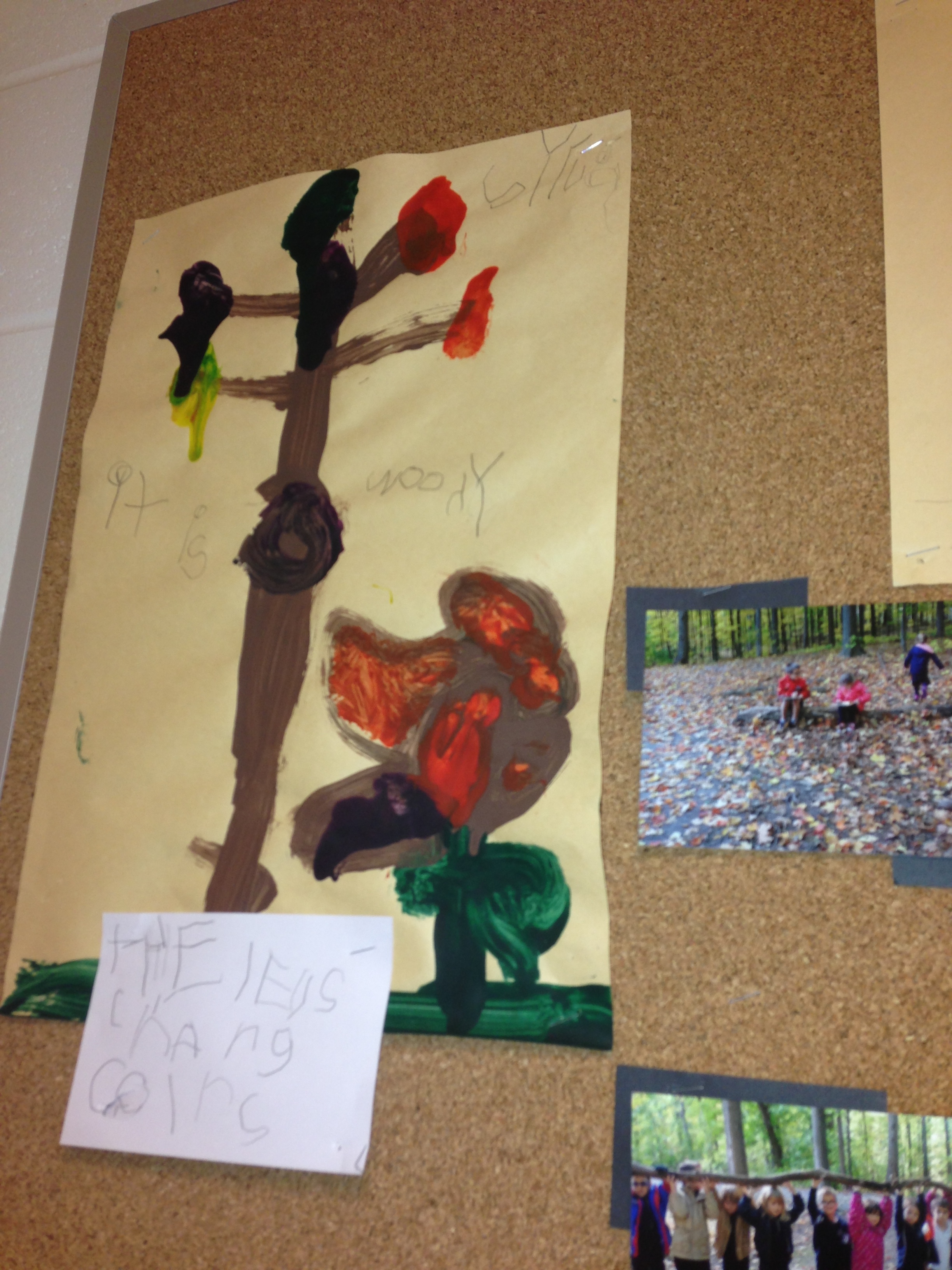
Sylvia Clare's portrait of "Woody", the tree the class adopted from the neighbourhood forest.
Sylvia Clare’s portrait of “Woody”, the tree the class adopted from the neighbourhood forest.

Children working in pairs, in small groups, independently on a variety of tasks throughout the room. The room was bustling yet highly organized. The room was loud but not noisy. I was thrilled to see so many “languages” brought to life (Reggio Emilia’s notion of the 100 languages in the classroom) ~ art opportunities everywhere; all purposeful and engaging. Everyone, including my Sylvia Clare had a place in the space and was engaged in the life of the room. The teachers encouraged Sylvia Clare to show me her portfolio (a binder with evidence of her work). Then Sylvia Clare led me to her interests where we explored and worked together.  Once well settled into the observation, the teacher sat down next to me and asked, “Do you have any questions or concerns?”  This was such an open and  welcoming way to start our discussion. My questions:

Is Sylvia Clare happy at school?

Does she have friends and is she social? Who does she play with the most?

Where does she spend most of her time in the room?

I see she is learning a lot from all that she shares at home. What do you think?

The teacher provided specific description of Sylvia Clare’s work in the classroom: what she talks about, who she plays with, what she enjoys doing, and how she interacts in the classroom. It was clear to me the teachers have a good sense of who Sylvia Clare is, what she likes, areas she has shown significant growth already and areas for improvement. Then I asked:

What can we work on at home to support her learning? 

Continued literacy development, focusing on sound/letter recognition.  I realize now, as a parent of a child who is developing their reading skills just how complex the process is for children. It takes time. Some children acquire skills faster than others; some struggle  but all children need time, exposure, practice to basic skill development. In theory, I knew this. To witness it through the lens of a parent however is somewhat different.  Experiencing literacy development in one young child in live time, watching her gain letter recognition, one letter at a time, one sound at a time, is quite fascinating.  Sylvia Clare is getting there. Beyond the daily read alouds and story telling I need to work through phonic games and drills with Sylvia Clare.

After our brief conversation I felt comfortable and confident that my child has adjusted to full day schooling and getting along well.  Sylvia Clare then ushered me over to the snack table and we chatted while  some of her friends came over to meet me. Shortly after, I said my goodbyes and was on my way.

It was remarkable observing my child in this setting; a setting outside our home, a setting in which I am but an observer and Sylvia Clare is the participant. The observation experience provided very clear, detailed description of my child’s work at school, far more than I would have gathered from a formal report card.


Literacy/English Teacher Educator study

I (Clare) am the Principle Investigator  of a large-scale study of 28 literacy/English teacher educators from four countries. This week I am doing a presentation at the Ontario Ministry of Education where I will give an overview of our findings. Attached is the powerpoint which I thought you might find interesting. MOE LTE 2014

For more information on the study click on the tab  Projects and then click on Literacy Teacher Educators: Their Backgrounds, Visions, and Practices.

Teaching Between The Lines

A group of us just had a proposal accepted for AERA on teacher resistance, as part of a symposium on that topic. Our paper will be on how the teachers we are studying “teach between the lines,” finding ways to “live with” system mandates and teach (in varying degrees) in a holistic, constructivist manner.

I (Clive) just came across a very relevant quote in Nel Noddings’ 2013 book Education and Democracy in the 21st Century that will help us as we write the paper. She says:

“[In this book] we will consider how schools can help students to achieve satisfying lives in three great domains: home, occupation, and civic life…. [H]owever, I want to make it clear that I do not foresee dramatic changes in the basic structure of curriculum in America. We have to work within that basic structure. Sadly, I think we will go right on with English, mathematics, social studies, science, and foreign languages as the backbone of our curriculum. Indeed, if we continue in the direction we are now headed, the curriculum will become even more isolated from real life and its subjects more carefully separated from one another. It is this tendency that we should resist, and effective resistance will require collaboration, critical thinking, and creativity.” (p. 11, my italics)

Wow! While talking strongly of resistance Noddings says we have to work within the system, which if anything will get worse. What then does resistance mean?

It can mean campaigning publically against the retrograde measures; or negotiating at the school level to modify their implementation. Or it can mean finding holes – or “interstices” as the post-structuralists say – within the system that enable teachers to teach the way they believe in, to the extent possible.

This third approach is important because it allows teachers to keep their jobs and continue to be there for their students. We mustn’t dismiss this type of resistance as mere compromise. Rather, we must join with teachers in looking for ways to teach well within the system. And teacher educators must discuss the challenges and possible strategies at length with their students, so they come to teaching prepared to teach between the lines, rather than having to figure it out on their own.


Explaining Explain Everything (App)

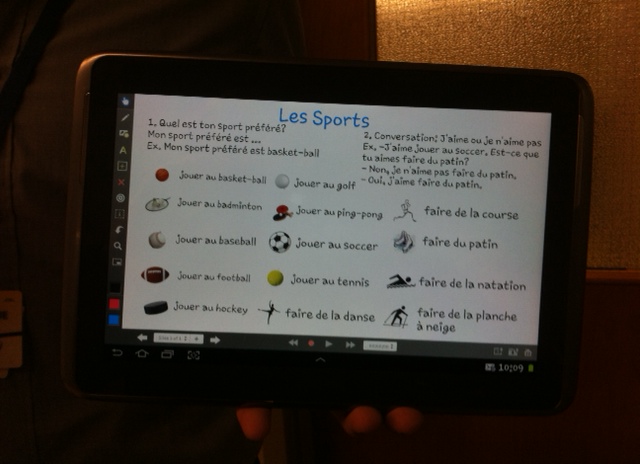
I (Cathy) find that one of the exciting aspects of teaching is learning from my students- especially about digital technology.    One of my student teachers, Drake, taught a lesson last week using Explain Everything.  With the aid of this app he successfully taught  a lesson in French which enabled his grade 6 students to engage in conversations about sports.  How he used the app was definitely key to the success of his lesson and I gave him full credit for cleverly scaffolding the sequence of the questions and answers so that that student conversations were set up for success.  Yet, Drake insisted it was the app that enabled him to teach the lesson so clearly.  Below are pictures of how Drake set up the lesson on his ipad and then mailed it to himself as a handout for his students.  Well done Drake!

Drakeipad

Intrigued, I began to play with this app myself.  I discovered it has a wide range of  applications. It feels like a cross between a power point and a smart board, but completely doable on an ipad.   Very convenient.  Below is an link to a you tube video that demonstrates how students can use the app in a classroom.